
How to Find a Mental Health Professional Without Losing Your Mind
Dr. Elizabeth Barlow, LCSW-S · 5/8/2026

Why Finding a Mental Health Professional Feels So Hard (And How to Make It Easier)
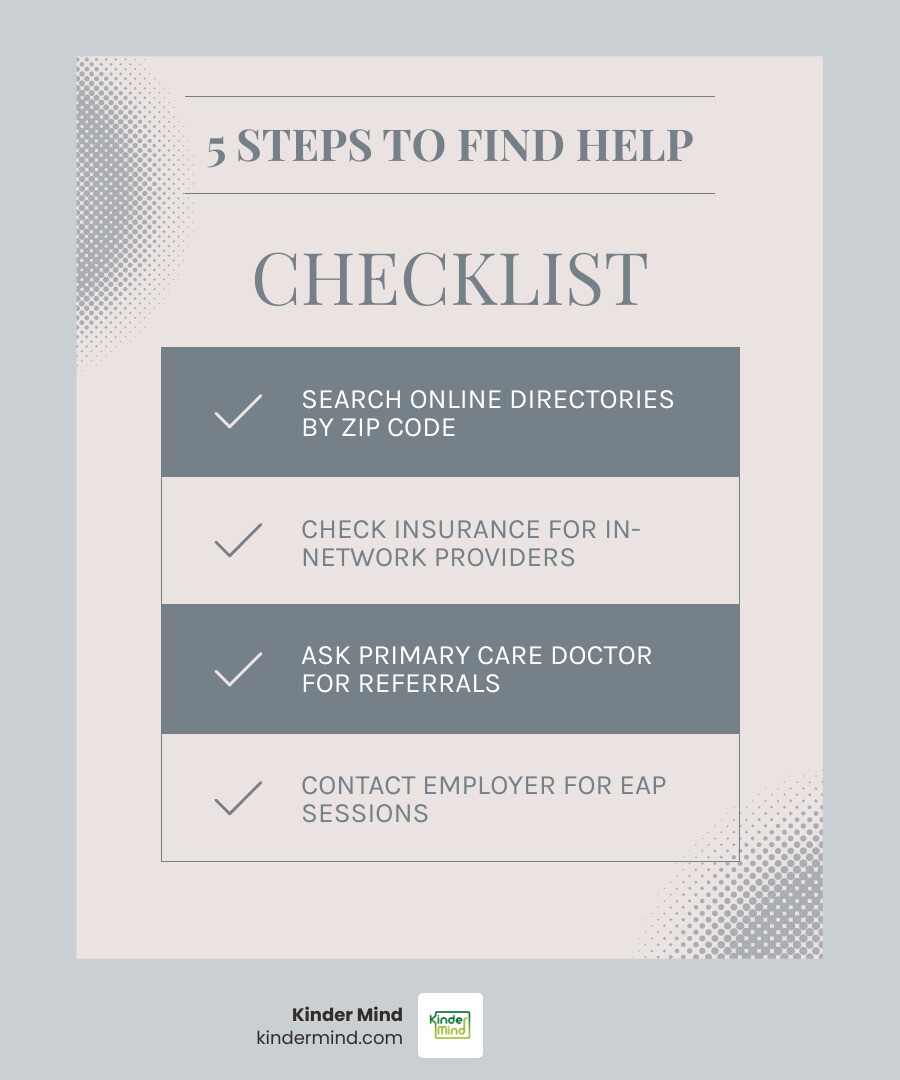
If you’re wondering how can i find a mental health professional near me, here’s the short answer:
- Search an online directory like Psychology Today or the APA Psychologist Locator and filter by your ZIP code
- Check your insurance provider’s website for in-network therapists near you
- Ask your primary care doctor for a referral
- Contact your employer about free sessions through an Employee Assistance Program (EAP)
- Try telehealth if local options are limited or wait times are long
Deciding to get mental health support is a big step. But then comes the part nobody warns you about: actually finding someone.
The search can feel overwhelming. Which type of provider do you need? Will your insurance cover it? What if the waitlist is months long?
You’re not alone in feeling this way. And the effort is absolutely worth it — research shows that roughly 75% of people who enter psychotherapy benefit from it, according to the American Psychological Association.
This guide breaks the whole process down into simple, manageable steps — so you can stop searching in circles and start getting the support you deserve.
How can i find a mental health professional near me word roundup:
Understanding the Different Types of Mental Health Professionals
Before you dive into a search engine, it helps to know who does what. The mental health field is full of acronyms and titles that can make anyone’s head spin. Choosing the right type of professional depends on whether you need medication, talk therapy, or help with specific life logistics.
Psychiatrists
Psychiatrists are medical doctors (MDs or DOs) who specialize in mental health. Because of their medical background, they are the primary providers for medication management. If you have a complex condition like bipolar disorder or severe depression that requires a prescription, a psychiatrist is often the first stop. While some do provide talk therapy, many focus on the biological side of mental health.
Psychologists
Psychologists typically hold a doctoral degree (PhD or PsyD). They are experts in human behavior and psychology, often using evidence-based talk therapies to help patients process trauma, manage anxiety, or change behavioral patterns. They also perform psychological testing and evaluations. You can learn more about Finding a Mental Health Professional | NAMI to see how these roles differ in a clinical setting.
Social Workers and Counselors
Licensed Clinical Social Workers (LCSWs) and Licensed Professional Counselors (LPCs) make up a large portion of the workforce. They generally hold master’s degrees and provide excellent talk therapy. Social workers often have additional training in connecting clients with community resources like housing or employment assistance. If you are looking for Mental Health Professionals Near Me, these providers are often the most accessible for regular weekly sessions.
Specialized Therapists
Depending on your needs, you might seek out specialists like a Marriage Family Counselor Near Me or a Psychologist Life Coach Near Me. These professionals focus on specific dynamics, such as relationship conflict or personal goal setting.
How Can I Find a Mental Health Professional Near Me Using Online Directories?
Once you know the type of provider you need, the next step is locating them. Digital directories have replaced the old-fashioned phone book, offering powerful filters to help you narrow down your search by ZIP code, specialty, and insurance.

The Psychology Today Directory
One of the most comprehensive tools available is the Psychology Today Directory. It allows you to search for therapists in all 50 U.S. states, including Alabama, California, New York, and Texas.
The best part? You can filter by:
- Issues: Anxiety, depression, eating disorders, or ADHD.
- Insurance: Only see providers who take your specific plan.
- Price: Look for providers who offer sliding scale fees.
- Identity: Find providers who share your cultural background or specialize in LGBTQ+ issues.
APA Psychologist Locator
If you specifically want a doctoral-level psychologist, the APA Psychologist Locator is the gold standard. It only lists licensed members of the American Psychological Association, ensuring a high level of verified credentialing. It even handles “city disambiguation”—so if you live in “Washington,” it helps you pick the right state so you don’t accidentally book a session three time zones away.
Using Localized Search Terms
When using a search engine, being specific helps. Instead of a generic query, try searching for Find A Therapist Near Me or Divorce Therapy Near Me to get results tailored to your current life situation.
Navigating Insurance, EAPs, and Affordability
Cost is often the biggest hurdle when people ask, “how can i find a mental health professional near me?” However, there are more ways to pay for care than you might realize.
In-Network vs. Out-of-Network
- In-Network: These providers have a contract with your insurance company. You usually only pay a set copayment (often a small fraction of the total cost).
- Out-of-Network: You pay the full fee upfront, and your insurance might reimburse a portion of it later. Always call your insurance company first to ask about your “out-of-network benefits.”
Employee Assistance Programs (EAPs)
Many employers offer an EAP, which provides a limited number of therapy sessions (usually 3 to 8) entirely for free. These are confidential and a great way to bridge the gap while searching for a long-term provider. If you’re struggling with work-related stress, an Anxiety Professionals Near Me search can help you find someone who understands workplace burnout.
Primary Care and Community Centers
Your family doctor is a powerful resource. They can perform basic mental health screenings and refer you to specialists they trust. Additionally, Federally Qualified Health Centers (FQHCs) and community mental health centers offer care based on a “sliding scale,” meaning the price is adjusted based on your income.
Cost Comparison: In-Person vs. Telehealth
| Feature | In-Person Therapy | Telehealth / Online |
|---|---|---|
| Average Cost | Higher (due to office overhead) | Often Lower |
| Commute | Requires travel time | Zero travel |
| Insurance | Widely accepted | Increasingly covered |
| Privacy | High (private office) | High (if in a quiet home space) |
Evaluating the Right Fit and Preparing for Your First Session
Finding a name on a list is only half the battle. The most important factor in successful therapy isn’t actually the therapist’s degree—it’s the “therapeutic alliance,” or how well you click with them.
The Initial Consultation
Many providers, including Our Providers, offer a free 15-minute phone consultation. This is your chance to “interview” them. Don’t be shy! You are the consumer of a service.
Ask questions like:
- “How much experience do you have helping people with [your specific concern]?”
- “What is your typical treatment approach? (e.g., CBT, EMDR, psychodynamic)”
- “How do you incorporate cultural competence into your practice?”
- “What should I expect from a typical session?”
Cultural Competence and Specialties
It is perfectly okay to look for a provider who understands your lived experience. Whether you are looking for a Stress Management Counselor Near Me or Seeking Imago Therapy How To Find The Right Practitioner Near Me, ensuring the provider has the right clinical experience is vital for long-term progress.
Preparing for the First Appointment
Your first session is usually an “intake.” The provider will ask about your history, your symptoms, and your goals. To prepare, jot down a few notes about what has been bothering you lately and what you hope to achieve. This helps the provider create a personalized plan for professional online counseling.
Overcoming Barriers: Waitlists, Rural Access, and Crisis Care
Sometimes, even after searching “how can i find a mental health professional near me,” you might hit a wall. High demand can lead to long waitlists, especially in rural areas.
Handling Waitlists
If your preferred therapist is full, ask to be put on their cancellation list. People often drop out or reschedule, and you might get a call sooner than expected. In the meantime, consider joining a peer support group through organizations like NAMI to stay connected to a community.
Telehealth: The Great Equalizer
If you live in a rural part of Alaska, Montana, or West Virginia, local options might be slim. Telehealth allows you to see a licensed professional located anywhere in your state. This dramatically increases your choices and often reduces wait times.
Immediate Crisis Resources
If you are in immediate distress and cannot wait for an appointment, help is available 24/7. You do not need to have a “diagnosis” to call.
- 988 Suicide & Crisis Lifeline: Call or text 988 anytime.
- Crisis Text Line: Text HOME to 741741.
- Emergency Services: Call 911 or go to the nearest emergency room if you are in a life-threatening situation.
Frequently Asked Questions about Finding Care
How can I find a mental health professional near me if I am uninsured?
Look for “sliding scale” clinics or university-affiliated centers where graduate students provide supervised care at a significant discount. You can also search for a Counselor For Bipolar Disorder Near Me at community health centers, which are federally mandated to provide care regardless of your ability to pay.
How can I find a mental health professional near me for specialized treatment?
Use specific directories or filters. For example, if you are looking for non-traditional relationship support, check out How To Find A Poly Friendly Therapist Who Gets It or Your Guide To Finding A Polyamory Informed Therapist Online And Near You. For trauma, look for “EMDR certified” or “Trauma-Informed” tags in online directories.
What is the difference between a psychologist and a psychiatrist?
The main difference is their training and treatment focus. A psychiatrist is a medical doctor who primarily manages mental health through medication. A psychologist holds a doctoral degree in psychology and primarily uses talk therapy and behavioral interventions. Many people benefit from seeing both: one for biological management and one for emotional processing.

