
5 Effective Tips for Finding Mental Health Professionals Near Me
Kinder Mind · 10/28/2025

Why Finding the Right Mental Health Support Matters
Mental health professionals near me can include psychiatrists, psychologists, licensed counselors (LPC), marriage and family therapists (LMFT), and clinical social workers (LCSW). Here’s how to start your search:
Quick Answer: How to Find Mental Health Professionals Near You
- Use online directories – Search tools from professional organizations can help you find qualified providers.
- Check your insurance provider – Most insurers offer online search tools for in-network providers.
- Contact your Employee Assistance Program (EAP) – Many employers offer free mental health referrals.
- Visit community mental health centers – These are affordable local options for those without insurance.
- Ask your primary care doctor – They can provide trusted referrals to specialists.
Taking the first step toward mental health support can feel overwhelming, especially since millions of Americans live in areas with a shortage of professionals. Whether you’re dealing with anxiety, depression, or simply need someone to talk to, finding the right professional is possible.
The key is knowing where to look. Professionals differ in their approach—some prescribe medication, while others focus on talk therapy. Understanding these differences helps you find affordable, accessible care that fits your unique needs.
This guide breaks down five practical tips to help you steer the search process with confidence.
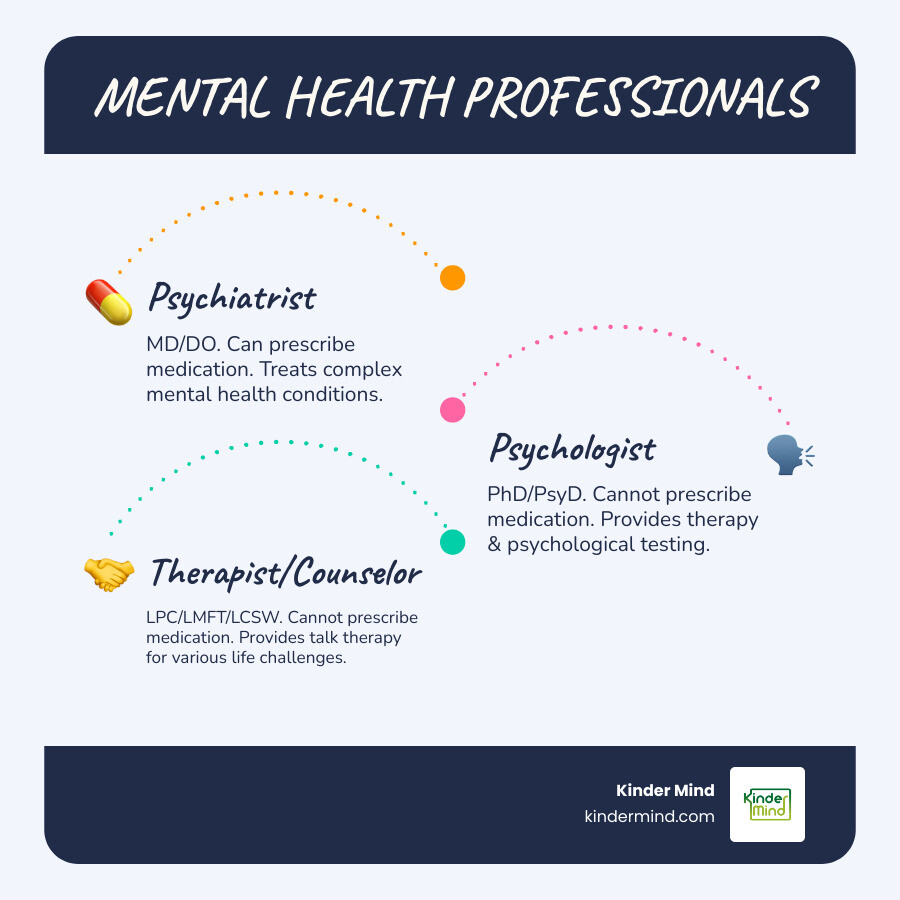
Tip 1: Understand the Different Types of Mental Health Professionals

When you search for mental health professionals near me, you’ll find several types of providers. Understanding their roles is about finding the right match for your needs.
Psychiatrists are medical doctors (MD or DO) who specialize in mental health. They can diagnose conditions, prescribe medication, and provide therapy, making them a good starting point for complex conditions or if you think medication may be needed. The American Psychiatric Association offers a ‘Find a Psychiatrist’ tool to locate these specialists.
Psychologists hold a doctoral degree (Ph.D. or Psy.D.) and are experts in psychological testing, assessment, and talk therapy. While most cannot prescribe medication, they excel at helping you understand and change unhelpful mental patterns. The American Psychological Association maintains a directory of verified psychologists.
Licensed Professional Counselors (LPCs) have a master’s degree in counseling and help individuals and families with a range of challenges using practical, real-world strategies.
Licensed Marriage and Family Therapists (LMFTs) also have a master’s degree but specialize in relationship dynamics, helping couples and families improve communication and resolve conflict.
Licensed Clinical Social Workers (LCSWs) hold a master’s in social work and take a holistic approach, considering environmental factors like your job and community alongside your emotional concerns.
The biggest difference is that only psychiatrists can prescribe medication. All other professionals focus on talk therapy to help you develop healthier coping mechanisms.
Common Mental Health Specializations
Many professionals specialize in specific areas, which can make treatment more effective.
- Anxiety disorders: Look for professionals trained in cognitive-behavioral therapy (CBT) or exposure therapy.
- Depression: Therapists often use CBT, interpersonal therapy, or psychodynamic approaches.
- Trauma and PTSD: This requires specialized care from therapists trained in Eye Movement Desensitization and Reprocessing (EMDR) or trauma-focused CBT.
- ADHD: Professionals can teach practical strategies for managing attention and organization for both children and adults.
- Couples counseling: LMFTs and other relationship-focused therapists help partners rebuild communication and connection.
- Family therapy: This approach addresses struggles by looking at the family system as a whole.
- Grief and loss: A therapist specializing in bereavement can help you steer the complex emotions of loss.
- Addiction: Specialists provide evidence-based treatment for substance use and behavioral addictions.
- Eating disorders: Professionals who understand the physical and emotional components are needed for conditions like anorexia and bulimia.
- LGBTQ+ issues: Some therapists provide affirming care that understands the unique challenges faced by the queer community.
Knowing these roles and specializations provides a roadmap for your search, helping you find a professional with the right expertise for what you’re facing.
Tip 2: How to Find Mental Health Professionals Near Me

Now that you understand the different types of professionals, it’s time to find one. You have more options than you might think.
Trusted online directories are a great starting point. Platforms from professional organizations let you filter your search by location, specialty, and insurance, helping you narrow down your options. For example, the APA Psychologist Locator helps you find qualified psychologists, and the American Psychiatric Association offers a ‘Find a Psychiatrist’ tool. Organizations like NAMI (National Alliance on Mental Illness) also provide resources and local referrals.
Your health insurance provider should be your next stop. Most insurance companies have online tools to find mental health professionals near me who are in your network. Companies like UnitedHealthcare provide member portals and apps where you can sign in to your account to check benefits and search for covered providers. This approach helps keep your out-of-pocket costs manageable.
Don’t overlook your Employee Assistance Program (EAP) if your workplace offers one. EAPs typically provide a few free counseling sessions and can refer you to ongoing care. It’s confidential and a great way to start without worrying about cost.
Community mental health centers are lifelines for those without insurance or seeking affordable options. These centers often offer services on a sliding scale based on your income. A quick online search or a call to your local NAMI chapter can point you in the right direction. At Kinder Mind, we’re also committed to affordability through various payment options, including reduced-rate plans.
Your primary care doctor can be an invaluable ally. They can rule out physical health issues and provide trusted referrals to specialists. If you’re feeling overwhelmed, your doctor’s office is a safe first call.
[TABLE] Comparing Search Methods
| Method | Pros | Cons |
|---|---|---|
| Online Directories | Large selection, detailed filters (e.g., by specialty, location, insurance) | Quality can be unverified; some platforms may have a commercial bias |
| Insurance Portals | Guarantees coverage, lower out-of-pocket costs | Limited to in-network providers, potentially smaller selection |
| Community Centers | Affordable, local support, often sliding-scale fees | May have long waitlists, services might be limited |
Each of these paths has its strengths. The important thing is to start somewhere. If you’re looking for compassionate, accessible care, find a therapist with Kinder Mind. We serve communities across the country, making it easier to connect with someone who understands your needs.
Tip 3: Vet Professionals and Prepare for Your First Conversation

Once you have a list of potential mental health professionals near me, the next step is vetting them. The connection you feel with a therapist is just as important as their credentials, as this rapport is the foundation of effective therapy. You need to feel heard, respected, and safe. If something feels off, trust your instinct. This stage is a two-way interview where you evaluate if they are the right fit for you.
What to Look for When Choosing Mental Health Professionals Near Me
Before your first conversation, do some homework to feel more confident in your choice.
- Credentials and licensing: Ensure any professional you consider is licensed by their state board, which you can typically verify online. This confirms they have the required education and supervised experience. Some directories don’t verify credentials, so it’s smart to double-check.
- Years of experience: An experienced therapist has likely seen a wider range of situations. However, newer therapists can also be excellent and up-to-date on the latest research.
- Specialties and focus areas: Find a therapist who specializes in the issues you’re facing, whether it’s trauma, grief, or anxiety. This ensures they have relevant expertise.
- Therapeutic approach: Professionals use different methods, like Cognitive Behavioral Therapy (CBT), Dialectical Behavior Therapy (DBT), or psychodynamic therapy. Read about these modalities to see which resonates with you.
- Online reviews and testimonials: These can offer a glimpse into what it’s like to work with a therapist, revealing patterns in their practice style and client relationships.
[LIST] of Questions to Ask During an Initial Consultation
Your first conversation is a chance to ask important questions. A good therapist will answer openly.
- What is your experience treating issues like mine? This helps confirm they have the right expertise for your needs.
- What is your therapeutic approach or philosophy? Understanding their methods helps you know what to expect from sessions.
- What are your fees and do you accept my insurance? It’s important to discuss cost upfront. At Kinder Mind, we offer various payment options, including insurance and reduced-rate plans, to make therapy accessible.
- What can I expect during our first few sessions? This helps you feel prepared for the initial phase of therapy.
- How do you measure progress with your clients? This shows how they’ll track whether therapy is effective for you.
- Are you available for in-person or virtual sessions? Know your options for session formats. Kinder Mind provides both to give you flexibility.
If the first therapist doesn’t feel right, that’s normal. It can take a few tries to find your match. The goal is to find someone you can genuinely connect with.
Tip 4: Explore Different Ways to Access Mental Health Support

The way we access mental health support has changed. When searching for mental health professionals near me, consider all your options to find what best fits your life.
In-person therapy provides a dedicated, private space separate from your daily life. For many, the physical presence of a therapist helps build a strong connection and makes it easier to open up. Kinder Mind offers accessible in-person therapy services in many locations, including major cities across California, New York, Texas, and Florida, among others.
Virtual therapy has transformed mental health care by offering incredible flexibility. You can meet with a professional from anywhere with a private internet connection, which is a game-changer for those with busy schedules, mobility challenges, or who live in areas with few local providers. The American Psychological Association’s Psychologist Locator now includes telehealth filters, reflecting this trend. Kinder Mind also provides virtual therapy services, ensuring
