
Finding Your Virtual Therapist: A Professional’s Guide
Dr. Elizabeth Barlow, LCSW-S · 3/9/2026

Why Professional Online Counseling Matters Now More Than Ever
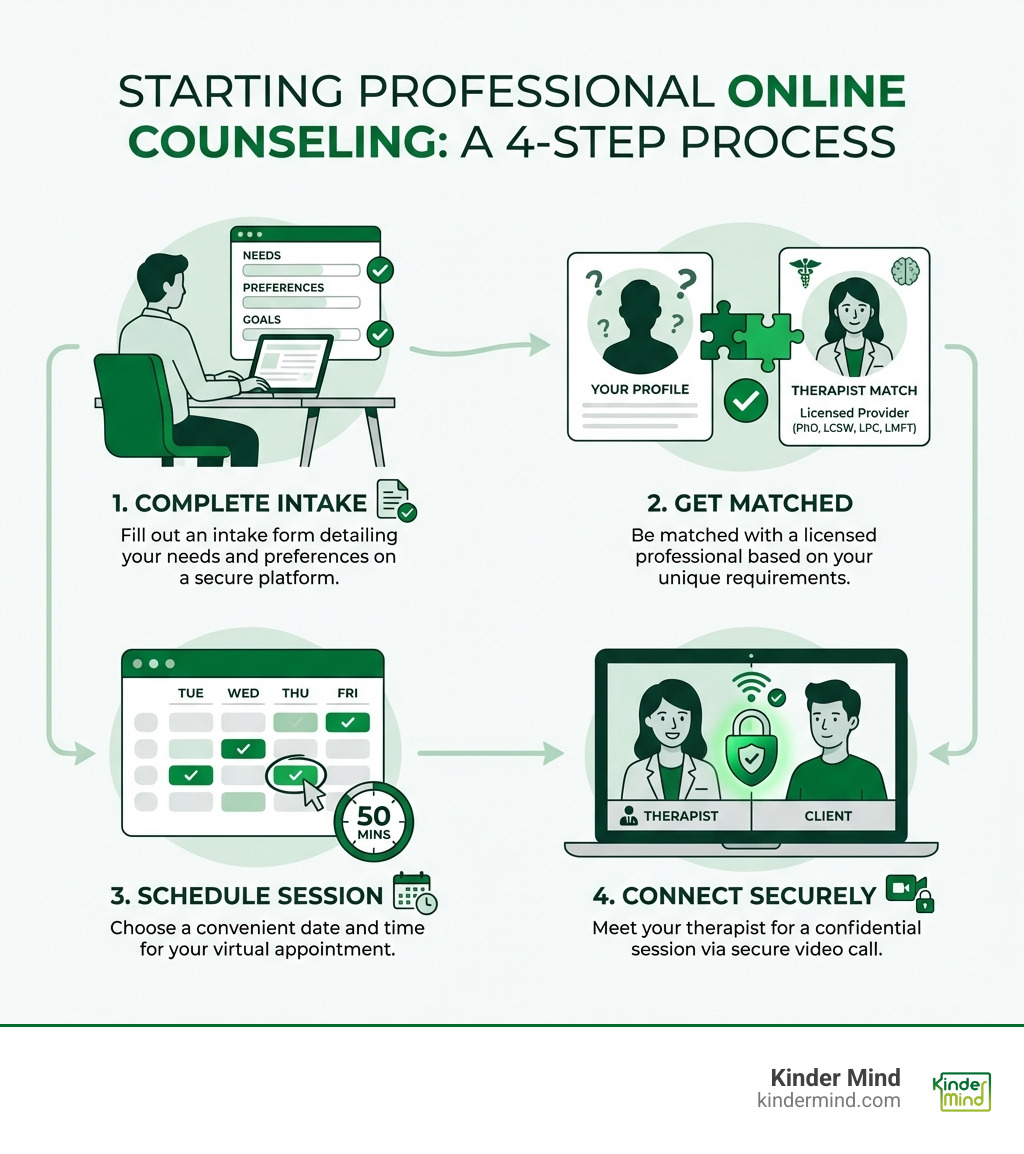
Professional online counseling connects you with licensed therapists through secure video, phone, or messaging. Here is how to start:
- Choose a platform – Select a service with licensed therapists (PhD, LCSW, LPC, LMFT).
- Get matched – Complete an intake form describing your needs.
- Schedule sessions – Book appointments that fit your schedule.
- Connect remotely – Meet via video, phone, or secure messaging.
What It Treats: Depression, anxiety, trauma, grief, relationship issues, stress, and parenting challenges.
Cost Range: Most services charge weekly or monthly rates, often covered by insurance.
Over 6 million people have turned to online therapy. Research shows it works as well as traditional face-to-face sessions. For many, getting help used to mean taking time off work or finding childcare. Now, you can talk to a licensed therapist from your living room.
Studies in the Journal of Affective Disorders and Behaviour Research and Therapy confirm that online treatment is equally effective for depression and anxiety, with improvements lasting long after treatment ends. Online counseling removes barriers like travel time and the stigma of visiting a physical office.
Professional online counseling also supports consistency. When therapy is easier to attend, people are more likely to show up week after week, which is often where the biggest gains happen. Virtual sessions can be especially helpful during major life transitions, including a move to a new state, a new job, a new baby, or caring for a family member. Because the setting is familiar, many clients find it easier to open up about anxiety symptoms, relationship stress, or grief without the added pressure of a waiting room.
For families, students, and working adults, flexibility matters. Teletherapy can offer:
- More appointment options (including evenings in many practices)
- Less disruption to school, work, and caregiving schedules
- Improved access for people who do not live near a clinic
- A comfortable environment that can reduce first-session nerves
If you are considering care, it helps to think about what you want from therapy: symptom relief, better coping tools, support through a difficult season, or deeper long-term personal growth. A good match with a licensed professional can clarify goals and create a plan that fits your life.
Understanding Professional Online Counseling and Its Effectiveness
Professional online counseling, or teletherapy, provides mental health support via the internet. Clients connect with therapists from any location using a computer or smartphone. While the delivery method changes, the core principles remain: a licensed professional provides a confidential environment to work toward personal growth.

| Feature | Professional Online Counseling | Traditional In-Person Therapy |
|---|---|---|
| Location | Anywhere with internet | Physical office |
| Convenience | High (no commute) | Moderate (requires travel) |
| Accessibility | High (remote/mobility access) | Limited by geography |
| Methods | Video, phone, chat | Face-to-face |
| Privacy | Improved (home-based) | Standard (public waiting rooms) |
| Effectiveness | Proven equal for many conditions | Well-established |
The Science Behind Online Support
Research consistently shows virtual therapy is as potent as in-person care for many common concerns. A 2014 study in the Journal of Affective Disorders found online treatment just as effective for depression. Similarly, a 2018 study in the Journal of Psychological Disorders highlighted online cognitive behavioral therapy (CBT) as effective for panic disorder, social anxiety, and generalized anxiety. For more on CBT strategies, see MindShift CBT.
Effectiveness is not only about the screen. Outcomes are strongly linked to the quality of the therapeutic relationship, clear goals, and consistent attendance. In practice, many evidence-based approaches translate well to online sessions because they rely on conversation, skills practice, and structured exercises. Depending on the concern and your therapist’s training, professional online counseling may include:
- Identifying unhelpful thoughts and building alternative perspectives (CBT)
- Strengthening emotion regulation and distress tolerance skills (DBT-informed therapy)
- Clarifying values and building psychological flexibility (ACT)
- Improving communication patterns and boundaries in relationships
Online sessions can also include worksheets, between-session practice plans, and secure message check-ins when appropriate. These tools can help clients apply what they learn in real life rather than keeping therapy limited to the session itself.
Specialized Support
Online therapists address a wide range of issues, including:
- Trauma & Grief: Using EMDR and trauma-informed care to process painful memories.
- Relationships: Improving communication and rebuilding trust through couples or family therapy.
- Postpartum Support: Convenient care for new parents without the need for childcare.
- Anxiety & Depression: Managing symptoms through evidence-based modalities like CBT, DBT, and ACT.
- Addictions & Eating Disorders: Providing strategies for behavioral change.
Specialization can matter if you are looking for targeted help. For example, someone coping with panic symptoms may benefit from a structured CBT approach, while someone navigating bereavement may need a different pace and style of support. If you are unsure what type of therapy is right, an intake process can help clarify goals and match you to an appropriate clinician.
By offering specialized services, professional online counseling ensures individuals find the precise support they need. Explore Kinder Mind mental health resources and support to learn more about available therapeutic approaches.
Key Benefits of Choosing Virtual Mental Health Support
Professional online counseling has transformed mental health care by improving accessibility. For those in remote areas or with mobility issues, virtual therapy brings expert care directly to the home. Kinder Mind serves clients across numerous states, ensuring that location is no longer a barrier to quality support.
Therapy from a familiar space reduces anxiety and fosters openness. It also offers a layer of anonymity, reducing the stigma some feel when entering a physical office. Flexible scheduling allows clients to fit sessions into busy lives, including evenings and weekends. Furthermore, eliminating commutes saves both time and money, making consistent care more sustainable.
Beyond convenience, virtual therapy can make it easier to build momentum. When sessions are easier to attend, clients may be more likely to stay engaged during stressful periods rather than pausing care because of logistics. This can be especially important for people managing ongoing symptoms of anxiety or depression, or those working on longer-term goals like self-esteem, boundaries, or relationship patterns.
Additional benefits of choosing virtual mental health support include:
- Continuity during travel or life changes: If you are away from home temporarily, you can often keep appointments without losing progress.
- More comfortable first steps: For people who feel intimidated by therapy, starting at home can lower the activation barrier.
- Better access for caregivers: Parents and caregivers can sometimes schedule around naps, school drop-off, or medical appointments.
- Options for different communication styles: Some clients prefer video, while others start with phone or messaging and transition to video when ready.
Virtual care is not one-size-fits-all, and it is okay to have preferences. Some clients do best with video sessions for the face-to-face connection, while others prefer phone sessions for added privacy. If you are unsure, you can discuss the format with your therapist and adjust over time.
For many people, the biggest advantage is simply making support realistic. When therapy fits into daily life, it becomes easier to practice skills consistently, reflect between sessions, and show up for the work that leads to lasting change.
How to Find, Vet, and Prepare for Your Session
Starting professional online counseling is a straightforward process. Most platforms use intake forms to match you with a therapist based on your goals. Kinder Mind offers an Online Intake Form to speed up the process. If a match doesn’t feel right, you can typically switch therapists easily.
To prepare for your session:
- Find a Private Space: Choose a quiet room with a door.
- Check Connection: Ensure your internet is stable and your device is charged.
- Minimize Distractions: Use headphones and silence notifications.
- Reflect: Allow time after the session to process the discussion.
It can also help to do a quick personal check-in beforehand. Write down what you want to focus on, any symptoms that have changed since your last session, and one goal you would like to move forward. If you are new to therapy, consider noting:
- What prompted you to seek support now
- What you have already tried (and what has or has not helped)
- Any preferences (therapist style, faith-informed care, trauma-informed approach, etc.)
If you are meeting from home, small setup choices can improve the experience. Try positioning your camera at eye level, keeping a glass of water nearby, and planning for a few minutes of privacy at the end of the session so you do not have to jump immediately back into work or family responsibilities.
Vetting Qualifications and Privacy
Ensure your therapist holds recognized credentials, such as:
- LPC/LMHC: Master’s degree with supervised clinical hours.
- LCSW: Master’s in social work with extensive clinical experience.
- LMFT: Specialized in relationship and family dynamics.
- Psychologist (PhD/PsyD): Doctoral-level training in diagnosis and treatment.
In addition to credentials, you can ask practical questions during an initial consultation or early sessions:
- What issues do you most often help clients with?
- What therapy approaches do you use, and why?
- How do you measure progress or revisit goals?
- What should I do if I have a technology problem during a session?
Reputable platforms like Kinder Mind require therapists to be state-licensed with significant clinical experience. Privacy is protected through HIPAA-compliant, encrypted platforms. For more on regulation, consult Information on profession and regulation.
If you ever feel unsure about privacy, look for clear policies on data handling, session security, and informed consent. A professional therapist should also explain confidentiality limits (such as situations involving imminent risk) in an understandable way so you know what to expect from the start.
Costs, Insurance, and the Role of Psychiatry
Online therapy costs vary, but many providers now offer subscription models or per-session rates. A major advantage is that many insurance plans cover professional online counseling just like in-person visits. Kinder Mind integrates with insurance and offers reduced-rate plans to keep care affordable.
If you are using insurance, it can help to confirm a few details with your plan before your first appointment:
- Whether telehealth mental health visits are covered
- Any deductible, co-pay, or co-insurance amount
- Whether you need a referral (some plans do, many do not)
- Whether there are limits on the number of covered sessions
If you are paying out of pocket, ask about self-pay rates, reduced-rate options, and whether you can use HSA or FSA funds. Many clients find that having clear expectations about cost reduces stress and helps them stay consistent with care.
It is also helpful to understand the difference between therapy and psychiatry:
- Therapy: Licensed therapists (LPCs, LCSWs) help you explore feelings and develop coping strategies. They do not prescribe medication.
- Psychiatry: Medical doctors (MDs) or APRNs diagnose disorders and provide medication management.
People sometimes assume they must choose one or the other, but for certain concerns, a combined approach can be useful. Therapy can help you learn coping skills, improve relationships, and make behavioral changes, while medication (when appropriate) may help reduce symptoms enough to engage more fully in therapy.
If you are considering medication, a therapist can help you coordinate next steps, such as discussing symptoms to track and questions to ask a prescribing provider. Combining both can be highly effective for complex conditions, ensuring both psychological and biological needs are met.
Frequently Asked Questions about Virtual Therapy
Is online therapy as effective as in-person sessions?
Yes. P
