
How to Find a Poly Friendly Therapist Who Gets It
Dr. Elizabeth Barlow, LCSW-S · 3/17/2026

Why Finding a Poly Friendly Therapist Actually Matters
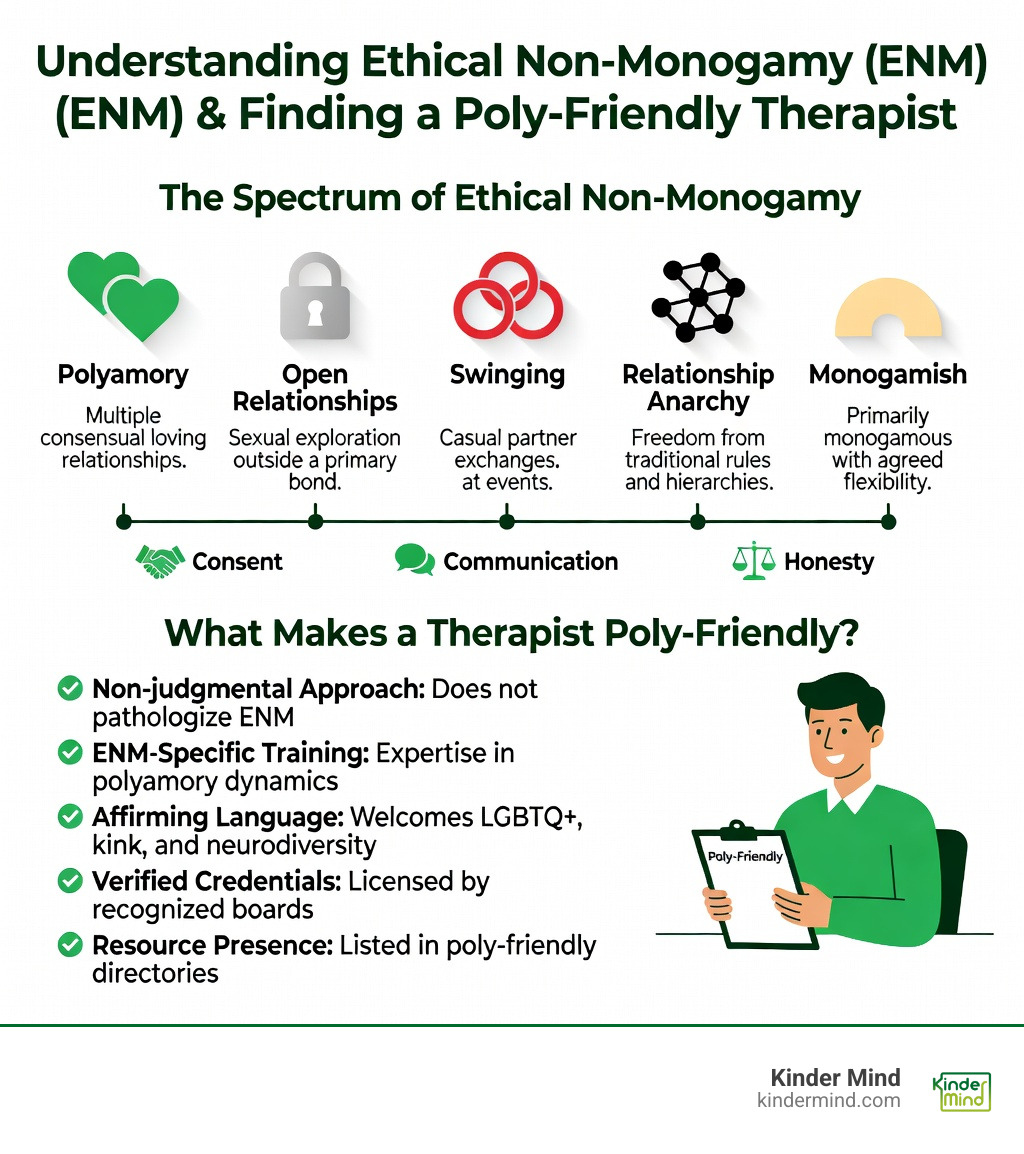
A poly friendly therapist is a licensed mental health professional who understands and affirms polyamorous and ethically non-monogamous (ENM) relationships — without judgment, bias, or trying to “fix” your relationship structure.
Here’s a quick overview of what to look for:
- Non-pathologizing approach — they don’t treat polyamory as a problem to solve
- Relevant training — experience with ENM, open relationships, or relationship anarchy
- Affirming language — inclusive of LGBTQ+, kink, and neurodivergent identities
- Verified credentials — licensed through an official state or provincial board
- Directory presence — listed on reputable professional resources
Finding the right therapist is already hard. Finding one who gets your relationship structure? That’s a whole other challenge.
Many people in polyamorous or ENM relationships have sat across from a therapist — only to spend half the session explaining what polyamory even is. Worse, some therapists subtly (or not so subtly) treat non-monogamy as the source of every problem.
That experience isn’t just frustrating. It can actively set back your mental health and relationship wellbeing.
The good news: the field is growing. There are now over 2,200 licensed or registered psychotherapists listed in specialized professional directories alone — plus hundreds of non-licensed counselors, coaches, and other professionals who specialize in this space.
Whether you’re navigating jealousy, new relationship energy, boundary-setting, or just figuring out if non-monogamy is right for you — the right therapist can make a real difference.
Understanding the Role of a Poly Friendly Therapist
A poly friendly therapist (or poly-affirmative therapist) does more than just “tolerate” your relationship structure. They actively support it. In a world that often assumes monogamy is the only healthy way to love, these professionals provide a sanctuary where your lifestyle is validated as a legitimate, healthy choice.
When you work with a therapist who understands Poly Therapy, you don’t have to spend your precious (and often expensive) session time explaining terms like “metamour,” “kitchen table poly,” or “polycule.” They already know the language. More importantly, they understand the unique social stigmas you might face, from workplace fears to the complexities of disclosing your relationship status to family.
Affirmative care means the therapist recognizes that while being polyamorous might bring unique challenges, it is not the cause of your mental health struggles. They can help you explore Polyamory and Attachment styles without assuming that wanting multiple partners is a sign of “commitment issues” or “attachment trauma.”

Identifying a Qualified Poly Friendly Therapist
So, how do you know if a therapist is truly “poly-friendly” or just trying to be trendy? A qualified professional usually has specific markers in their practice:
- Specialized Training: Look for clinicians who have sought out continuing education in consensual non-monogamy (CNM).
- Lived Experience: Some therapists, like Susan Wenzel, openly share that they have personal experience in the polyamory lifestyle. While not every therapist shares their personal life, many “out” poly therapists offer a unique level of “boots on the ground” empathy.
- Non-Pathologizing Language: They won’t use clinical terms to imply your relationship is “broken.” Instead, they focus on Counseling Polyamory as a way to enhance communication and intimacy.
- Curiosity Over Judgment: They lead with curiosity, allowing you to define what your relationship looks like rather than forcing you into a “standard” poly box.
The Benefits of a Poly Friendly Therapist for Intersecting Identities
Polyamory rarely exists in a vacuum. Many people in the community also identify as LGBTQ+, are active in the BDSM/kink community, or are neurodivergent (often referred to as “neuro-queer” or “neuro-poly”).
A truly poly friendly therapist understands these intersections. For example, a Focus Area Sex-Positive Kink Allied therapist won’t blink if you discuss power exchange dynamics alongside your calendar management for three different partners.
For neurodivergent individuals—especially those with ADHD or Autism (AuDHD)—the “rules” of traditional monogamy can often feel stifling or illogical. An inclusive therapist can help navigate the executive functioning required for polyamory (like that color-coded Google Calendar) while respecting your sensory needs and communication style.
Navigating Complex Dynamics: Jealousy, NRE, and Boundaries
One of the biggest reasons to seek a poly friendly therapist is to handle the “Big Three” of non-monogamy: Jealousy, New Relationship Energy (NRE), and Boundaries.
In traditional couples therapy, the goal is often to return to a state of “two-person security.” In poly-affirmative therapy, the goal is emotional buoyancy—the ability to stay afloat and thrive even when dynamics are shifting.
| Feature | Traditional Couples Therapy | Poly-Affirmative Therapy |
|---|---|---|
| Primary Goal | Maintaining the dyad (two people) | Individual and relationship growth |
| View of Jealousy | Often seen as a sign of a threat | Seen as an opportunity for inward healing |
| Boundaries | Often rigid/standardized | Highly customized and negotiated |
| Focus | Reducing outside “interference” | Managing multiple connections and NRE |
Therapy helps you move toward “compersion”—the feeling of joy when your partner finds happiness with someone else—while acknowledging that Polyamory and Jealousy are normal. A specialized therapist teaches you that jealousy isn’t a “failure”; it’s a signal that a need isn’t being met. They provide the tools for Communication in Polyamory so you can ask for what you need without shame.
Managing New Relationship Energy (NRE)
NRE is the “honeymoon phase” on steroids. It’s exhilarating, but it can lead to partner neglect if not managed carefully. A poly friendly therapist helps you navigate the “brain soup” of new love while ensuring your existing commitments remain stable. They can guide you through the Consent in Polyamory Guide to ensure that as you expand your circle, everyone’s boundaries are respected.
Support for the Poly-Curious
You don’t have to be in a “triad” or “quad” to benefit from this type of therapy. Many people seek out a poly friendly therapist when they are simply curious.
Therapy provides a safe space for Exploring Ethical Non-Monogamy and Polyamory before taking the plunge. It’s much easier to work through the fears of Opening Up a Relationship with a professional than it is to do it in the heat of a Saturday night argument.
How to Verify and Vet Your Professional
Just because someone puts “poly-friendly” on their website doesn’t mean they have the credentials to back it up. Anyone can claim expertise, so do your homework.
Credential Verification and Red Flags
When searching for a poly friendly therapist, keep these safety tips in mind:
- Verify the License: Always check with your state board (e.g., the California Board of Behavioral Sciences or the New York State Office of the Professions) to ensure their license is active and in good standing. If you’re not sure what a “licensed mental health professional” means in your region, see Mental health professional.
- Non-Sexual Services Only: Legitimate therapy is always non-sexual. If a therapist or “coach” suggests sexual contact or “demonstrations” as part of the process, this is a massive red flag and should be reported to the licensing board immediately.
- The “Eyebrow Test”: If you mention having three partners and your therapist raises an eyebrow, looks shocked, or immediately asks “What happened in your childhood to make you want this?”, they are likely not the right fit.
Essential Questions for Your First Session
Most therapists offer a free 15-minute consultation. Use this time to “interview” them. Don’t be shy, you are hiring them.
Ask things like:
- “What is your experience working with polyamorous clients or polycules?”
- “How do you view the difference between polyamory and infidelity?”
- “Are you familiar with terms like relationship anarchy or kitchen table poly?”
- “Do you have a specific therapeutic approach for An Essential Guide to ENM Therapy?”
Where to Find a Poly Friendly Therapist Near You
The search for specialized care has become much easier thanks to dedicated directories. Currently, specialized professional databases list over 2,227 licensed psychotherapists and 292 non-licensed therapists who have self-identified as being sensitive to the needs of the poly community.
If you are in a major hub, you might find a high concentration of specialists. For instance, there are approximately 163 counselors specializing in open relationships and non-monogamy in Montréal, QC. Similarly, cities like New York, San Francisco, and Los Angeles have robust communities of poly-affirmative providers.
For those in other states, utilizing specialized search terms on professional databases can help you filter specifically for “Open Relationships” or “Non-Monogamy.”
Check out Your Guide to Finding a Polyamory Informed Therapist Online and Near You for a more detailed breakdown of how to use these search tools effectively.
Online vs. In-Person Specialized Care
One of the silver linings of the modern era is the rise of telehealth. If you live in a rural area of Alabama or Arkansas where a poly friendly therapist is hard to find, you can now connect with specialists across your entire state via video.
Polyamorous Couples Counseling online is particularly helpful because it allows all partners—even those in different locations—to join the same session. This is a game-changer for “long-distance poly” or those trying to coordinate schedules between multiple households. If you prefer the energy of an office, searching for Poly Couples Near Me can help you find local practitioners who offer in-person sessions in states like California, Texas, or Massachusetts.
Logistics of Care: Costs and Insurance
Let’s talk about the “un-fun” part: the bill. Specialized therapy can sometimes be more expensive, especially if the therapist has invested in advanced certifications.
However, many therapists offer sliding scale options. This means they set aside a certain number of slots for clients who may not be able to afford their full fee. For example, some providers might offer individual sessions at a lower rate for those in financial need, while relationship therapy might range from $175 to $270 per session depending on the location and complexity.
- Insurance: Many therapists accept major insurance plans to help cover the cost of care.
- Superbills: If a therapist is “out-of-network,” they can often provide you with a “superbill” that you can submit to your insurance for potential reimbursement.
- Employee Assistance Programs (EAPs): Don’t overlook your workplace benefits. Many EAPs provide a set number of free sessions, and you can request a provider who specializes in Open Relationship Counseling.
Frequently Asked Questions about Poly Friendly Therapy
Can therapy help if I am not currently in a polyamorous relationship?
Absolutely. Many people use therapy
