
Mind Games: Everything You Need to Know About Psychology
Dr. Elizabeth Barlow, LCSW-S · 2/18/2026

Understanding Psychology: The Science Behind Human Experience
Psychology is the scientific study of the mind and behavior. It explores how we think, feel, and act—examining everything from our deepest emotions to our everyday decisions.
Quick Definition:
- What it is: The study of mental processes and behavior in humans and other animals
- What it covers: Thoughts, feelings, motivations, perceptions, memories, and actions
- How it works: Uses scientific methods like experiments, observations, and surveys
- Main goals: To describe, explain, predict, and change behavior
Psychology emerged as a distinct discipline in the late 19th century, breaking away from philosophy to become a rigorous science. Today, it touches nearly every aspect of our lives—from how we learn and remember information to how we form relationships and cope with stress.
The field is both broad and deep. It spans natural and social sciences, examining everything from brain chemistry to social interactions. Psychologists work in hospitals, schools, research labs, businesses, and private practices. Some focus on treating mental health conditions, while others study how people think, develop, or behave in groups.
At its core, psychology seeks to answer fundamental questions about human nature. Why do we behave the way we do? How do our minds work? What makes us happy, motivated, or anxious? These aren’t just academic questions—they have real-world implications for mental health, education, relationships, and personal growth.
Understanding psychology can help you make sense of your own experiences, improve your relationships, and recognize when you might benefit from professional support. Whether you’re curious about how memory works, wondering why habits are so hard to break, or considering therapy for the first time, psychology offers evidence-based insights into the human experience.
What is Psychology? The Scientific Study of Mind and Behavior
At its most fundamental, psychology is the scientific study of the mind and behavior. This definition encompasses a vast landscape of human (and even animal) experience. The word “psychology” derives from the Greek “psyche,” meaning spirit or soul, and “-logia,” meaning study or research. So, literally, it’s the “study of the soul” or mind.
This scientific discipline digs into both observable actions and internal mental states. Psychologists are interested in everything from why we blink when startled to the intricate processes behind our thoughts, feelings, and motivations. They seek to understand how these elements interact to shape who we are.
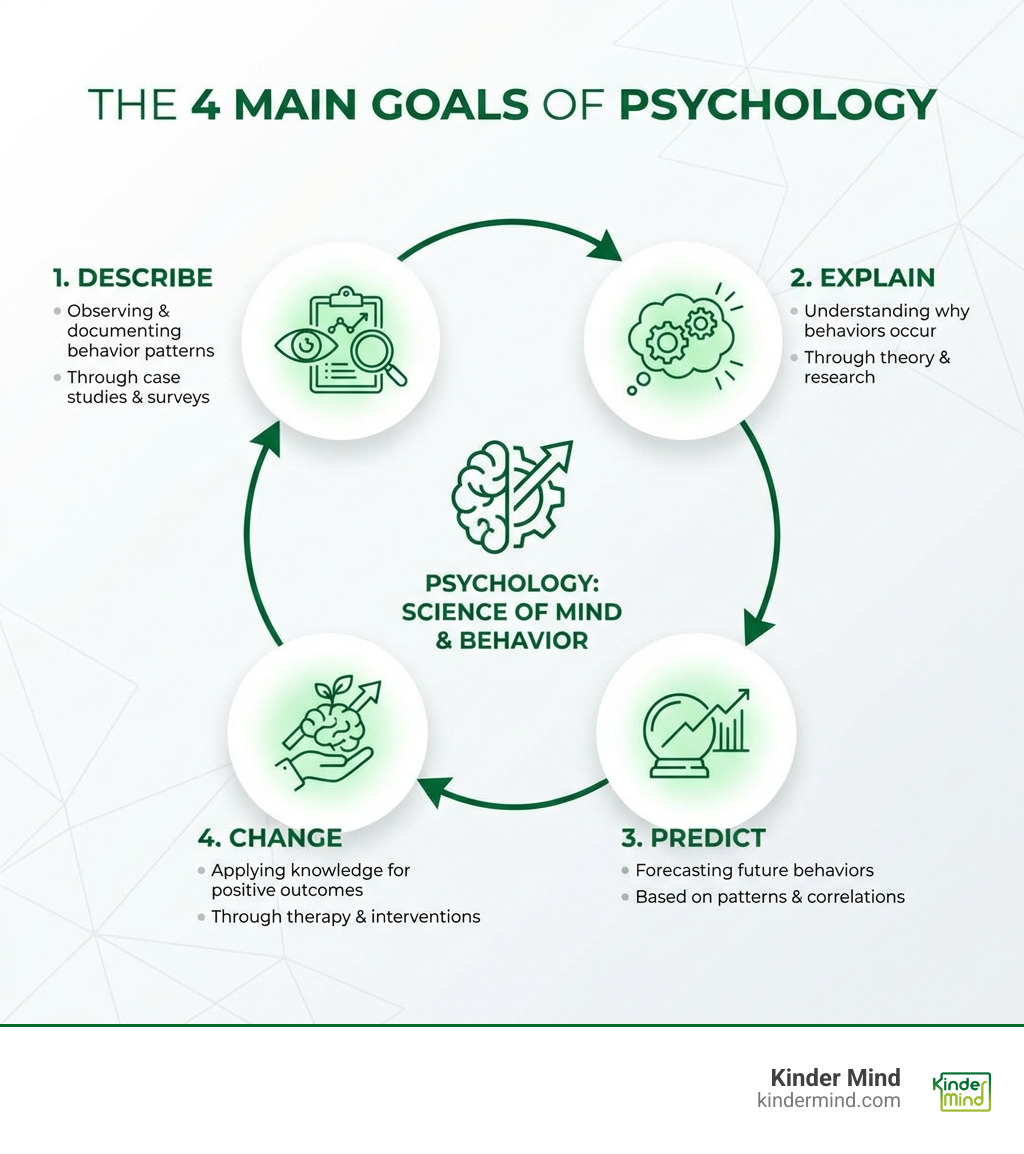
The overarching goals of psychology are to describe, explain, predict, and ultimately, to change or influence behavior. Psychologists aim to piece together the complex workings of the human mind to gain a clearer picture.
The Four Main Goals of Psychology
The journey of understanding the human mind and behavior is guided by four primary goals:
- Describe: The first step is to observe and document what is happening. Psychologists use methods like direct observation, case studies, and surveys to gather data on behavior, laying the groundwork for deeper understanding.
- Explain: Once a behavior is described, the next question is, “Why is it happening?” This involves developing theories and testing hypotheses to uncover the underlying causes of observed behaviors, which can range from biological to environmental factors.
- Predict: If we can explain why something happens, we can often predict when it might happen again. Psychologists use research to identify relationships between variables, allowing them to forecast future behaviors.
- Change: The ultimate goal for many psychologists is to apply their knowledge to create positive change. This involves developing interventions and therapies designed to influence behavior in beneficial ways, improving well-being and solving real-world problems.
Foundational Concepts in the Study of Psychology
At the heart of psychology lie several enduring questions and concepts that have shaped its inquiry:
- Nature vs. Nurture: This debate explores the roles of genetics (nature) and environment (nurture) in shaping us. Today’s consensus is that both are crucial and interact.
- Mind-Body Problem: This concept examines the relationship between the mind (thoughts, consciousness) and the body (the brain and biological processes). Modern neuroscience continues to explore this connection.
- Consciousness: This concept explores our subjective awareness of ourselves and our environment, including attention, perception, and self-awareness.
- Unconscious mind: Pioneered by Sigmund Freud, this concept suggests that mental processes outside our awareness (desires, fears) influence our behavior. Modern psychology explores this through concepts like implicit memory.
- Sensation and Perception: This area studies how we receive information through our senses and how our brain interprets it to create a meaningful experience of reality.
- Learning and Memory: This area explores how we acquire, retain, and retrieve knowledge and skills, covering conditioning and the different types of memory.
- Motivation and Emotion: This area investigates the forces that drive our behavior (motivation) and the subjective feelings (emotion) that color our lives.
- Personality: Personality psychology explores the enduring patterns of thought, feeling, and behavior that make each individual unique.
- Social Influence: This area examines how other people and social settings affect our thoughts, feelings, and behaviors, covering topics like conformity and group dynamics.
A Journey Through Time: The History and Key Figures of Psychology

The roots of psychology stretch back to ancient philosophers in Egypt, Greece, China, and India who pondered the mind, consciousness, and human nature. In ancient Greece, figures like Plato and Aristotle engaged in psychological inquiry, discussing topics like memory and learning. Hippocrates theorized about human temperaments and linked them to biological factors.
However, psychology as a scientific discipline emerged in the 19th century, shifting from philosophical speculation to empirical investigation. This marked a pivotal moment, moving the study of the mind into laboratories.
One of the most significant figures in this transition was Wilhelm Wundt. In 1879, Wundt established the first laboratory dedicated to psychological research in Leipzig, Germany, an event widely considered the birth of modern experimental psychology. His approach, structuralism, aimed to break down mental processes into basic components using introspection. While introspection proved somewhat unreliable, Wundt’s rigorous methods laid the foundation for future research.
Around the same time, American psychologist William James developed an alternative approach called functionalism. James was more interested in the purpose and function of mental processes—how they help organisms adapt. His seminal work, The Principles of Psychology (1890), had a lasting impact by emphasizing the practical applications of psychology.
Another notable figure, Hermann Ebbinghaus, conducted pioneering research on memory in the late 19th century. He systematically studied learning and forgetting, famously finding the “forgetting curve” and proving that complex mental processes could be studied experimentally.
Key Milestones and the Evolution of Psychology
The early 20th century saw the rise of several influential schools of thought that profoundly shaped the evolution of psychology:
- Sigmund Freud and Psychoanalysis: The Vienna-trained physician Sigmund Freud introduced psychoanalysis, proposing that unconscious desires, conflicts, and early childhood experiences drive behavior. His theories, though controversial and often criticized as unscientific, revolutionized our understanding of personality, mental disorders, and the role of the unconscious.
- John B. Watson and Behaviorism: During the first half of the 20th century, behaviorism gained dominance. John B. Watson, a key founder, urged in his influential 1913 paper, “Psychology as the Behaviorist Views It”, that psychologists should only study observable actions. Behaviorists like B.F. Skinner later demonstrated the power of operant conditioning (shaping behavior with rewards and punishments), building on Ivan Pavlov’s work with classical conditioning.
- Cognitive Revolution: Reacting against behaviorism, the cognitive revolution began in the 1950s. This movement shifted focus back to mental processes like perception, memory, and problem-solving. Researchers like Noam Chomsky highlighted the complexity of human cognition. Cognitive psychology views the mind as an information processor, studying how we acquire and use knowledge.
- Humanistic Psychology: Emerging in the mid-20th century as a “third force,” humanistic psychology emphasizes free will, self-actualization, and personal growth. Key figures like Abraham Maslow (hierarchy of needs) and Carl Rogers (client-centered therapy) focused on the potential for good that is innate to all humans.
The Pioneering Role of Women in Psychology
Historically, women faced significant barriers in psychology. Despite these challenges, many pioneering women made invaluable contributions that shaped the field.

- Mary Whiton Calkins completed all requirements for a Ph.D. at Harvard but was denied the degree because of her gender. She became the first woman president of the American Psychological Association (APA) in 1905 and left a legacy through her research on memory and self-psychology.
- Leta Stetter Hollingworth challenged prevailing sexist beliefs with groundbreaking research on sex differences, debunking the idea of female intellectual inferiority.
- Mamie Phipps Clark, with her husband Kenneth Clark, conducted the famous “doll studies” in the 1940s. Their research on the psychological effects of segregation on African American children was instrumental in the landmark 1954 Supreme Court case, Brown v. Board of Education.
- Anna Freud, Sigmund Freud’s daughter, was a prominent psychoanalyst who specialized in child psychoanalysis and developed theories on defense mechanisms.
- Karen Horney was an influential psychoanalyst known for her feminist critiques of Freud’s theories and her emphasis on social and cultural factors in personality.
- Melanie Klein was a key figure in object relations theory, focusing on the importance of early relationships in shaping the psyche, particularly through play therapy.
- Mary Ainsworth made significant contributions to developmental psychology with her “Strange Situation” procedure, which provided evidence for different attachment styles between infants and caregivers.
The impact of these and many other women continues to resonate. Today, women represent a significant majority of psychology students in the United States. Disciplinary organizations like the APA and the European Federation of Professional Psychology Associations play a crucial role in supporting this diverse workforce.
The Major Schools of Thought: Different Lenses on Human Behavior
Just as a diamond sparkles differently depending on how the light hits it, human behavior can be understood through various theoretical frameworks, or “schools of thought,” in psychology. Each perspective offers a unique lens, emphasizing different aspects of the human experience. While they differ in their explanations, many psychologists today adopt an eclectic approach, drawing insights from multiple perspectives to gain a comprehensive understanding.
The Biological and Psychodynamic Perspectives
- Biological Approach: This perspective focuses on the connections between biology and behavior. It examines how the brain, nervous system, genetics, and hormones influence our thoughts and actions. For instance, a biological psychologist might study how neurotransmitters affect mood or how brain injuries, like the famous case of Phineas Gage, impact personality.
- Psychodynamic Approach: Stemming from Sigmund Freud’s work, this approach emphasizes the role of unconscious drives, conflicts, and early childhood experiences in shaping personality. It suggests motivations outside our awareness influence our choices. While often criticized for its lack of testability, psychodynamic theories continue to influence therapeutic practices.
The Behaviorist and Humanistic Perspectives
- Behaviorism: Championed by figures like John B. Watson and B.F. Skinner, behaviorism focuses exclusively on observable behavior and how it is learned through interaction with the environment. It posits that behaviors are acquired through conditioning, such as B.F. Skinner’s operant conditioning (learning through consequences) and Ivan Pavlov’s classical conditioning.
- Humanistic Approach: In contrast to behaviorism and psychodynamic psychology, the humanistic approach champions free will and the innate drive towards self-actualization—reaching one’s full potential. Pioneers like Abraham Maslow (hierarchy of needs) and Carl Rogers (client-centered therapy) believed that individuals are inherently good and capable of personal growth.
The Cognitive and Sociocultural Perspectives
- Cognitive Approach: This perspective digs into our internal mental processes, exploring how we think, perceive, and solve problems. It views the mind as an active information processor. Cognitive psychologists study topics like attention, language acquisition (with figures like Noam Chomsky challenging behaviorist explanations), and decision-making. This approach has significantly influenced education and therapy.
- Sociocultural Approach: The sociocultural perspective examines how social norms, cultural values, and group influences shape individual behavior. It recognizes that our environment—from our family to our broader society—profoundly impacts our development. Theorists like Lev Vygotsky emphasized the critical role of social interaction in cognitive development.
Psychology in the Real World: Research, Careers, and Common Questions
The world of psychology isn’t just confined to academic discussions; it’s a dynamic field that impacts daily life, from mental health support to workplace dynamics. However, like any science, it relies on rigorous research and critical evaluation.
<
