The Complete Guide to Child Behavior Therapy
Dr. Elizabeth Barlow, LCSW-S · 6/10/2026

When Your Child’s Behavior Feels Overwhelming — Here’s What Actually Helps
Child behavior therapy is a structured, evidence-based approach that helps children reduce problem behaviors and build healthier skills — by changing how the people and environments around them respond.
Quick answer: What is child behavior therapy?
- What it is: A set of proven techniques that teach children and caregivers how to strengthen positive behaviors and reduce harmful ones
- Who it’s for: Children with ADHD, anxiety, autism, ODD, conduct disorder, depression, and other behavioral or emotional challenges
- How it works: Uses methods like positive reinforcement, goal-setting, and consistent consequences — often with heavy parent involvement
- Main types: Applied Behavior Analysis (ABA), Cognitive Behavioral Therapy (CBT), Behavioral Parent Training (BPT), and Parent-Child Interaction Therapy (PCIT)
- Does it work? Yes — for the most common childhood conditions, behavior therapy and CBT are more likely to reduce symptoms than other therapy approaches
Every child has tough moments. Tantrums, defiance, emotional meltdowns — these are part of growing up. But when the behavior is persistent, intense, or getting in the way of school, friendships, or family life, it’s worth taking a closer look.
Here’s the thing most parents don’t realize: behavioral problems are rarely just “bad behavior.” They’re often a sign that a child’s needs aren’t being fully met — and that the child doesn’t yet have the skills to cope differently.
That’s exactly what child behavior therapy addresses. Rather than simply talking about feelings, it gives children and caregivers concrete tools to change what’s actually happening day to day.
The research is clear. Most experts recommend behavior therapy — sometimes alongside medication, sometimes on its own — as a first-line treatment for conditions like ADHD, oppositional defiant disorder, and anxiety. For young children especially, parent training in behavior management is often recommended before trying medication at all.
This guide walks you through everything: how behavior therapy works, which types exist, what conditions it helps, and how to find affordable care for your child.
Basic Child behavior therapy glossary:
Understanding Child Behavior Therapy and How It Works
To understand child behavior therapy, it helps to look at how it differs from traditional “talk therapy” or play therapy. Traditional therapies often focus on helping a child express internal emotions or process past events. While that has its place, behavior therapy is highly action-oriented. It focuses on the present: the actual, observable actions a child takes and how the environment reinforces them.
Instead of trying to change the child’s internal personality, behavior therapy focuses on how important people (like parents and teachers) and places (like home and school) can adapt to support the child.
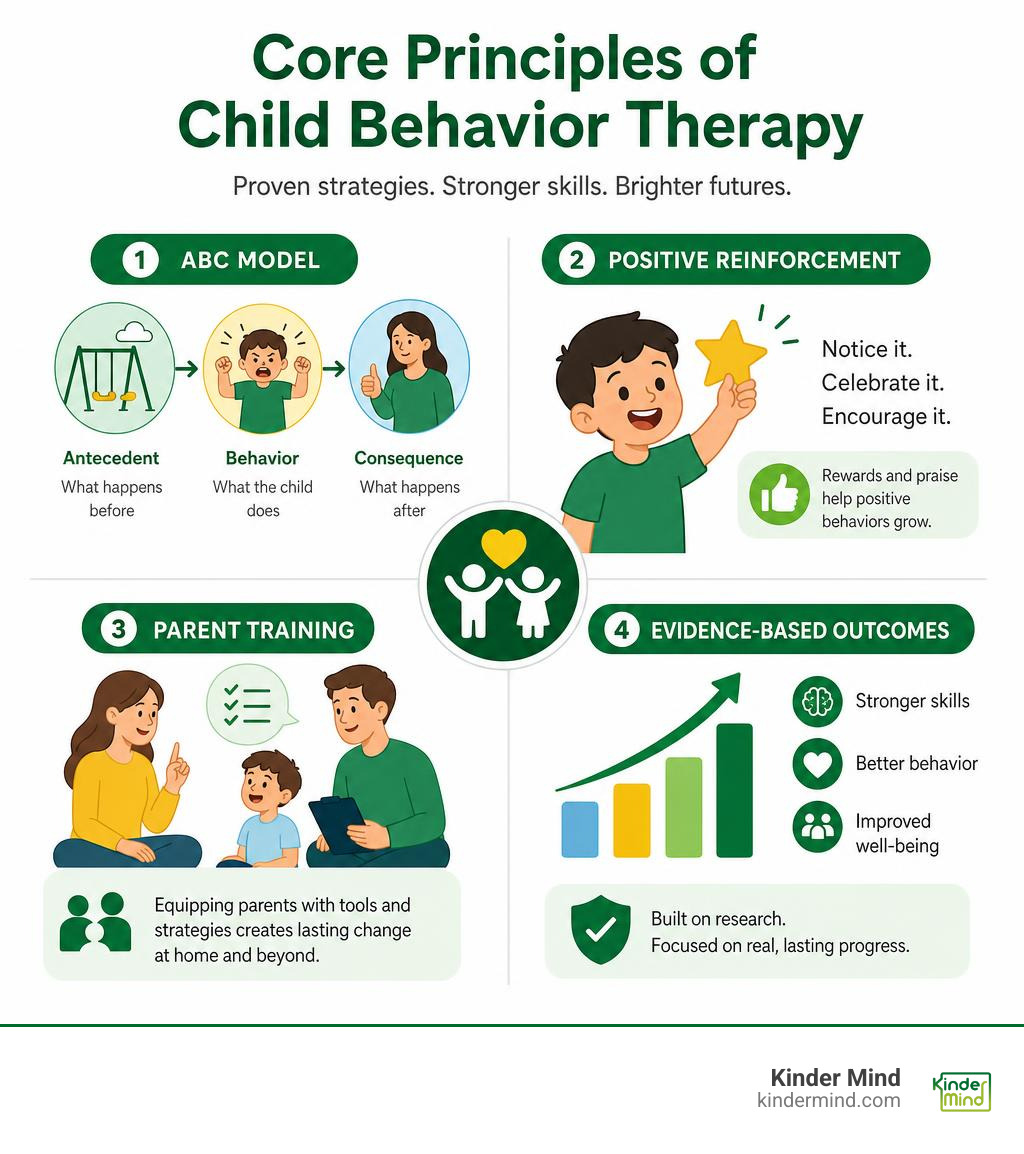
At the very heart of this approach is the ABC model of behavior:
- Antecedents (A): What happens immediately before the behavior occurs? This includes triggers, instructions, environmental distractions, or even the parent’s tone of voice.
- Behavior (B): The specific, observable action the child takes (e.g., screaming, refusing to clean up, or conversely, asking politely).
- Consequences (C): What happens immediately after the behavior? This is how the environment responds, which either encourages the behavior to happen again or discourages it.
For example, if a child yells when asked to turn off a video game (Antecedent), and the parent allows them to play for another ten minutes to stop the yelling (Consequence), the child learns that yelling is an effective way to get more screen time. Behavior therapy flips this script by teaching caregivers how to alter both the antecedents and the consequences to encourage positive actions.
By adjusting these daily interactions, families can build predictable routines where positive behaviors are consistently rewarded and negative behaviors do not yield the desired payoff. If you want to explore how these structured approaches can help your family, you can learn more about child therapy services tailored to these exact needs.
Core Types of Behavioral Interventions for Children
There is no one-size-fits-all version of behavior therapy. Instead, professionals use several highly structured, manualized protocols. These evidence-based therapies are designed with specific step-by-step guidelines, ensuring consistent delivery and clear ways to measure progress over a set treatment duration.
Applied Behavior Analysis (ABA) as a Child Behavior Therapy
Applied Behavior Analysis (ABA) is a highly structured, data-driven therapy based on the science of learning and behavior. Historically developed in the 1960s, ABA is widely recognized as an evidence-based best practice by major scientific bodies, including the American Psychological Association.
- Who it is for: Primarily children on the autism spectrum, though its principles apply to other developmental or intellectual disabilities.
- How it works: ABA breaks complex tasks (like social interactions, verbal communication, or self-care) into small, manageable steps. It relies heavily on positive reinforcement to build helpful skills and decrease harmful behaviors.
- The Team: A Board Certified Behavior Analyst (BCBA) designs and oversees the customized program, while a Registered Behavior Technician (RBT) typically works one-on-one with the child to implement the daily exercises.
- The Commitment: Intensive ABA programs can range from 25 to 40 hours per week, lasting anywhere from 1 to 3 years, though part-time options also exist.
More than 20 studies have established that intensive, long-term therapy using ABA principles significantly improves outcomes for many children, leading to documented gains in intellectual functioning, language development, daily living skills, and social functioning. To dive deeper into the science behind these structured reinforcement methods, you can read this scientific research on ABA therapy or explore our dedicated resources for autism support.
Cognitive Behavioral Therapy (CBT) and Child Behavior Therapy
While pure behavior therapy focuses on external actions, Cognitive Behavioral Therapy (CBT) connects those actions to internal thoughts and feelings.
- Who it is for: Older children and adolescents struggling with anxiety, depression, obsessive-compulsive disorder (OCD), trauma, or emotional regulation.
- How it works: CBT teaches children to identify distorted or illogical thoughts (e.g., “If I make one mistake, everyone will laugh at me”) and replace them with more realistic, balanced thoughts. It also equips them with physical coping skills, like deep breathing and progressive muscle relaxation, to manage physical anxiety.
- Techniques: Often includes gradual exposure, where a child is slowly and safely introduced to a fear trigger in small increments to build tolerance and reduce avoidance.
For adolescents navigating these complex emotional shifts, you can find a comprehensive breakdown in our CBT for teens guide.
Behavioral Parent Training (BPT) and Parent-Child Interaction Therapy (PCIT)
One of the most powerful insights of modern child psychology is that behavior therapy is most effective when delivered through the parents. Rather than sitting a young child on a couch for an hour, these modalities focus on training the adults who shape the child’s daily environment.
- Behavioral Parent Training (BPT): Also known as behavioral parent management training, this approach typically spans 8 to 20 weekly sessions. Parents learn to give clear commands, establish predictable daily schedules, reduce environmental distractions, and implement calm, consistent discipline (like brief time-outs or the strategic removal of privileges).
- Parent-Child Interaction Therapy (PCIT): Designed for children ages 2 to 7 with disruptive behaviors. In PCIT, the therapist sits behind a one-way mirror and provides live, real-time coaching to the parent via a wireless earpiece while the parent plays with the child. This immediate feedback helps parents master positive reinforcement and boundary-setting in the moment.
These parent-focused strategies are highly effective for managing conditions like oppositional defiant disorder (ODD) and ADHD. You can review the scientific research on parent training for ADHD from the CDC or find practical parenting strategies in our guide to parenting support.
Conditions That Benefit Most from Behavioral Therapy
Decades of clinical research have mapped out which behavioral therapies work best for specific childhood challenges. The table below outlines the primary treatment pathways recommended by clinical guidelines:
| Condition / Challenge | Recommended Behavioral Intervention | Primary Focus of Treatment | Expected Outcomes |
|---|---|---|---|
| ADHD | Behavioral Parent Training (BPT) + School Collaboration | Establishing structure, daily routines, positive reinforcement, and clear, calm discipline. | Improved focus, reduced impulsivity, better task completion, and higher self-esteem. |
| Oppositional Defiant Disorder (ODD) & Conduct Problems | Parent-Child Interaction Therapy (PCIT) or Parent Management Training (PMT) | Disrupting coercive cycles, establishing firm boundaries, and using strategic praise. | Significant reductions in defiance, arguing, aggression, and physical outbursts. |
| Autism Spectrum Disorder | Applied Behavior Analysis (ABA) | Skill acquisition, communication development, and reducing self-injurious or repetitive behaviors. | Greater independence, improved social communication, and better daily living skills. |
| Anxiety & Phobias | Cognitive Behavioral Therapy (CBT) + Exposure Therapy | Identifying anxious thoughts, practicing relaxation, and gradual exposure to triggers. | Decreased avoidance, lower physical anxiety symptoms, and improved emotional resilience. |
| Depression | CBT + Behavioral Activation | Scheduling positive, rewarding activities to jumpstart mood and re-engage with peers. | Reduced social withdrawal, improved mood stability, and healthier cognitive patterns. |
ADHD and Disruptive Behavior Disorders
For children with disruptive behavior disorders, parent-centered behavioral therapy is considered the core therapeutic mechanism. In fact, for children under the age of 6 diagnosed with ADHD, clinical guidelines recommend parent training in behavior management as the first-line treatment before trying medication.
When children exhibit severe defiance, arguing, or aggression, they may be caught in a “coercive cycle.” This is a pattern where a child’s negative behavior is accidentally reinforced by the parent’s response (such as giving in to stop a tantrum), which in turn teaches the child to use even more extreme behaviors next time.
Programs like the Incredible Years, Triple P (Positive Parenting Program), and Parent Management Training break this cycle. They teach parents how to systematically reward compliance and ignore minor attention-seeking behaviors. To understand the clinical evidence behind these interventions, read the scientific research on disruptive behavior disorders. You can also find specialized guidance on our resource pages for ADHD support and ODD support.
Anxiety, Depression, and Emotional Regulation
When children struggle with “internalizing” symptoms — such as excessive worry, sadness, social withdrawal, or sudden emotional outbursts — behavioral therapies offer practical, skill-based relief.
Recent research highlights a fascinating “cascading effect” in child therapy: when parents learn specific behavioral skills, it doesn’t just improve external behavior; it also dramatically reduces a child’s internal anxiety and depression. For instance, a key component in behavioral parent training is the “Attends” skill, where a parent describes their child’s positive activities with warmth, enthusiasm, and zero criticism for a few minutes each day. Studies show that when parents consistently practice the “Attends” skill, children experience significant drops in internalizing symptoms by sessions 7 to 10 of treatment.
To explore this connection further, check out the scientific research on early-onset behavior disorders or learn more about managing behavioral issues at home.
Key Techniques and How Progress is Measured

How do therapists turn these behavioral theories into everyday success? They rely on a set of highly practical, repeatable techniques:
- Strategic Praise: Inst