
The Teen’s Guide to Cognitive Behavioral Therapy
Dr. Elizabeth Barlow, LCSW-S · 4/21/2026

What Is CBT for Teens? (Quick Answer)
CBT for teens is a structured, evidence-based therapy that helps teenagers identify and change unhelpful thought and behavior patterns — and it’s one of the most effective mental health treatments available for adolescents today.
Here’s what you need to know at a glance:
- What it is: Cognitive Behavioral Therapy (CBT) is a talk therapy that works by connecting thoughts, feelings, and behaviors
- Who it helps: Teens struggling with anxiety, depression, anger, stress, low self-esteem, OCD, PTSD, and more
- How long it takes: Most teens need around 15 sessions to build real proficiency in CBT skills
- How well it works: Over 77% of teen participants showed significant symptom improvement after CBT treatment
- What it involves: Structured sessions, practical skill-building, and homework to practice between sessions
Adolescence is a lot. Hormones are shifting. Social pressure is intense. And the part of the brain responsible for decision-making and emotional regulation — the prefrontal cortex — is still developing.
It’s no surprise that nearly 32% of adolescents have an anxiety disorder, and 42% of high school students report feeling persistently sad or hopeless, according to CDC data.
That’s not a small problem. That’s a crisis.
The good news? There’s a well-researched, practical tool that can genuinely help: Cognitive Behavioral Therapy. CBT doesn’t just treat symptoms in the short term — it teaches teens real skills they can carry into adulthood.
This guide walks you through exactly how CBT works for teenagers, what techniques are involved, what to expect from the process, and how to get started.

CBT for teens terms made easy:
What is CBT for Teens and How Does it Work?
At its heart, CBT for teens is based on a simple but powerful idea: our thoughts, feelings, and behaviors are all interconnected. If a teenager thinks, “Nobody likes me,” they will likely feel sad or lonely, which might lead them to sit alone at lunch. That behavior then reinforces the original thought, creating a “vicious cycle.”
CBT works by breaking that cycle. Unlike some traditional therapies that spend years digging into childhood memories, CBT is present-focused. It looks at the challenges a teen is facing right now and provides practical tools to solve them. Scientific research on CBT effectiveness for youth shows that this approach is incredibly successful, with one study noting a 49.4% remission rate in anxiety for youth who received CBT compared to only 17.8% for those with no treatment.
The Developing Teen Brain
There is a biological reason why CBT for teens is so effective. During adolescence, the brain is undergoing a massive “remodeling” project. The prefrontal cortex—the area responsible for logical thinking and impulse control—isn’t fully developed until the mid-20s. Meanwhile, the amygdala—the emotional center—is firing on all cylinders.
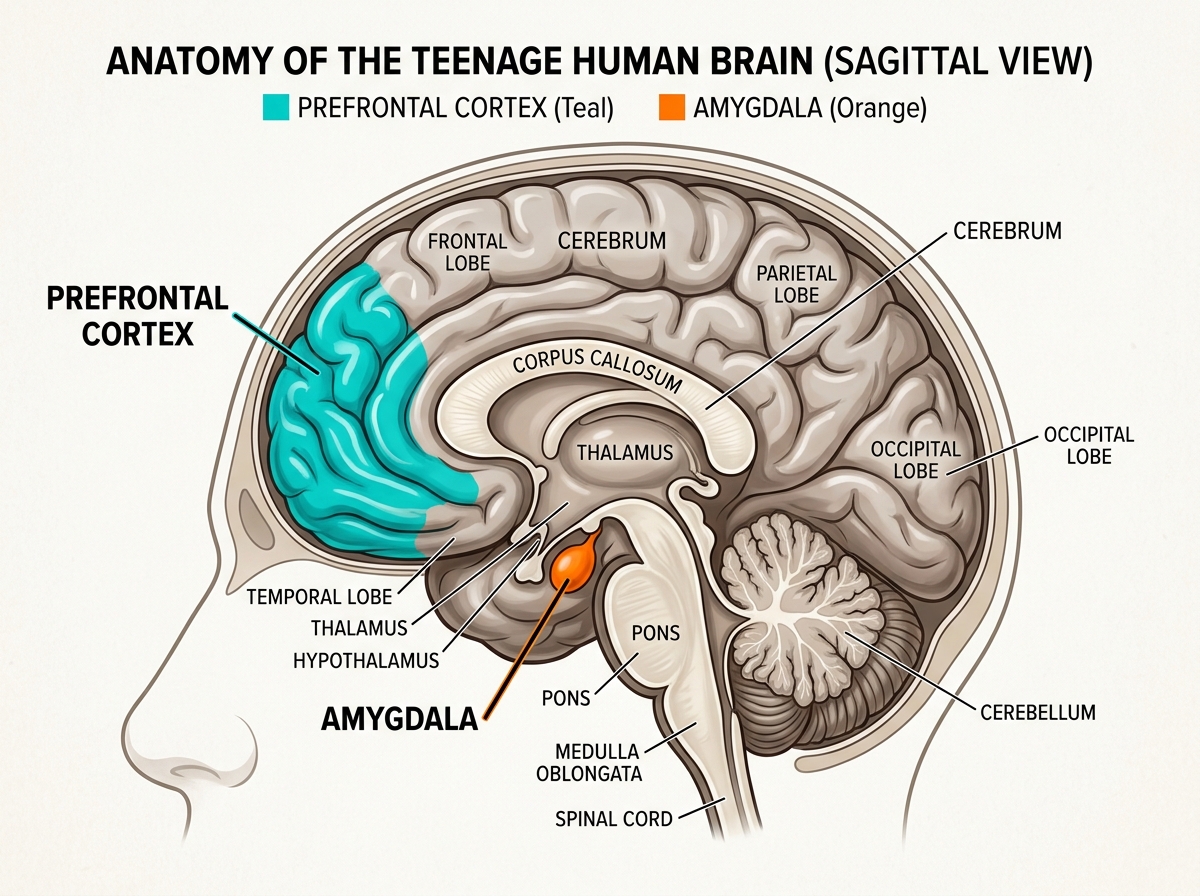
This creates a “biological gap” where emotions often override logic. CBT helps bridge this gap by teaching the brain to use logical analysis to check emotional impulses. It also addresses identity formation and core beliefs. As teens mature, they often develop “internal scripts” about who they are. If those scripts are negative (e.g., “I am a failure”), CBT helps rewrite them into more balanced, realistic narratives. You can find more info about CBT modalities to see how these structured approaches vary.
Core Techniques: How to Practice CBT for Teens
CBT isn’t just “talk therapy”; it’s “doing therapy.” It involves learning specific skills that act like a mental toolkit.
Cognitive Restructuring: Reframing Your Thoughts
Cognitive restructuring is the process of identifying and challenging “thinking traps” or cognitive distortions. These are biased ways of thinking that aren’t actually true but feel very real. Common traps for teens include:
- Catastrophizing: Assuming the absolute worst-case scenario will happen (e.g., “I failed one quiz, now I’ll never get into college”).
- All-or-Nothing Thinking: Seeing things in black and white with no middle ground (e.g., “If I’m not the best on the team, I’m a total loser”).
- Mind Reading: Assuming you know what others are thinking (e.g., “They didn’t wave back, so they must hate me”).
In a Mind Over Matter guide, teens learn to become “thought detectives.” They look for evidence for and against their negative thoughts. Instead of accepting a thought as fact, they ask, “Is this actually true? What is the evidence?” This leads to a more balanced perspective. Cognitive journaling is a great way to practice this, using columns to track the situation, the automatic thought, the emotion, and a more realistic alternative thought.
Behavioral Activation and Exposure in CBT for Teens
When teens feel depressed or anxious, they often fall into avoidance cycles. If social situations make a teen anxious, they might stop going to parties. While this feels better in the moment, it actually makes the anxiety grow over time because they never learn they can handle the situation.
CBT uses a “fear hierarchy” to help teens face their fears step-by-step. For example, a teen with social anxiety might start by simply saying “hi” to one person, then move up to asking a question in class. Anxiety treatment insights suggest that gradual exposure is the “gold standard” for overcoming phobias and social fears.
Teens also use SMART goals (Specific, Measurable, Attainable, Realistic, Time-specific) to re-engage with life. Behavioral activation encourages them to schedule small, enjoyable activities—like drawing or going for a walk—to boost their mood and build self-efficacy.
Mindfulness and Grounding Tools
Because teen emotions can be so intense, CBT incorporates grounding tools to calm the nervous system. These are especially helpful during panic attacks or moments of high stress.
- The 5-4-3-2-1 Technique: Identify 5 things you can see, 4 you can touch, 3 you can hear, 2 you can smell, and 1 you can taste.
- Relaxed Breathing: Inhaling for four counts and exhaling for four counts to signal to the brain that it is safe.
- Progressive Muscle Relaxation: Tensing and then releasing different muscle groups to physically let go of stress.
Research on mindfulness for youth shows that these practices significantly reduce negative thinking and improve emotional regulation. By practicing body scanning and distress tolerance, teens learn that they can experience a difficult emotion without being overwhelmed by it.
What to Expect During Your Therapy Journey
If a teen is starting CBT for teens, they can expect a very different experience than what is usually shown in movies. There’s no lying on a couch talking about dreams. Instead, sessions are collaborative and structured.
Typically, a session follows this flow:
- Check-in: How was the week? Any big wins or struggles?
- Homework Review: Did the teen try the techniques discussed last time? What happened?
- Agenda Setting: What specific problem do we want to tackle today?
- Skill Building: Learning a new tool (like reframing or problem-solving).
- Homework Assignment: Planning how to use the new skill before the next session.
The teen therapy expectations emphasize that the teen is an active partner in the process. They aren’t being “fixed”; they are being coached.
| Feature | Individual CBT | Group CBT |
|---|---|---|
| Focus | Deeply personalized to one teen’s specific triggers. | Shared experiences and social learning. |
| Privacy | Maximum confidentiality for sensitive topics. | High, but involves sharing with peers. |
| Social Skills | Practiced through role-play with a therapist. | Practiced in real-time with other teens. |
| Cost | Standard individual rates. | Often more affordable and efficient. |
The Role of Parents in CBT for Teens
Should parents be involved? The short answer is yes, but the “how” matters. Literature shows that parental involvement is essential for the efficacy of CBT, but it must be balanced with the teen’s need for privacy and autonomy.
Parents often participate in “coaching” sessions where they learn the same skills the teen is learning. This helps with skill generalization—meaning the teen is supported in using their tools at home, not just in the therapist’s office. Supporting your teen’s mental health journey involves parents learning to validate emotions without necessarily agreeing with the distorted thoughts. A strong therapeutic alliance between the teen, the parent, and the therapist is the foundation for success.
Frequently Asked Questions about CBT for Teens
How long does it take to see results?
While every teen is unique, CBT for teens is designed to be short-term. On average, it takes about 15 sessions for a teen to acquire proficiency in practicing CBT skills. Some see symptom improvement within 4 to 6 weeks, especially if they are consistent with their homework. The goal isn’t to be in therapy forever; it’s to give the teen the tools to become their own therapist. Why therapy rocks for students is that these skills often lead to better grades and social lives almost immediately.
Can CBT be combined with medication?
Absolutely. For many teens, a multimodal treatment plan is the most effective approach. For severe depression or anxiety, medication can “lower the volume” of the symptoms enough so that the teen can actually engage with the CBT skills. A Mayo Clinic Q&A on teen anxiety notes that combining therapy and medication often leads to the best clinical outcomes. Therapists at Kinder Mind often collaborate with psychiatrists to ensure holistic care.
Is online CBT as effective as in-person?
Yes. Research on internet-based CBT (iCBT) consistently shows that it is just as effective as in-person therapy for anxiety and depression. In fact, many teens prefer virtual therapy benefits because they feel more comfortable in their own rooms and can use digital tools like apps to track their progress. Online counseling options provide the convenience and privacy that fits a busy high schooler’s schedule.
Conclusion
Adolescence doesn’t have to be a period of constant suffering. By using CBT for teens, young people can build the resilience, self-esteem, and emotional intelligence they need to thrive. Whether they are dealing with a specific diagnosis or just the “standard” stress of being a teenager, these tools offer a roadmap for personal growth.
At Kinder Mind, we believe that every teen deserves access to high-quality, affordable mental health support. We offer both in-person and virtual therapy sessions across the United States, from Alabama to Washington, and we accept various insurance and reduced-rate plans to make sure care is within reach.
Ready to help your teen rewrite their story? Start your teen’s therapy journey with Kinder Mind today.
