
A Lifeline for Helping Couples on the Brink of Divorce
Dr. Elizabeth Barlow, LCSW-S · 5/4/2026

When a Marriage Reaches a Breaking Point: What Actually Helps
Helping couples on the brink of divorce is not a one-size-fits-all process — and knowing where to start can make all the difference.
If you or your partner is unsure whether to stay or go, here is a quick overview of the most effective options:
| Option | Best For | Length |
|---|---|---|
| Discernment Counseling | One partner wants to leave, one wants to stay | 1-5 sessions |
| Couples Therapy | Both partners committed to working on the relationship | Months |
| Individual Therapy | Personal clarity, managing anxiety or grief | Ongoing |
| Mediation | Couples leaning toward amicable separation | Varies |
Marriage crises rarely appear overnight. Most couples wait six years after problems begin before seeking help. By then, patterns of disconnection, resentment, and silence have often taken deep root.
And yet — the picture is not as hopeless as it feels in the middle of it.
Research shows that even among couples who have already filed for divorce, roughly one in three still has some ambivalence about ending the marriage. A quarter of divorcing parents believe their marriage could still be saved with enough work. These are not small numbers.
The challenge is that most couples in this situation don’t fit neatly into the usual therapy model. One partner may be ready to walk out the door. The other may be desperate to hold things together. Traditional couples therapy wasn’t designed for that gap.
That’s where specialized approaches — and the right kind of support — come in.
Easy helping couples on the brink of divorce word list:
Understanding the “Mixed-Agenda” Couple

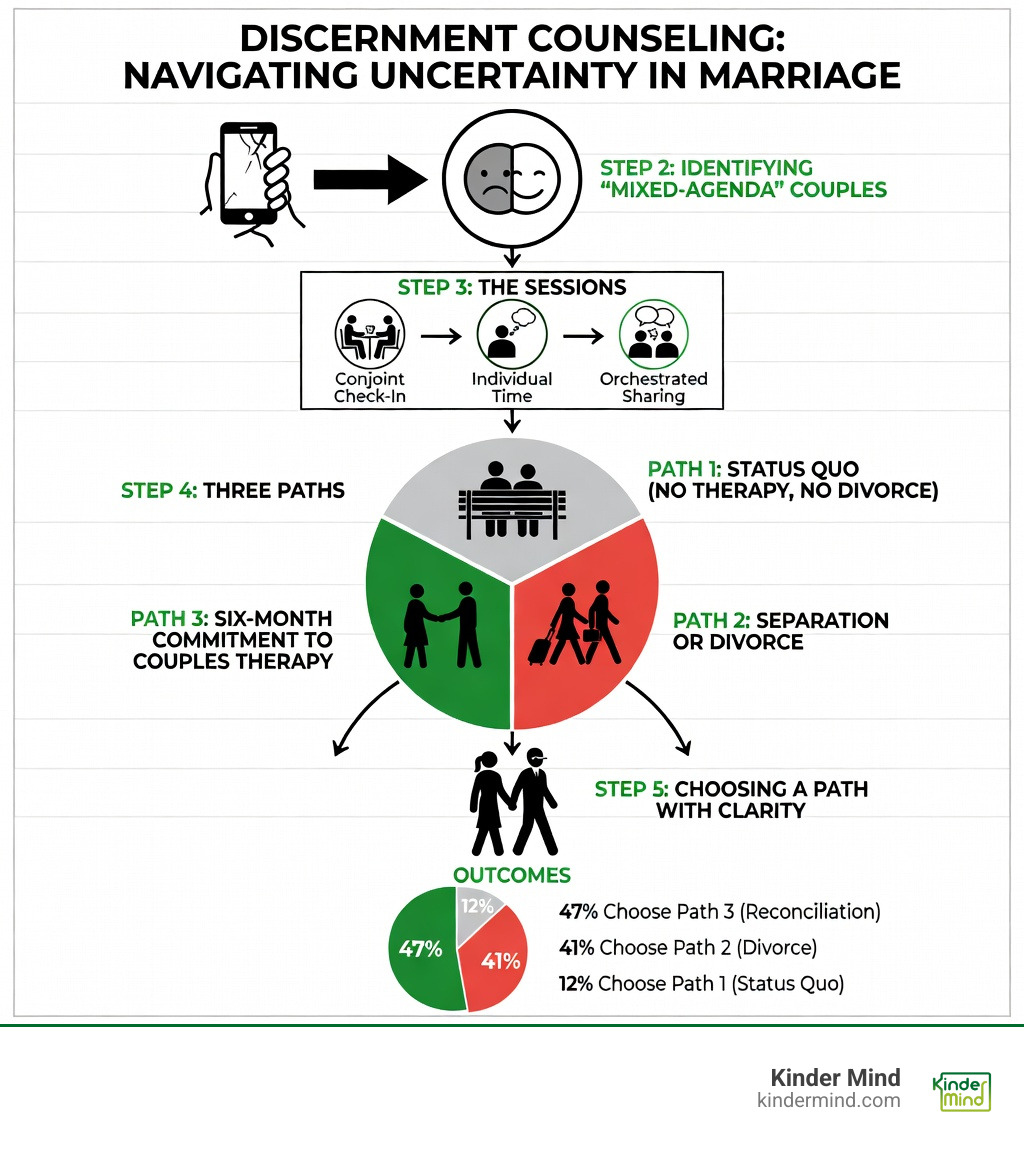
When we talk about helping couples on the brink of divorce, we are often talking about “mixed-agenda” couples. This term describes a specific, high-tension dynamic where one spouse is “leaning out”—seriously considering divorce and feeling reluctant to try more therapy—while the other spouse is “leaning in,” desperate to save the marriage and eager for professional intervention.
This isn’t a rare occurrence. In fact, research indicates that up to 30% of couples seeking clinical help are mixed-agenda couples. These pairs present a unique challenge because they aren’t starting from the same baseline of commitment. According to research on reasons for divorce and reconciliation openness, “soft” reasons like growing apart or feeling lonely are incredibly common, yet they often lead to this painful imbalance where one partner has already mentally checked out while the other is still fighting.
For more information on the complexities of these dynamics, you can explore our resources on divorce therapy.
Identifying Mixed-Agendas when Helping Couples on the Brink of Divorce
The primary marker of a mixed-agenda couple is a significant commitment imbalance. This often leads to a state of decision-making paralysis. The leaning-out spouse feels pressured and smothered, while the leaning-in spouse feels panicked and rejected. This creates a state of psychological ambivalence where neither partner knows how to move forward.
The leaning-out partner often experiences “negative sentiment override,” where every interaction is viewed through a lens of past hurt. Conversely, the leaning-in partner may try to “fix” things through increased pursuit, which ironically pushes the other partner further away. Understanding discernment counseling vs. couples therapy is vital here, as the goals for these two groups are fundamentally different.
Why Traditional Therapy Fails when Helping Couples on the Brink of Divorce
Traditional couples therapy usually assumes that both people have a shared goal: to improve the relationship. It focuses on skill-building, such as learning how to communicate better or resolve conflict. However, if one person isn’t sure they even want to be in the room, these “homework assignments” can feel like a chore or even a trap.
This often triggers a “pursuer-distancer” dynamic. The therapist might inadvertently align with the leaning-in spouse by trying to “save” the marriage, which makes the leaning-out spouse feel unheard and more resistant. To break this cycle, therapists must move beyond the blame game and address the commitment gap before attempting any relationship repair.
Discernment Counseling: A Specialized Approach for Helping Couples on the Brink of Divorce
Discernment counseling is a short-term, structured protocol specifically designed to help mixed-agenda couples. Unlike traditional therapy, which can go on for months, this process is limited to one to five sessions. The goal isn’t to fix the marriage; it’s to gain clarity and confidence about which direction to take.
| Feature | Discernment Counseling | Traditional Couples Therapy |
|---|---|---|
| Goal | Clarity and confidence in a decision | Relationship improvement and repair |
| Focus | Individual contributions and future paths | Communication skills and conflict resolution |
| Structure | Mostly individual conversations | Mostly conjoint (together) sessions |
| Duration | Short-term (1-5 sessions) | Ongoing (months to years) |
For a deeper dive into this method, see our discernment counseling complete guide.
The Session Structure: Individual vs. Couple Time
The structure of discernment counseling is unique. While sessions begin and end with the couple together for a brief check-in, the vast majority of the time is spent in individual coaching sessions with the therapist.
During this individual time, the therapist helps the leaning-out spouse explore the sources of their discouragement and whether the marriage is truly “done.” Simultaneously, the leaning-in spouse is coached on managing their anxiety and taking personal accountability for their part in the marital breakdown. The session concludes with “orchestrated sharing,” where each partner summarizes what they learned about themselves and their perspective on the relationship. This format is further detailed in our beginners guide to discernment counseling.
Theoretical Foundations of the Approach
This specialized approach is built on several robust psychological frameworks. The Family FIRO (Fundamental Interpersonal Relations Orientation) model suggests that inclusion (commitment) must be addressed before a couple can work on control (conflict) or intimacy.
Additionally, Adult Attachment Theory explains the panic and withdrawal seen in marital crises, while Differentiation of Self helps partners stand on their own two feet rather than reacting solely to the other person’s emotions. These foundations are explored in depth in scientific research on helping couples on the brink of divorce.
The Three Paths: Navigating the Crossroads
The ultimate output of discernment counseling is for the couple to choose one of three distinct paths. This framework removes the pressure of “fixing it now” and replaces it with a clear decision-making process.
- Path 1: The Status Quo. The couple decides to stay together as they are, neither pursuing divorce nor intensive therapy. This is often a “holding pattern.”
- Path 2: Separation or Divorce. The couple decides that the relationship has reached its end and moves toward a healthy, informed dissolution.
- Path 3: A Six-Month Reconciliation Effort. The couple commits to six months of intensive couples therapy with divorce “off the table” for that duration.
Understanding when therapy leads to I do or I don’t helps couples realize that any of these choices can be the “right” one if made with clarity.
Common Scenarios: Affairs and Lost Feelings
Many couples on the brink are dealing with “hard” reasons like infidelity or “soft” reasons like “falling out of love.” When an affair is involved, discernment counseling provides a space to see if repair is even desired before diving into the grueling work of trust-building.
In cases where one partner says, “I love you but I’m not in love with you,” the therapist helps the couple distinguish between a temporary loss of “the spark” and a permanent loss of connection. Utilizing specific divorce therapy techniques can help surface these underlying truths.
Statistical Outcomes and Success Rates
The outcomes of discernment counseling are telling. In an evaluation of 100 cases:
- 47% chose Path 3 (six months of therapy to reconcile).
- 41% chose Path 2 (separation/divorce).
- 12% chose Path 1 (status quo).
Interestingly, the research shows that if a couple has already seen a divorce lawyer, the likelihood of choosing Path 3 drops significantly (from 52% to 31%). This highlights the importance of early intervention. Regardless of the path chosen, many individuals find they need grief counseling for divorce to process the transition.
Beyond the Therapy Room: The Role of Legal and Community Support
Helping couples on the brink of divorce requires a village. Therapists are not the only professionals who encounter these couples; lawyers, mediators, and clergy members are often on the front lines.
When these professionals understand the signs of ambivalence, they can refer couples to discernment counseling rather than immediately pushing for litigation. This collaborative approach ensures that if a divorce does happen, it is handled with less vitriol, which is especially important when considering therapy for kids of divorce.
How Lawyers and Mediators Can Help
Legal professionals can play a vital role by screening for ambivalence. If a client seems unsure, a lawyer might suggest a “pause” for discernment counseling. This can lead to out-of-court resolutions like collaborative divorce or mediation, which save time, money, and emotional energy.
Shifting the focus from “winning” to “clarity” helps move the process from chaos to calm, allowing both partners to feel more in control of their future.
Frequently Asked Questions about Helping Couples on the Brink of Divorce
What is the difference between discernment counseling and marriage counseling?
Marriage counseling is designed to improve a relationship that both partners want to save. Discernment counseling is designed for couples where one or both are unsure if they want to save it. It focuses on clarity and decision-making rather than skill-building or conflict resolution.
Can discernment counseling work if one partner has already filed for divorce?
Yes. Research shows that about 33% of people who have already filed for divorce still have mixed feelings. Even if the legal process has begun, discernment counseling can help the couple decide whether to proceed with certainty or attempt a final reconciliation effort.
How do we find a therapist trained in this specific protocol?
It is essential to look for therapists who have specific training in the discernment counseling protocol, as it requires “unlearning” some traditional therapy habits. You can search for specialized divorce therapy near me to find practitioners who understand the mixed-agenda dynamic.
Conclusion
At Kinder Mind, we understand that being on the brink of divorce is one of the m
