
Discernment Counseling vs. Couples Therapy: What’s the Difference for Your Marriage?
Dr. Elizabeth Barlow, LCSW-S · 1/23/2026

When Your Marriage is at a Crossroads
Discernment couples counseling is a short-term therapy process (typically 1-5 sessions) designed specifically for couples where one partner is considering divorce while the other wants to save the relationship. Unlike traditional couples therapy, which aims to fix relationship problems, discernment counseling helps you gain clarity and confidence about whether to stay together, separate, or commit to working on the marriage.
Quick Answer: What is Discernment Couples Counseling?
- Purpose: Help “mixed-agenda” couples decide the future of their relationship
- Duration: 1-5 sessions (vs. 6+ months for couples therapy)
- Structure: Individual conversations with the therapist, plus brief joint check-ins
- Goal: Clarity and confidence in your decision, not immediate relationship repair
- Three Possible Outcomes:
- Keep things as they are
- Move toward separation/divorce
- Commit to 6 months of couples therapy
Many couples enter therapy with a shared commitment to improve their relationship. But what if you arrive for therapy and feel like you’re already mentally packing your bags, while your partner wants to work together to unpack them?
This is the reality for what experts call “mixed-agenda” couples—and research shows they represent up to 30% of all couples seeking therapy. In these relationships, one partner is “leaning out” (considering divorce) while the other is “leaning in” (hoping to save the marriage).
Traditional couples therapy isn’t designed for this situation. It assumes both partners want to work on the relationship. When one person is already halfway out the door, marriage counseling often feels forced, ineffective, or even harmful.
That’s where discernment counseling comes in. It creates a safe space to pause, reflect, and make an informed decision about your relationship’s future—without the pressure to immediately reconcile or separate.
What is Discernment Counseling?

Discernment couples counseling is a specialized, short-term form of therapy designed to help couples who are on the brink of divorce or separation, but are uncertain about their next steps. Its primary purpose is to help both partners gain clarity and confidence in their decision-making process regarding the future of their marriage. This approach is particularly well-suited for “mixed-agenda” couples, a dynamic where one partner is seriously considering ending the relationship (the “leaning-out” partner) while the other is eager to save it and work through issues (the “leaning-in” partner).
Research indicates that as many as 30 percent of couples who seek couples therapy fall into this “mixed-agenda” category. These couples often find themselves in a difficult bind: the leaning-in partner wants to engage in traditional couples therapy to fix problems, but the leaning-out partner isn’t ready or willing to commit to that process, as they are still weighing their options. Discernment counseling provides a structured, safe space to explore these differing perspectives without the pressure of immediate reconciliation or divorce.
Instead of working to solve existing relationship problems, discernment couples counseling focuses on understanding the dynamics that led to the current crossroads, each partner’s contributions to the relationship’s state, and the potential paths forward. It aims to help each individual thoughtfully explore their feelings and intentions, leading to a clearer, more confident decision about whether to pursue divorce, commit to intensive couples therapy, or maintain the status quo. You can find More info about discernment counseling to deepen your understanding.
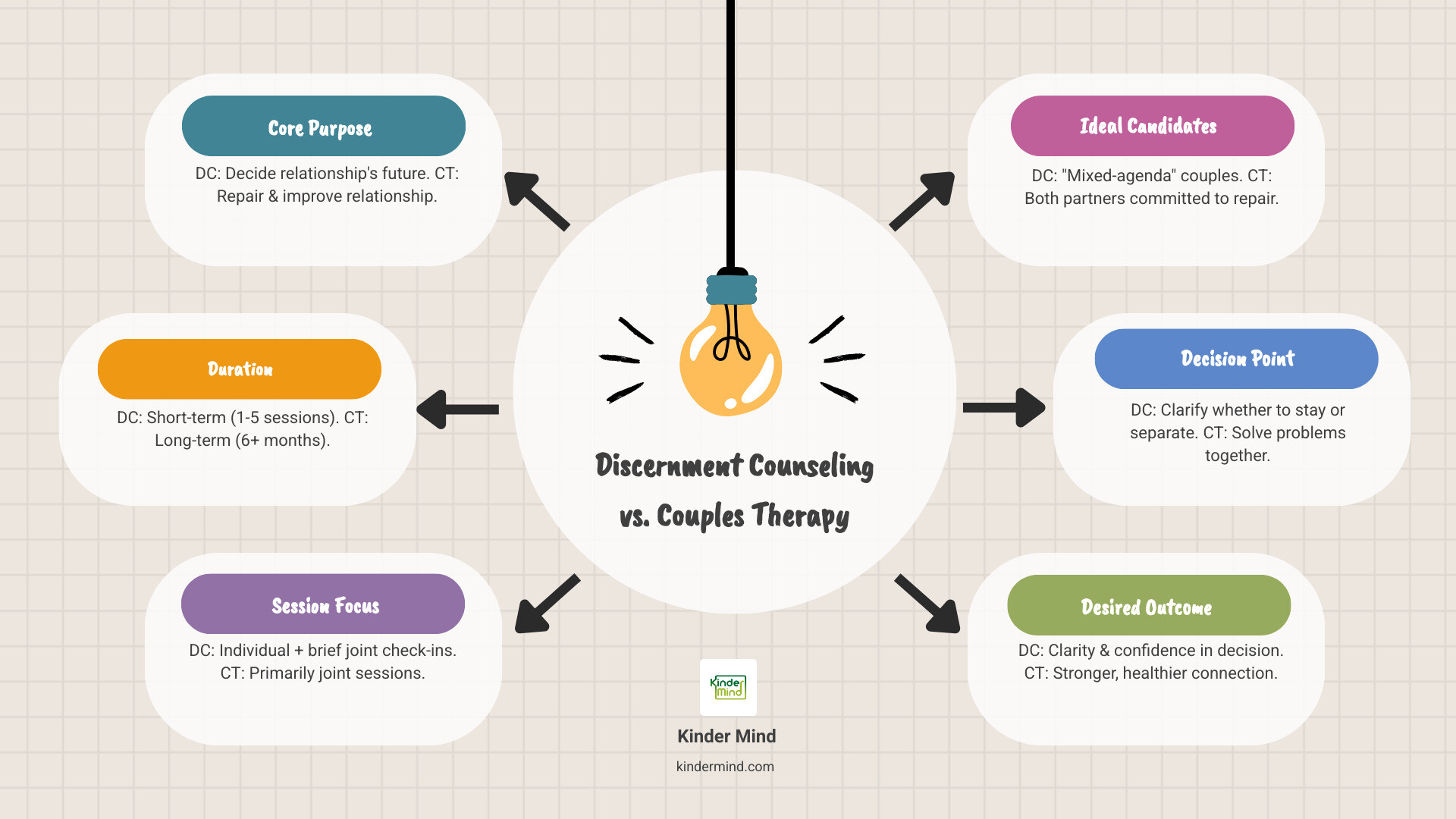
Discernment Counseling vs. Traditional Couples Therapy: A Head-to-Head Comparison
Understanding the fundamental differences between discernment couples counseling and traditional couples therapy is crucial for choosing the right path for your relationship. While both involve a therapist working with a couple, their goals, processes, and ideal candidates are distinct.
| Feature | Discernment Counseling | Couples Therapy |
|---|---|---|
| Core Goal | Clarity and confidence in decision-making (stay or go) | Repair, improve, and strengthen the relationship |
| Duration | Short-term (typically 1-5 sessions) | Longer-term (often 6+ months) |
| Session Focus | Individual reflection, understanding contributions, decision-making | Joint problem-solving, communication skills, emotional connection |
| Ideal Candidates | “Mixed-agenda” couples, high ambivalence about divorce | Couples committed to working on the relationship, shared goals |
| Therapist Role | Neutral guide, facilitator of clarity, not an advocate for either outcome | Coach, mediator, helping improve relational dynamics |
For couples experiencing significant ambivalence about their future, discernment counseling offers a unique opportunity to pause and reflect. In contrast, traditional couples therapy requires both partners to be genuinely committed to improving the relationship. If one partner is already leaning out, couples therapy can be counterproductive. To learn more about relationship repair, you can explore More info about couples therapy services.
Core Goal: Decision vs. Repair
The most significant difference lies in the core objective. For discernment couples counseling, the primary goal is to help couples make a clear, informed decision about the future of their relationship. This isn’t about saving the marriage or pushing for divorce; it’s about providing a structured process for evaluating options. The intensive work focuses on individual clarity regarding the relationship’s trajectory.
Conversely, traditional couples therapy has a clear mission of relationship repair. When a couple engages in couples therapy, the shared intention is to address specific issues, improve communication, rebuild trust, deepen intimacy, and ultimately strengthen their bond. It assumes both partners are “leaning in” and actively seeking to heal and grow together.
Session Structure: Individual vs. Joint Focus
The way sessions are structured also highlights a key distinction. In discernment couples counseling, a significant portion of the work occurs in individual conversations between each partner and the therapist. This allows each person to openly explore their feelings, concerns, and contributions without the immediate presence or potential influence of their spouse. Joint sessions are typically brief check-ins where reflections are shared, carefully facilitated by the therapist.
Traditional couples therapy, on the other hand, primarily involves joint sessions. The therapist works with both partners simultaneously, observing their interactions, mediating discussions, and teaching new communication and conflict-resolution skills. While individual sessions might occasionally be part of a broader couples therapy plan, the core of the work is done together.
Time Commitment: 1-5 Sessions vs. 6+ Months
Discernment couples counseling is designed to be a brief, intensive process. It typically spans only one to five sessions, with an average of 3.5 sessions. Each session is structured to stand alone, allowing couples to make a decision at any point or to opt for another session as needed. This short-term nature reflects its focus on decision-making rather than long-term problem-solving.
Traditional couples therapy, by its very nature, is a longer-term commitment. Repairing deeply ingrained patterns, improving communication, and rebuilding trust takes time and consistent effort. Couples therapy often extends for six months or more, depending on the complexity of the issues and the couple’s progress.
The Process and Outcomes of Discernment Couples Counseling
The journey through discernment couples counseling is distinct and highly structured, especially for “mixed-agenda” couples. The therapist acts as a neutral guide, not advocating for a specific outcome, but rather facilitating a deeper understanding for both partners. This process is designed to help couples gain clarity and confidence, as detailed in research on Discernment counseling for “mixed-agenda” couples.
What to Expect in a Session
A typical discernment couples counseling session involves a unique blend of joint and individual time. The initial appointment is usually longer, around 90-120 minutes, with subsequent sessions lasting approximately 90 minutes.
Here’s a general breakdown:
- Initial Joint Meeting: The session begins with both partners and the therapist together. This allows for a brief check-in and to set the agenda for that particular session.
- Separate Individual Conversations: This is where much of the core work happens. The therapist meets individually with each partner, typically for 30-45 minutes. During this time, each person can openly explore their feelings, perspectives, and contributions to the relationship’s issues without the other spouse present. This private space is crucial for the “leaning-out” partner to articulate their doubts and for the “leaning-in” partner to express their hopes and fears.
- Brief Joint Summary: After the individual conversations, the couple reconvenes with the therapist. The therapist facilitates a summary of what was learned and reflected upon during the individual sessions, ensuring confidentiality while sharing insights that can move the process forward.
A key aspect of discernment couples counseling is that there is no pressure to commit beyond one session at a time. After each appointment, the couple decides if they wish to continue with another discernment session, reflecting the gradual, thoughtful nature of the decision-making process.
The Three Paths Forward
At the conclusion of discernment couples counseling, couples typically arrive at one of three possible paths forward, each chosen with greater clarity and confidence:
- Path 1: Maintain the Status Quo. In this outcome, the couple decides to stay together without committing to immediate changes or formal couples therapy. They might agree to take a break from discussing divorce, perhaps for a set period, to see if circumstances or feelings shift. This path is often chosen when ambivalence remains high, and more time is needed for individual reflection.
- Path 2: Move Toward Separation or Divorce. After thorough exploration, one or both partners may decide that divorce is the most appropriate path. This decision, though difficult, is made with a deeper understanding of what led to this point and often with a plan for a more amicable separation, especially if children are involved.
- Path 3: Commit to Six Months of Couples Therapy with Divorce Off the Table. This path signifies a renewed commitment to the relationship. Both partners agree to put divorce on hold for a minimum of six months and actively engage in couples therapy with the genuine intention of trying to repair and improve their marriage. This commitment is crucial for couples therapy to be effective.
These outcomes represent the typical paths forward, offering a clear direction for couples who were previously stuck in uncertainty.
What “Success” Looks Like in Discernment Couples Counseling
In discernment couples counseling, “success” isn’t necessarily defined by whether a couple stays together or divorces. Instead, success is measured by the clarity and confidence both partners gain in their decision about the relationship’s future, regardless of the outcome. The goal is to ensure that the decision made is thoughtful, informed, and free from unresolved regret.
One of the significant benefits of this process is reducing the likelihood of future regret. Statistics show that up to 40 percent of divorced people have regrets about their decision, often because they feel they (and their partner) didn’t try hard enough to make the marriage work. Discernment couples counseling helps address this by ensuring both partners have thoroughly explored their options and understood their own contributions to the relationship’s challenges.
By fostering mutual understanding and encouraging each partner to take ownership of their role in the relationship’s dynamics, the process empowers individuals to make a decision they can stand by. This newfound clarity and confidence can lead to a more peaceful path forward, whether that means recommitting to the marriage with renewed purpose or navigating a separation with greater respect and cooperation.
Benefits and Limitations of Discernment Counseling
Discernment couples counseling offers unique advantages, particularly for couples struggling with deep uncertainty, but it also has specific situations where it is not appropriate.
Key Benefits for Uncertain Couples
The benefits of discernment couples counseling are profound, especially for those “mixed-agenda” couples who feel stuck:
- Gaining Clarity and Confidence: This is the cornerstone benefit. Both the leaning-out and leaning-in partners emerge with a clearer understanding of their own feelings, the relationship’s history, and their contributions to its current state. This clarity empowers them to make a confident decision about the future.
- Hope and Understanding: For the leaning-in partner, the process provides an opportunity to be heard and understood, and potentially to understand their partner’s perspective better. For the leaning-out partner, it offers a safe space to explore their ambivalence without feeling pressured.
- Potential for a “Good Divorce”: If the decision is to separate, discernment couples counseling can pave the way for a less contentious and more amicable divorce. Participants often report that the structured decision-making process leads to greater coparental cooperation post-divorce. Research shows that 64% of participants characterized their post-divorce relationships with their former spouses as cooperative in some aspects after discernment counseling. This focus on respectful separation can significantly benefit children. You can read more about The impact of discernment counseling on post-divorce communication.
- Improved Post-Divorce Communication: Even when couples decide to divorce, the insights gained in discernment counseling can lead
