
Beyond Envy: How to Navigate Jealousy in Your Polyamorous Life
Kinder Mind · 12/31/2025

Why Polyamory and Jealousy Are Often Misunderstood
Polyamory and jealousy are often linked by one question: “But don’t you get jealous?” The assumption is that jealousy makes non-monogamy impossible. The truth is, jealousy is a universal emotion that appears in all relationship structures, including monogamy. The key isn’t whether you feel it, but how you respond to it.
Quick Answer: How to Steer Jealousy in Polyamory
- Acknowledge it – Jealousy is normal and doesn’t mean polyamory isn’t for you.
- Get curious – Ask what story you’re telling yourself and what need isn’t being met.
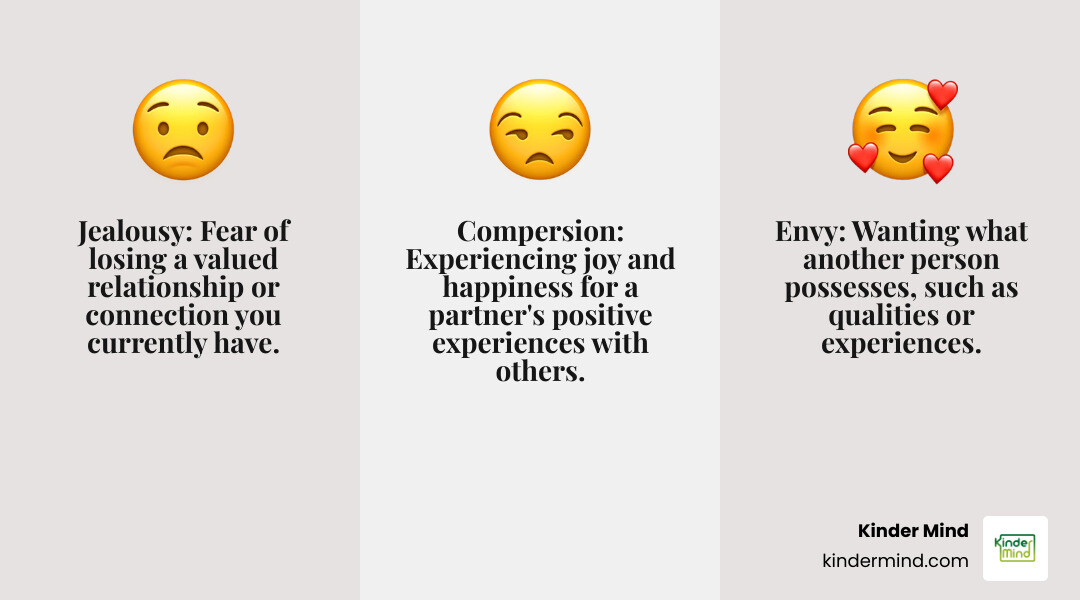
- Differentiate emotions – Separate jealousy (fear of loss) from envy (wanting what someone else has).
- Communicate openly – Use “I” statements to share feelings without blame.
- Seek support – Work with a polyamory-friendly therapist when needed.
Research shows that while 69% of polyamorous individuals report experiencing jealousy, 70% also experience compersion—joy in a partner’s happiness with others. In polyamorous communities, jealousy is often viewed as a tool for self-growth. It signals an unmet need, an insecurity, or a fear that deserves attention. Instead of a monster to defeat, jealousy is information about yourself and your relationships.
This article will help you understand jealousy in polyamory, identify its roots, and develop strategies to work through it. You’ll learn to communicate with partners, offer support, and even cultivate compersion, leading to stronger relationships and personal growth.
Understanding Polyamory and Jealousy: More Than a Green-Eyed Monster

Popular culture often misrepresents jealousy as proof of love, but in polyamory, it’s a signal that something needs your attention. It typically shows up as a fear of losing your partner’s time, affection, or the unique connection you share. However, this fear of loss is very different from possessiveness. Healthy polyamory recognizes partners as autonomous individuals; jealousy is your internal experience, not an excuse to control them.
Interestingly, while 69% of polyamorous people experience jealousy, they often report less of it overall than people in monogamous relationships. This isn’t because they are emotionally superior, but because consensual non-monogamy provides a framework for working through these feelings. In monogamy, jealousy can signal cheating; in polyamory, it’s a dashboard light telling you to look under the hood. Research on compersion shows that with more experience, compersion often increases as jealousy decreases. For more context, see our guide on Exploring Ethical Non-Monogamy and Polyamory.
The Root Causes: What’s Really Underneath?
Jealousy is rarely a standalone emotion. It’s often connected to deeper feelings and insecurities.
- Insecurity and Low Self-Esteem: A core driver of jealousy is doubting your own worth, which makes it easy to fear a partner will find someone “better.” This creates a vicious cycle of comparison and inadequacy.
- Fear of Abandonment: Our attachment styles, often formed in childhood, influence how we handle connection. Research shows that anxious or avoidant attachment patterns can intensify jealous feelings. Learn more about this in our article on Polyamory and Attachment.
- Past Trauma: Deep betrayals or emotional wounds can amplify jealousy to overwhelming levels. This type of jealousy often requires professional support to heal the underlying trauma.
Common Triggers in Polyamorous Dynamics
Knowing what situations can spark jealousy helps you prepare and communicate your needs. Common triggers include:
- New Relationship Energy (NRE): The intense excitement of a new connection can leave an existing partner feeling forgotten.
- A Partner’s Dating Success: This can sting if you’re struggling to find connections, leading to feelings of being “less than.”
- Feeling Left Out: When your partner and metamour share experiences you wish you could have, it can trigger loneliness.
- Comparing Yourself to a Metamour: Stacking yourself up against a partner’s other partner in terms of looks, success, or personality is a common jealousy trap.
- Changes in Time or Attention: A shift in quality time or emotional presence can feel threatening, even if unintentional.
- Special Occasions: Holidays and birthdays can become emotional minefields when a partner splits their time, raising fears about your importance.
How to Work Through Jealousy: A Step-by-Step Guide

When jealousy appears, it’s tempting to ignore it or let it explode. A better approach is to treat it as information. The most powerful tool for managing polyamory and jealousy is self-reflection. Pausing to respond with intention, rather than reacting immediately, is where personal growth happens. Your feelings are valid, but they don’t have to dictate your actions. This process builds stronger, more resilient relationships and is a vital skill if you are Opening Up A Relationship.
Step 1: Sit With the Feeling and Get Curious
Resist the urge to immediately react. First, acknowledge the emotion without judgment. Jealousy is normal; suppressing it often makes it more intense. Find a quiet space and notice where you feel it in your body. Grounding techniques, like focusing on your breath or the 5-4-3-2-1 sensory method, can interrupt anxious thought spirals.
Next, practice self-soothing to regulate your nervous system so you can think clearly. Make tea, listen to music, or take a walk. Once you’re calmer, get curious. Ask yourself:
- “What story am I telling myself right now?” (e.g., “My partner will leave me.”) These are often assumptions, not facts.
- “What am I afraid of losing?” (e.g., security, time, love?)
- “What need is not being met?” (e.g., reassurance, quality time, validation?)
These questions help you understand the jealousy so you can address its true source.
Step 2: Identify the Core Emotion
Jealousy is often a tangle of different feelings. Untangling them clarifies what to do next.
- Differentiate jealousy from envy. Envy is wanting what someone else has (“I wish I had a partner as adventurous as my metamour”). Jealousy is the fear of losing something you have (“I’m afraid my partner will leave me for my metamour”).
- Unpack the insecurity. Is this feeling tied to doubts about your own worth? Recognize insecure thoughts (“I’m not good enough”) as beliefs, not objective truths.
- Name the specific fear. Is it abandonment, not being loved, or being replaced? Naming the fear makes it less overwhelming.
- Pinpoint the unmet need. If you identify a need for more quality time or reassurance, you can then communicate that need and work toward meeting it.
Step 3: Healthy vs. Unhealthy Expressions of Polyamory and Jealousy
How you express jealousy is critical. Healthy expressions build connection, while unhealthy ones cause damage.
Healthy Expressions:
- Using “I” statements: “I feel anxious when…” instead of “You make me feel…”
- Asking for reassurance: “Could you tell me what you appreciate about our connection?”
- Constructive communication: Discussing feelings calmly to find solutions, not to assign blame.
- Setting boundaries: Protecting your wellbeing (e.g., “I need a check-in before you go on a date”) without controlling your partner.
- Seeking support: Talking to a polyamory-informed therapist or support group.
- Focusing on self-care: Nurturing your own hobbies, friendships, and sense of self.
Unhealthy Expressions:
- Controlling behavior: Demanding limits on who your partner sees or what they do.
- Accusations and blame: “You’re always choosing them over me.”
- Punishment: Using the silent treatment or withholding affection.
- Snooping: Breaking trust by checking a partner’s phone or email.
- Keeping score: Turning the relationship into a competition over time or affection.
- Threats or ultimatums: “If you see them again, I’m leaving.”
When jealousy consistently leads to controlling, manipulative, or aggressive behaviors, it has become toxic jealousy and can indicate an abusive dynamic. If you recognize these behaviors in yourself, seek professional help. If you’re experiencing them from a partner, please reach out for support. The National Domestic Violence Hotline offers confidential assistance 24/7. Healthy relationships are built on respect, trust, and autonomy.
Strengthening Your Bonds: Communication and Mutual Support

When navigating polyamory and jealousy, communication is essential. Open, honest dialogue prevents misunderstandings and resentment from cracking the trust you’ve built. The goal is to create a safe space where all partners can be vulnerable with their fears and needs without judgment. This level of communication takes practice and intention. For more guidance, see our article on Communication in Polyamory. If you’re stuck, a therapist who understands Relationship Issues can help.
How to Talk About Jealousy with Your Partner(s)
Admitting you feel jealous can be scary, but avoiding the conversation makes it worse. Here’s how to approach it constructively:
- Choose the right time. Find a calm moment when you both have the emotional space to talk. Ask, “I’d love to talk about some jealous feelings I’m having. Is now a good time?”
- Use “I” statements. This keeps the focus on your experience without blaming your partner. Try “I feel anxious when…” instead of “You make me jealous when…”
- Express your needs clearly. After self-reflection, state your needs specifically. Instead of “I need more attention,” try “I’d really value a dedicated date night once a week.”
- Avoid the blame game. Frame the issue as a challenge to tackle together. Your partner isn’t the enemy; you’re a team.
- Practice active listening. Genuinely hear your partner’s response. Reflect back what you hear (“So it sounds like you’re saying…”) to ensure you understand their perspective.
Supporting a Partner Who Is Feeling Jealous
When your partner is jealous, your response can either strengthen your bond or create distance. They are trusting you with their vulnerability, which deserves care.
- Validate their feelings. You don’t have to agree with their perspective to acknowledge their pain. A simple “I can see you’re feeling really anxious, and that sounds hard” can defuse tension.
- Offer reassurance. Jealousy is often rooted in fear of loss. Be specific about what you love and appreciate about them and your relationship. A heartfelt “You are so important to me” can ease fears.
- Approach with empathy. Try to understand their point of view. This helps you respond with compassion instead of defensiveness.
- Offer quality time. If they feel disconnected, be fully present with them. Put your phone away and show them they are a priority.
- Collaborate on solutions. Work together to find solutions that respect everyone’s autonomy. This might mean adjusting communication habits or scheduling protected time. The goal is to meet needs while honoring boundaries, which builds trust and strengthens your relationship.
From Challenge to Growth: Cultivating Compersion and Seeking Support
The goal isn’t to eliminate jealousy—an unrealistic task—but to learn from it. Jealousy carries information about your needs, boundaries, and emotional landscape. Navigating polyamory and jealousy is about using that insight as fuel for personal growth and stronger relationships. When you commit to understanding your jealousy, you develop deeper self-awareness, clearer communication, and emotional resilience.
Sometimes, this journey is too heavy to carry alone. When you need support, Poly Therapy can provide the guidance and tools to help you move forward.
