
Navigating the Open Road: A Guide to Ethical Non-Monogamy
Kinder Mind · 10/31/2025

Why Opening Up a Relationship Requires Intention and Care
Opening up a relationship means transitioning from monogamy to a form of consensual non-monogamy where partners agree that one or both can have romantic or sexual connections with others. At some point in a long-term relationship, many couples question monogamy. According to a poll of over 23,000 Americans, 25% are interested in an open relationship, with that number jumping to 41% among millennials.
This growing interest reflects a cultural shift, but success isn’t guaranteed. Ethical non-monogamy (ENM)—which includes open relationships, polyamory, and swinging—requires extraordinary communication, emotional maturity, and honesty. Done thoughtfully, it can deepen intimacy. Done carelessly, it can damage the relationship you’re trying to improve.
The difference comes down to consent and communication. Unlike cheating, which involves deception, ENM operates on mutually agreed-upon rules and transparency.
Essential Steps for Opening Up a Relationship:
- Have honest conversations – Both partners must genuinely want this, not just agree out of fear.
- Establish clear boundaries – Define what’s allowed sexually, emotionally, and practically.
- Start slowly – Begin with small steps and regular check-ins (weekly recommended).
- Practice safe sex – Use protection and get tested regularly.
- Manage jealousy – Expect it, discuss it openly, and work through it together.
- Keep communicating – Rules should evolve as you learn what works.
This guide will walk you through the essential questions, conversations, and practical steps for opening up a relationship ethically.
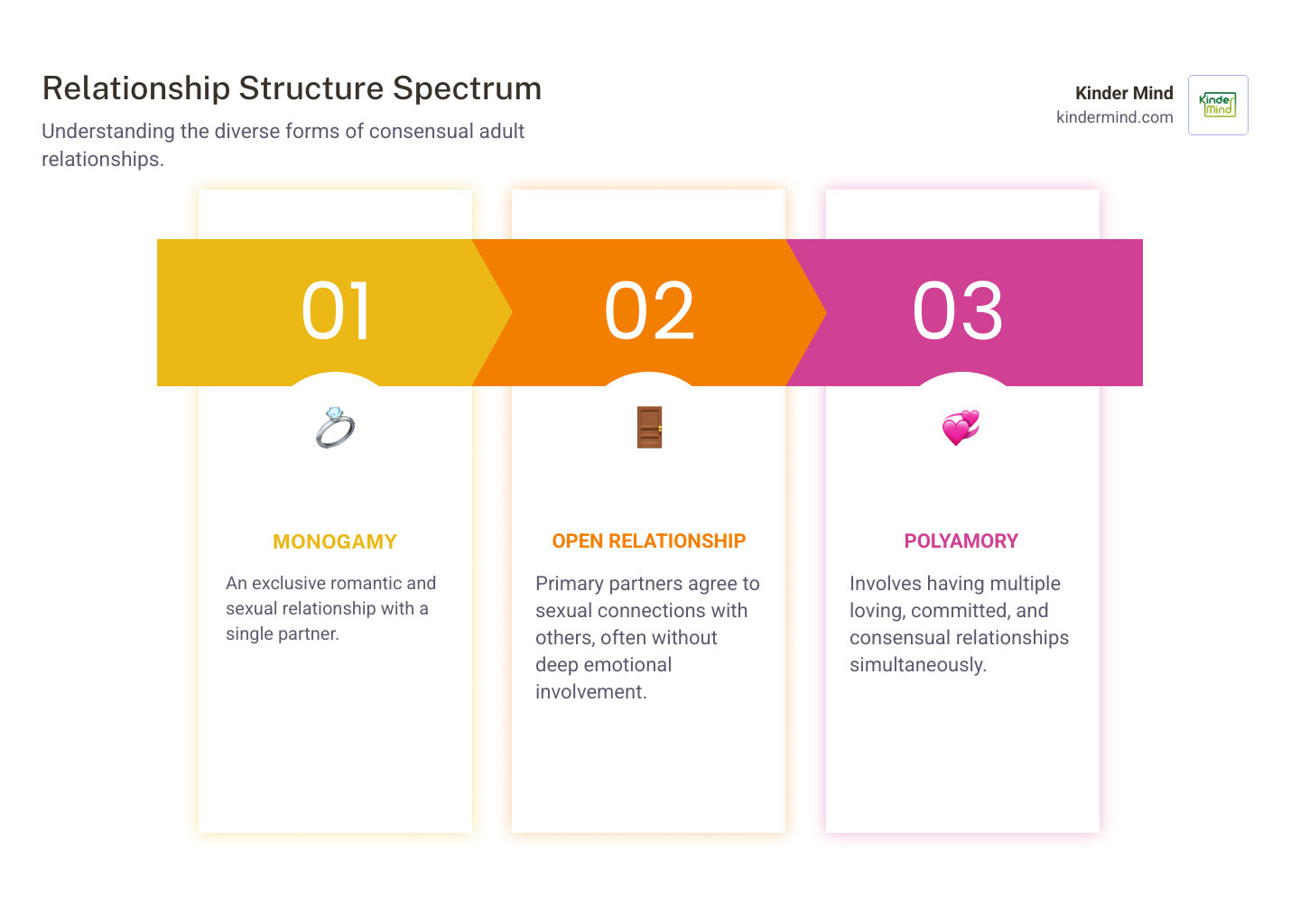
Understanding the Landscape of Ethical Non-Monogamy
Before you dive into opening up a relationship, it helps to understand the spectrum of relationship styles. Think of it like choosing a travel destination: a weekend getaway, a cross-country road trip, and moving abroad all require different levels of planning and preparation.

Defining the Terms: What is an Open Relationship?
“Open relationship” is often an umbrella term for consensual non-monogamy, but key distinctions exist.
- An open relationship typically means partners can have casual sexual or romantic connections with others, while the primary partnership remains central.
- Swinging involves couples engaging in sexual activities with other couples or individuals, often together. The focus is on shared recreational sex, with emotional attachments to outside partners typically discouraged.
- Polyamory (meaning “many loves”) is about having multiple committed, romantic relationships simultaneously, with everyone’s full knowledge and consent. It actively encourages emotional connection and love with multiple people.
| Feature | Open Relationship | Swinging | Polyamory |
|---|---|---|---|
| Emotional Connection | Typically discouraged or casual | Generally not a focus | Actively encouraged and central |
| Sexual Focus | Yes, with outside partners | Yes, often with other couples | Yes, with multiple partners |
| Commitment Structure | Primary relationship central; outside connections are casual | Primary relationship central; outside connections are recreational | Multiple committed relationships, often with varying levels of hierarchy |
| Relationship with Outside Partners | Casual dating, hookups | Group sex, partner swapping | Dating, loving, long-term partnerships |
Potential Benefits and Drawbacks
Opening up a relationship comes with genuine upsides and real challenges.
Benefits can include personal growth, deeper self-knowledge, and increased intimacy within the primary relationship due to the required honesty. It allows for authentic living, especially for those who feel constrained by monogamy, and can help address mismatched libidos or sexual interests without pressure.
Drawbacks are significant. Jealousy is a near certainty and requires emotional work. The time and energy commitment for communication and managing multiple relationships is substantial. More people mean more potential for conflict and emotional complexity. There is also societal stigma to contend with, which can add external pressure.
Common Misconceptions and How to Address Them
- “It’s just cheating with permission.” The key difference is consent. Cheating involves deception and violating agreements. ENM is built on transparency, honesty, and mutually agreed-upon boundaries.
- “It’s a way to fix a broken relationship.” This is a dangerous myth. Opening up amplifies existing problems like poor communication or trust issues; it doesn’t solve them. A strong foundation is a prerequisite, not an outcome.
- “People who want this just can’t commit.” The opposite is often true. Successful ENM requires an extraordinary degree of commitment to communication, honesty, and emotional labor.
- “It’s all about sex.” While sex is often involved, ENM can be about emotional connection (as in polyamory), personal growth, and the freedom to be authentic. Sex is rarely the whole story.
Is Opening Up Your Relationship the Right Move?
Deciding to open a relationship requires serious soul-searching and an honest look at your motivations and the current state of your partnership. The “why” behind this choice matters more than almost anything else.
Signs of a Healthy vs. Unhealthy Approach
Healthy reasons (Green Flags):
- Your relationship is already built on a strong foundation of trust and good communication.
- Both partners are genuinely and equally enthusiastic about exploring this path.
- The motivation is a desire for growth and new experiences, not to fix existing problems.
- You are both prepared to face challenges like jealousy and are committed to working through them together.
Unhealthy reasons (Red Flags):
- You’re trying to use it as a band-aid for existing issues like a lack of intimacy or poor communication. Opening up will amplify these problems.
- One partner is agreeing out of fear of losing the other. This is coercion, not consent.
- One partner is pressuring or manipulating the other into agreeing.
- Only one person truly wants this, while the other is deeply uncomfortable.
Key Questions to Ask Yourselves Before You Start
Before you do anything, have brutally honest conversations with each other. These questions are a necessary starting point.
- Why do we want this? Be honest about your motivations. Is it curiosity, a desire to grow, or an attempt to save a struggling relationship? (Spoiler: it won’t.)
- Are we both equally enthusiastic? Mismatched interest can lead to resentment.
- Is our relationship strong right now? You need a solid foundation of trust and respect. Address existing issues first.
- What are our biggest fears? Name your fears out loud: jealousy, feeling replaced, inadequacy. This is the first step to managing them.
- How will we handle jealousy? Create a game plan for how you’ll support each other when jealousy inevitably appears.
- What does “open” mean to us? Define if you’re talking about casual sex, dating, or full romantic relationships. Don’t assume you’re on the same page.
- What are our non-negotiable boundaries? What is completely off-limits (e.g., certain people, activities, bringing others home)?
- What are the practical logistics? How much time and energy can you realistically commit?
- What if one of us wants to close the relationship? Agree on a “reset” option before you need one.
- What counts as “cheating” now? Explicitly define what a violation of trust looks like in your new dynamic.
If these conversations feel overwhelming, Couples Therapy can provide a safe, guided space to explore these complex questions.
The Practical Guide to Opening Up a Relationship
You’ve done the soul-searching and had the hard conversations. Now comes the practical planning phase, where opening up a relationship moves from abstract to reality. This is where you build a foundation for success.

How to Start the Conversation
The first conversation is vulnerable. Set yourselves up for success.
- Timing and Setting: Choose a calm, private time when you’re both relaxed and can give it your full attention. No phones.
- Use “I” Statements: Frame the conversation around your feelings and desires, not your partner’s perceived flaws. For example, “I’ve been thinking about my own growth and would like to talk about our relationship structure.”
- Listen Actively: Your partner may have a strong reaction. Hear them out without getting defensive. Validate their feelings by saying things like, “I understand this is scary to hear.”
- Be Honest About Your “Why”: Transparency about your motivations builds trust and understanding.
Establishing Boundaries for Opening up a Relationship
Boundaries aren’t restrictions; they are agreements that protect your connection. Be specific.
- Make Rules Concrete: “No sleepovers” is a clear, behavioral rule. “Don’t fall in love” is an unenforceable, feeling-based rule. Stick to behaviors you can control.
- Sexual Boundaries: Discuss what activities are okay, what might be reserved for your primary relationship, and if any people (like mutual friends) are off-limits.
- Emotional Boundaries: Can you go on romantic dates? What happens if feelings develop? Can new partners meet friends or family?
- Practical Boundaries: How much time and money can be spent on other partners? Are certain nights reserved for just the two of you?
- Veto Power: Some couples agree that either partner can ask the other to end an outside relationship if it’s harming the primary one. If you use this, define its terms clearly to prevent misuse.
These boundaries will likely evolve. Regular check-ins are essential.
Navigating Information: ‘Don’t Ask, Don’t Tell’ vs. Full Transparency
Decide how much you want to know about your partner’s other connections.
- “Don’t Ask, Don’t Tell” (DADT): Partners agree not to share details. This can reduce anxiety for some but may also create emotional distance and prevent you from processing issues together.
- Full Transparency: You share all details. This can deepen trust but requires high emotional maturity.
- A Middle Ground: Most couples land here. For example, you might share who your partner is seeing and when, but not the intimate details. Respect each other’s needs for information, and be prepared for those needs to change over time.
Practical Considerations for Safety
Sexual health is critical. You are part of a network.
- Use Barrier Methods: Condoms and dental dams are essential for preventing STIs.
- Consider PrEP: Pre-Exposure Prophylaxis is a daily pill that significantly reduces the risk of contracting HIV. Talk to your doctor about it.
- Get Tested Regularly: Make STI testing a routine. Discuss schedules with your partner and be aware of window periods for different tests.
- Have Honest Conversations: You must discuss sexual health with everyone you are intimate with. Ask about their last test results and their practices with other partners.
If these conversations are difficult, a Sex Therapist can help you develop effective communication strategies.
Navigating the Emotional Journey of an Open Relationship
Opening up a relationship is an ongoing journey. It requires developing advanced emotional skills and a commitment to continuous communication and self-reflection.

Managing Jealousy and Cultivating Compersion
Jealousy is a normal human emotion. Feeling it doesn’t mean you’re failing at non-monogamy. The goal isn’t to eliminate it, but to approach it with c
