
Helping Your Teen Survive the Rollercoaster of Young Love
Dr. Elizabeth Barlow, LCSW-S · 5/20/2026

Why Teen Relationship Issues Deserve Your Attention Right Now
Teen relationship issues are one of the most common — and most overlooked — challenges facing adolescents today.
Here’s a quick overview of what you need to know:
- Healthy relationships are built on mutual respect, trust, honest communication, and consent
- Unhealthy relationships involve control, jealousy, isolation, dishonesty, or any form of abuse
- About 1 in 12 teens experience physical or sexual dating violence each year (CDC, 2019)
- Up to 19% of teens experience some form of dating violence overall
- Warning signs include mood changes, secrecy, withdrawal from friends, and walking on eggshells
- Parents can help by listening without judgment, setting clear limits, and keeping communication open
- Resources exist — call 1.866.331.9474 or text LOVEIS to 22522 for immediate, confidential support
Teen love is exciting. It’s also confusing, intense, and sometimes painful — for teens and their parents.
What makes it harder? Most teens are navigating relationships with very little experience. They may confuse jealousy with passion, control with care, or intensity with love. And nearly two-thirds of teens aged 13–17 have never been in a romantic relationship at all, meaning many are learning everything in real time.
The stakes are real. Unhealthy teen relationships don’t just cause heartbreak — they can lead to anxiety, depression, and patterns that follow young people well into adulthood.
This guide is here to help. Whether you’re a parent trying to figure out when to step in, or a teen trying to make sense of what you’re feeling, you’ll find practical, judgment-free guidance ahead.
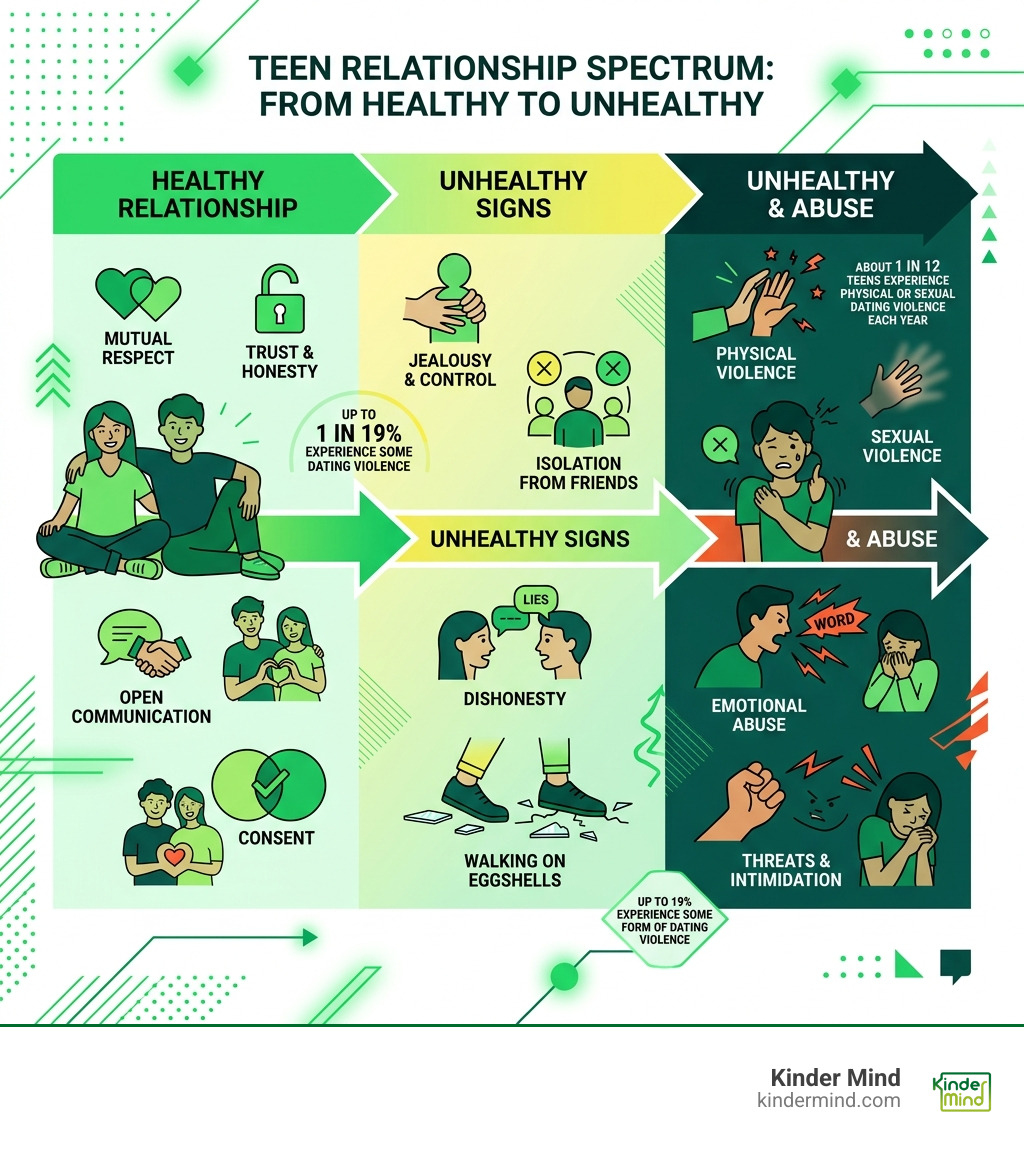
Know your Teen relationship issues terms:
Understanding the Landscape of Teen Relationship Issues in 2026
As of April 2026, the way teenagers date has undergone a significant transformation. While the media often portrays every teenager as being in a high-drama romance, the reality is quite different. Research shows that nearly two-thirds of adolescents aged 13-17 have never been in a dating or romantic relationship. This “non-dating” majority is actually the norm, yet many teens feel immense pressure to “couple up” to fit in.

When teens do date, the digital world is their primary playground. While only about 8% of all teenagers meet a partner online, that number jumps to 24% among those who have actual dating experience. Social media doesn’t just help them meet; it intensifies every interaction. A simple “like” on someone else’s photo or a delayed text response can spiral into major Teen relationship issues.
Digital boundaries are now a cornerstone of modern dating. Healthy relationships in 2026 require a shared understanding of privacy—such as not demanding passwords or “checking in” via location-sharing apps 24/7. According to Healthy Relationships in Adolescence | HHS Office of Population Affairs, these early connections are vital training grounds for adulthood, helping teens develop social skills and emotional resilience.
Spotting Red Flags and Common Teen Relationship Issues
It is easy to mistake “intensity” for “love” during the teenage years. Because hormones are surging and the prefrontal cortex (the brain’s executive center) is still developing, emotions feel like life-or-death situations. However, certain behaviors are never just “part of being a teen”—they are red flags.
- Jealousy and Control: If a partner gets angry when the teen spends time with friends or family, it is a sign of unhealthy possessiveness.
- Gaslighting: This involves making the teen doubt their own reality or feelings (e.g., “I never said that, you’re just being dramatic”).
- Love Bombing: An overwhelming amount of affection and attention early on, often used as a tactic to create dependence before the controlling behavior starts.
- Isolation: Gradually pulling the teen away from their support systems so they rely solely on the partner.
If you are noticing these patterns, it is important to dig deeper. You can find More info about relationship issues to help identify if a situation has crossed the line from a “rough patch” to a toxic cycle.
Differentiating Between a Crush, Infatuation, and Genuine Love
Teens often ask, “Is this the real thing?” Differentiating between these feelings is a key part of identity formation.
| Feature | Crush | Infatuation | Genuine Love |
|---|---|---|---|
| Primary Focus | Physical attraction or a specific trait. | Obsessive thoughts and “perfection.” | Mutual respect and knowing flaws. |
| Duration | Usually short-lived. | Intense but fades quickly. | Grows over time. |
| Emotional Impact | Daydreaming and “butterflies.” | High anxiety and emotional highs/lows. | Sense of safety and security. |
| Maturity Level | Surface-level admiration. | Centered on how the person makes you feel. | Centered on mutual growth and support. |
Genuine love involves understanding, patience, and trust. It doesn’t require “walking on eggshells” or changing who you are to please someone else.
How Parents Can Support Without Smothering
For parents, watching a teen navigate their first heartbreak or a confusing relationship is agonizing. The instinct is often to jump in and fix it—or forbid the relationship entirely. However, research suggests that forbidding dating often leads to secretive behavior rather than safety.

The most effective approach is nonjudgmental listening. When a teen shares something about their partner, avoid immediate criticism. Instead, use active listening. Reflect back what they said: “It sounds like you felt really hurt when they didn’t include you.” This emotional validation builds a bridge of trust.
Parents also need to be aware of age differences. While a two-year gap might seem small, the developmental difference between a 14-year-old and a 16-year-old is vast. Significant age gaps can create power imbalances where the older partner has more social or emotional leverage, increasing the risk of manipulation. For more guidance on these delicate topics, see Talking to Teens About Relationships, Sex and More | Children’s Hospital Colorado.
Fostering Open Communication to Prevent Teen Relationship Issues
One of the biggest “relationship destroyers” isn’t the partner—it’s the pressure of perfection. A staggering 95% of teens believe their parents expect them to be perfect. When teens feel they can’t make mistakes, they hide their Teen relationship issues because they don’t want to disappoint you.
To break the perfectionism trap:
- Share your own flaws: Talk about your own mistakes in past relationships. It normalizes imperfection.
- Let go of control: The teenage years are a training ground for independence. Shift from being the “manager” of their life to being their “consultant.”
- Praise the process: Focus on their kindness or their ability to set a boundary rather than just their “status” or grades.
Building this foundation is a key part of supporting your teen’s mental health journey.
Setting Healthy Limits on Serious Dating
“How serious is too serious?” is a question every parent asks. While you want your teen to explore their emotions, you also need to ensure they aren’t neglecting their development elsewhere.
- Time Management: Set clear limits on how many nights a week are “date nights.” Schoolwork and family time should remain priorities.
- Location Limits: Encourage dates in public places or supervised settings at home.
- The “Monthly Anniversary” Trap: Teens often celebrate every month, which can lead to expensive gift-giving and high pressure. Discuss the idea that gifts should be “no-strings-attached” and within their own budget.
- Heartbreak Resilience: Remind them that while it feels like the end of the world, breakups are actually opportunities to learn what they want (and don’t want) in a future partner.
Navigating Boundaries, Consent, and Digital Safety
Consent is not just about a “yes” or “no” in a single moment; it is an ongoing conversation about comfort and respect. Teens need to know that they have the right to change their mind at any time, and so does their partner.
Effective communication strategies involve being specific about physical boundaries. “I’m okay with holding hands, but I’m not ready for more than that” is a powerful statement of self-worth. Schools and parents should work together on Preventing Teen Dating Violence & Promoting Healthy Relationships by teaching these negotiation skills early.
Managing Long-Distance and Online Connections
Long-distance relationships (LDRs) are common for teens who meet at camp, through gaming, or via social media. While they present challenges, they can also teach incredible communication skills.
- Video Calls over Texting: Tone is easily lost in text. Video calls help build genuine connection and reduce misunderstandings.
- Social Media Etiquette: Discuss what is okay to post. Does the partner have permission to share photos? This is a vital part of peer relationships.
- Safe to Tell Policy: Create an agreement where the teen can come to you if they see something online (like pornography or a threatening message) without fear of having their phone taken away.
The Role of Peer Pressure in Modern Dating
Peer pressure isn’t always a “dare” to do something bad; often, it’s the subtle “social fitting” that makes a teen feel they must be in a relationship to be relevant. This can lead to sexual pressure or staying in an unhealthy situation just to avoid being single.
Parents can help by role-playing scenarios. Ask, “What would you say if your friends were teasing you about not being ‘experienced’?” Helping them find their own voice strengthens their social and peer interaction skills.
Taking Action Against Dating Violence and Mental Health Decline
We cannot ignore the darker side of Teen relationship issues. Dating violence is a reality for many high school students. It isn’t always a physical fight; it can be psychological aggression, stalking, or financial abuse (like a partner demanding they pay for everything or controlling their bank account).
The statistics are sobering:
- 1 in 12 high schoolers experience physical dating violence.
- 1 in 12 experience sexual dating violence.
- 76% of teens report experiencing some form of emotional or psychological abuse.
If you are in Alabama, resources like the Teen Dating Violence | Alabama Department of Public Health (ADPH) provide specific state-level support and education.
Identifying the Impact on Long-Term Well-Being
Unhealthy relationships are not just “phase” issues. They have a direct impact on a teen’s mental health. Chronic stress from a toxic partner can lead to:
- Anxiety and Depression: Constant worry about the partner’s reaction.
- Substance Misuse: Using drugs or alcohol to cope with emotional pain.
- Academic Decline: Inability to focus on school due to relationship drama.
- Suicidal Ideation: Feeling like there is no way out of a painful cycle.
Professional help is often necessary to break these patterns. Therapy for teens 13-17 can provide a safe space to process these emotions and rebuild self-esteem.
Safety Planning and Emergency Resources
If a teen is in an abusive relationship, leaving is the most dangerous time. A safety plan is essential. This includes:
- Identifying a “Safe Person”: A teacher, parent, or counselor who knows