When Your Marriage is on the Brink: Navigating Counseling Options Before Calling It Quits
Kinder Mind · 12/15/2025

Introduction: The Crossroads of a Relationship
What is discernment counseling? It’s a short-term therapy for couples who are uncertain about their relationship’s future—especially when one partner wants to end the marriage and the other wants to work on it.
Quick Answer:
- Purpose: Help couples gain clarity and confidence about whether to stay together, separate, or commit to intensive couples therapy.
- Duration: Typically 1-5 sessions.
- Who it’s for: “Mixed-agenda” couples where one partner is leaning out (considering divorce) and the other is leaning in (wants to save the relationship).
- Goal: Make a wise, informed decision—not to solve relationship problems immediately.
- Three possible outcomes:
- Keep things as they are (status quo).
- Move toward separation or divorce.
- Commit to 6 months of couples therapy with divorce off the table.
Many couples reach a crisis point where divorce is on the table. The challenge is even harder when partners aren’t on the same page. One may be desperate to save the marriage while the other is emotionally checked out. This is what therapists call a “mixed-agenda” couple, and traditional marriage counseling often fails in this scenario.
That’s where discernment counseling comes in. Developed by Dr. Bill Doherty, this approach creates a holding place for couples to pause and consider their options before making a life-changing decision. It’s not about pressure to stay or leave; it’s about helping both partners understand what happened, their role in it, and which path forward makes the most sense.
What is Discernment Counseling and Who Is It For?
What is discernment counseling at its core? It’s a specialized therapy that isn’t designed to fix your relationship problems. Instead, it helps you and your partner decide if your problems can be fixed—and if you’re both willing to try. It’s a thoughtful “holding place” to pause and examine your options before making a life-altering decision.
Developed by Dr. Bill Doherty, this approach was created for couples where one person is desperate to save the marriage while the other has one foot out the door. Traditional therapy often fails here because it assumes both partners are equally committed. Discernment counseling fills that gap, providing a structured way to gain clarity and confidence in your decision, whatever it may be.

The Ideal Candidate: The “Mixed-Agenda” Couple
Discernment counseling is for “mixed-agenda” couples—partners with different goals for the relationship.
- The “leaning-in” partner wants to save the marriage. They are hopeful and ready for couples therapy, but often feel hurt or confused by their partner’s uncertainty.
- The “leaning-out” partner is seriously considering divorce but isn’t 100% sure. They often feel hopeless or emotionally drained, but may still wonder if they’ve explored every option.
This imbalance is challenging. The leaning-out partner often resists traditional therapy, while the leaning-in partner feels rejected. Discernment counseling honors both perspectives, creating a safe space to steer the uncertainty without pressure. If you’re dealing with complex relationship dynamics, you might also find helpful resources on Relationship Issues.
Core Goals and Principles
The main goal of discernment counseling is to gain clarity and confidence about the future of your marriage, not to solve your problems.
- Clarity over problem-solving: The focus is on helping each partner understand their own feelings and contributions, not on mediating fights.
- Personal accountability: Both partners are encouraged to reflect on their role in the relationship’s struggles, moving beyond blame.
- Assessing solvability: The process helps you determine if your issues can be resolved and if both of you are willing to do the work.
- No pressure: The counselor will not push you to stay together or to separate. The goal is an informed decision.
- Therapist neutrality: The counselor remains balanced, respecting both partners’ feelings without taking sides.
Discernment Counseling vs. Traditional Couples Therapy
How does what is discernment counseling differ from traditional couples therapy? The distinction is critical, as choosing the wrong approach can make things worse.
The fundamental difference is the goal. Traditional couples therapy assumes both partners want to work on the relationship. Its focus is on solving problems, improving communication, and rebuilding connection over weeks or months of joint sessions. For couples ready to work together, Couples Therapy provides the necessary tools.
Discernment counseling is for couples who aren’t sure if they want to work on it. The goal isn’t to fix problems but to decide if they are fixable and if both partners are willing to try. The therapist is neutral, helping each person gain clarity. Forcing a leaning-out partner into traditional therapy can backfire, causing resentment and disengagement. Discernment counseling respects this uncertainty.
The Unique Structure of a Session
The structure of a discernment counseling session is unique. The first session is typically two hours, with any subsequent sessions (up to five total) lasting about 90 minutes.
- Brief Joint Opening: The session starts with both partners together, briefly sharing their story and what brought them to this crisis point.
- Individual Conversations: The core of the session involves the counselor meeting with each partner separately. This private time allows for honest exploration of feelings, doubts, and personal contributions to the problems without fear of starting an argument.
- Brief Joint Closing: The session ends with a short joint meeting where partners can share any key takeaways, but there’s no pressure to do so.
After each meeting, you decide whether to schedule another. The process is intentionally brief and focused on helping you reach a decision, not on providing long-term therapy.
The Three Paths: Deciding Your Future
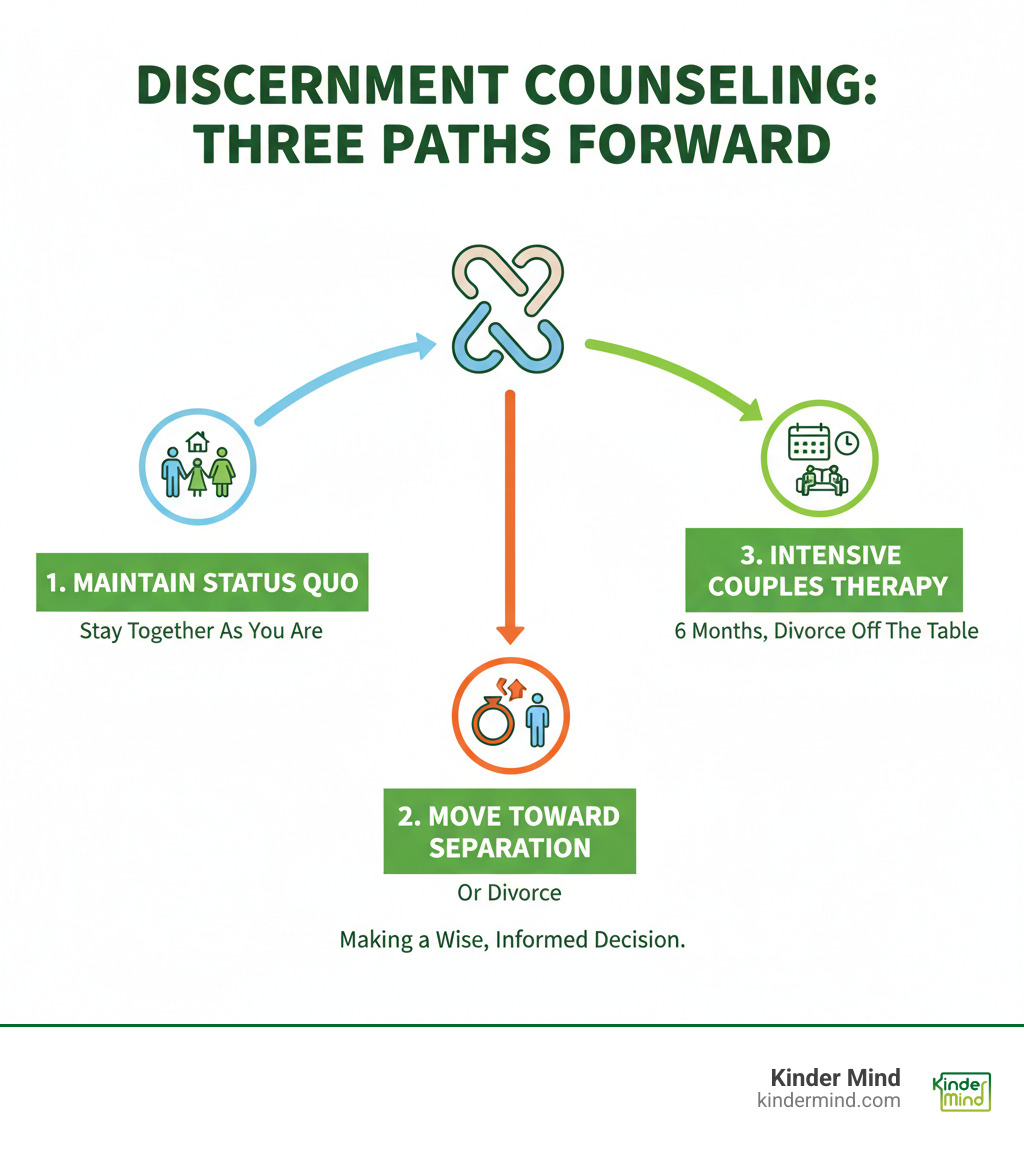
At the end of the process, you will choose one of three paths based on the clarity you’ve gained. The counselor presents these options neutrally.
- Path 1: Maintain the status quo. This means keeping the marriage as it is for now, without making a decision on divorce or therapy. This can be a wise choice if you need more time to process.
- Path 2: Move toward separation or divorce. If you conclude the marriage cannot continue, this path leads to ending the relationship. The process aims to make this transition clearer and more amicable. Divorce Therapy can provide support during this time.
- Path 3: Commit to six months of couples therapy. This is the reconciliation path. Both partners agree to take divorce off the table for six months and commit fully to intensive couples therapy to repair the relationship.
Research shows that about 47% of couples choose Path 3, 41% choose Path 2, and 12% choose Path 1. This highlights that discernment counseling is not designed to save every marriage, but to help you make the right decision for your situation.
The Process, Benefits, and Limitations
Discernment counseling is a journey of relational assessment. Understanding the process, its benefits, and its limitations can help you decide if it’s the right path for you.

What to Expect in Discernment Counseling
The process is designed to help you understand your relationship—and yourself—more deeply. The focus is on individual exploration. During your private time with the counselor, you will:
- Explore your perspective on what went wrong and what you truly want.
- Identify personal contributions to the conflict. This isn’t about blame but about taking ownership of your role, which is empowering regardless of the outcome.
- Discuss the best and worst of the relationship. Recalling what once worked provides context and helps you make a more balanced decision.
The counselor facilitates brief joint conversations to share insights constructively, helping you practice better communication. For more guidance, you might find resources on Couples Communication Skills helpful.
The Benefits of Gaining Clarity
The clarity gained from this process has far-reaching benefits:
- Reduced ambivalence: The agonizing uncertainty lifts, allowing you to make an informed, confident decision instead of reacting out of fear.
- Healthier post-divorce relationships: If you separate, the process can lead to a less contentious divorce because both partners have gained understanding and compassion.
- Improved co-parenting: Research shows that couples who use discernment counseling report better cooperation and less conflict as co-parents. A study in the Journal of Marital and Family Therapy confirmed these benefits.
- Greater self-awareness: The insights you gain about your own patterns help you build healthier relationships in the future.
- Less stressful transitions: Choosing your path thoughtfully reduces emotional turmoil and can save time, money, and heartache.
When Discernment Counseling is NOT Recommended
While transformative for many, what is discernment counseling is not always appropriate. It should be avoided in the following situations:
- Domestic violence or abuse: If there is a pattern of physical, emotional, or coercive control, the priority is safety. Individual therapy and safety planning are the correct steps, not joint counseling.
- A final decision has been made: If one partner has already decided on divorce and is not genuinely ambivalent, the process will not be helpful.
- One partner is coerced: Both individuals must attend willingly. The process cannot work if one person is being pressured or threatened.
- A restraining order is in place: Joint counseling is legally and ethically impossible under these circumstances.
In these cases, individual therapy is the appropriate path forward.
Frequently Asked Questions about Discernment Counseling
How long does discernment counseling typically last?
Discernment counseling is intentionally brief. The entire process lasts just one to five sessions. The first session is the longest, at 90-120 minutes, with subsequent sessions lasting about 90 minutes. You decide after each meeting whether to continue. The goal is to reach a decision, not to engage in long-term therapy.
What training is required for a discernment counselor?
Not all couples therapists are qualified to offer discernment counseling. It requires specialized training, typically through the Doherty Relationship Institute, which developed the method. When searching for a counselor, it’s wise to ask about their specific training and experience in this approach. Exploring options for a Marriage & Family Counselor Near Me can be a great starting point to find a qualified professional.
What is the main focus of what is discernment counseling?
The primary focus of what is discernment counseling is on the decision-making process itself, not on fixing the relationship problems. It helps couples gain clarity and confidence about the future of their marriage. The goal is to explore whether the problems are solvable and if both partners are willing to try. It’s about making a wise, intentional choice with a full understanding of your options and your own role in the situation.
Your Next Step: Making a Clear and Confident Decision
Standing at a marital crossroads is emotionally exhausting. What is discernment counseling if not a lifeline in this overwhelming time? It offers a structured pause from the emotional rollercoaster, allowing you to reflect thoughtfully on your future.
This process empowers you to make an intentional choice. Whether you decide to rebuild your relationship, separate amicably, or maintain the status quo, you will do so with clarity and confidence, free from the burden of “what if.”
A healthier future is possible regardless of the path you choose. The goal is not to force an outcome but to help you make a wise decision based on honesty and self-awareness.
If you and your partner are stuck between holding on and letting go, a discernment counselor can provide the guidance you need. Kinder Mind offers in-person and virtual therapy across many US states, creating a nonjudgmental space for you to explore your options safely. Taking this step can transform painful confusion into a clear, intentional choice for your future.
To connect with a therapist who supports couples through these difficult decisions, you can find a therapist specializing in Divorce who understands what you’re going through. You deserve clarity and confidence as you take this next step.