Conquer Your Social Fears with the Best Online Therapy
Dr. Elizabeth Barlow, LCSW-S · 3/30/2026

Social Anxiety Disorder: When Everyday Life Feels Like a Threat
The best online therapy for social anxiety connects you with licensed therapists who specialize in proven treatments — from the comfort of your own home. When searching for the right support, it is essential to prioritize clinical expertise, evidence-based approaches like CBT, and accessibility through insurance or affordable payment options.
Most of us know what it feels like to get nervous before a big presentation or feel awkward at a party. That’s normal.
But social anxiety disorder is something different.
It’s a persistent, intense fear of being watched, judged, or embarrassed in social situations. It can make everyday things — like ordering food, answering a question at work, or meeting new people — feel genuinely threatening.
The physical symptoms are real too: a racing heart, blushing, sweating, and a tight chest. And when it gets bad enough, people start avoiding the situations altogether. That avoidance brings short-term relief but makes the anxiety worse over time.
The good news? Social anxiety is one of the most treatable mental health conditions. And online therapy has made effective, specialized help more accessible than ever — whether you’re between jobs, living in a rural area, or just too anxious to walk into a therapist’s office.
Recognizing the Signs: Social Anxiety vs. Shyness
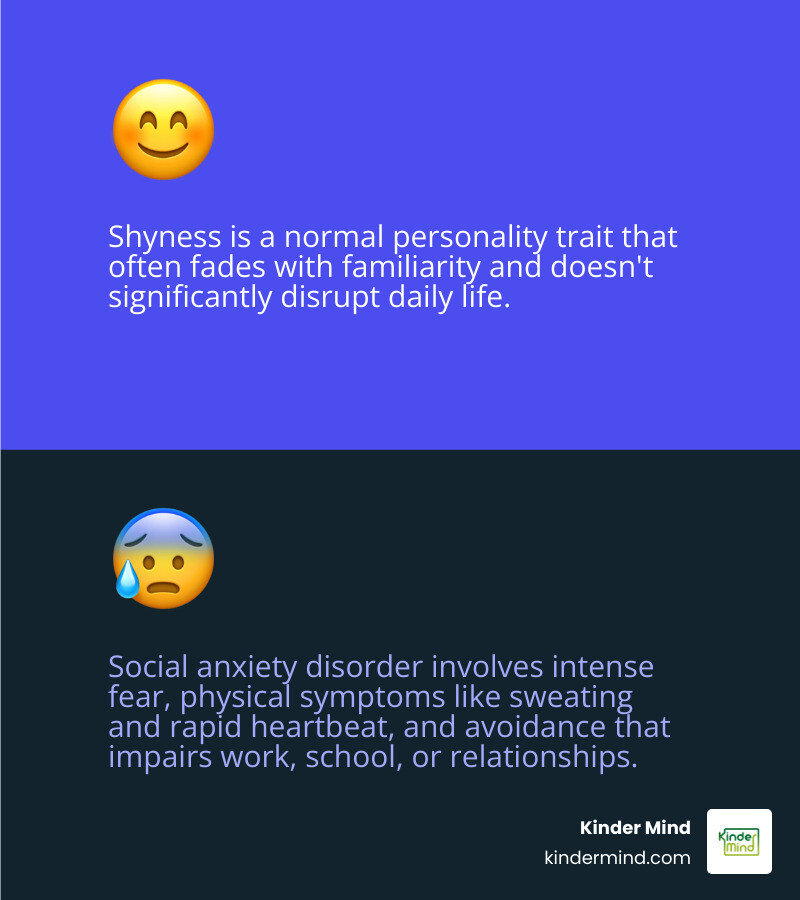
It is a common misconception that social anxiety is simply “extreme shyness.” While they share some surface-level similarities, they are fundamentally different experiences. Shyness is a personality trait; it often fades as a person becomes more comfortable in a specific environment. Social anxiety disorder (SAD), however, is a clinical condition that can be debilitating.
Individuals with social anxiety often experience a range of intense physical symptoms when they anticipate or enter social settings. These include:
- A pounding or racing heart.
- Profuse sweating or “cold sweats.”
- Visible trembling or shakiness.
- Blushing that feels impossible to hide.
- Muscle tension, particularly in the chest or neck.
- Nausea or “butterflies” that feel like a physical illness.
The emotional signs are equally taxing. A person might feel a constant sense of dread leading up to an event, sometimes weeks in advance. During the event, they may feel “on stage,” as if everyone is scrutinizing their every move for a reason to judge them. This often leads to social anxiety therapy becoming a necessary step for reclaiming one’s quality of life.
One of the most distinct markers of social anxiety is what psychologists call “post-mortemising.” This involves replaying social interactions over and over in one’s head after they are finished, focusing exclusively on perceived mistakes or awkward moments. This cycle of rumination reinforces the belief that one is socially incompetent, even if the interaction actually went well.
For many, this begins in the teenage years. Understanding the nuances of unmasking social anxiety recognizing and supporting teens is vital, as early intervention can prevent the disorder from narrowing a young person’s world. Left untreated, it can manifest as severe performance anxiety or public speaking fears that stall careers and personal growth.
How to Choose the Best Online Therapy for Social Anxiety
Choosing a platform for mental health support is a significant decision. When looking for the best online therapy for social anxiety, it is important to look beyond just the user interface.
First, consider the credentials of the providers. For social anxiety, you generally want a therapist who is well-versed in behavioral interventions. Licensed Clinical Social Workers (LCSWs), Licensed Professional Counselors (LPCs), and Psychologists (PhDs or PsyDs) are all qualified to provide high-quality care, but their specific experience with anxiety disorders is the most important factor.
The matching process is also a critical component. Some platforms use algorithms based on a questionnaire, while others allow you to browse directories. For someone with social anxiety, a platform that handles the matching for you might be less overwhelming, but having the option to switch therapists easily is a must. Not every therapist-client pair is a perfect fit, and finding someone you “click” with is one of the strongest predictors of success.
Privacy is another non-negotiable factor. Ensure the platform is fully HIPAA compliant. This means your data is encrypted and your sessions are private. Reviewing the platform’s privacy policies can help you understand how they handle your information and whether they share data with third parties.
Finally, look for providers that emphasize virtual anxiety treatment based on evidence. Scientific research on CBT for social anxiety consistently shows that structured approaches are often more effective than traditional “talk therapy” alone for this specific condition.

Key Features of the Best Online Therapy for Social Anxiety
The flexibility of online platforms allows for various session formats that can be tailored to your comfort level. These usually include:
- Video Calls: These are the closest digital equivalent to in-person therapy and allow the therapist to see your non-verbal cues.
- Phone Calls: Ideal for those who find the visual aspect of video calls too stimulating or anxiety-provoking initially.
- Unlimited Messaging: Many platforms offer asynchronous text-based support. This can be a great way to “check in” between sessions or practice expressing thoughts in writing.
When researching online therapy for anxiety, pay close attention to user reviews. Look for feedback regarding the platform’s ease of use—if the technology is frustrating, it adds another layer of stress you don’t need. Reliable customer support and an intuitive app or website can make the difference between sticking with therapy and giving up.
Results to Expect from the Best Online Therapy for Social Anxiety
Therapy is a journey of self-discovery, but it also requires a commitment to the process. Most people begin to see a reduction in the intensity of their physical symptoms within a few months of consistent sessions. However, the timeline varies for everyone.
A comprehensive virtual therapy anxiety guide will tell you that the goal isn’t just to “feel better,” but to build a toolkit of skills. You can expect to learn how to:
- Identify and challenge automatic negative thoughts.
- Shift your attention from internal sensations to the external environment.
- Gradually face feared situations without the need for “safety behaviors” (like checking your phone or staying near an exit).
Long-term recovery involves a shift in how you view yourself and your place in the world. While social anxiety may not have a “cure” in the traditional sense, many people reach a point where their fears no longer dictate their choices.
Effective Therapeutic Techniques for Social Phobia
The most successful treatments for social anxiety are active and skills-based. It isn’t just about talking about your past; it’s about changing how you interact with the present.
Cognitive Behavioral Therapy (CBT) CBT is the gold standard for social anxiety. It operates on the idea that our thoughts, feelings, and behaviors are all interconnected. By changing the way you think about a social situation, you can change how you feel and, subsequently, how you act. Scientific research on CBT vs other treatments has shown it to be more effective than medication alone for many people, as it provides long-term coping mechanisms.
Exposure Therapy This is often integrated into an online cbt for anxiety guide. Exposure involves gradually and systematically facing the situations you avoid. Under the guidance of a therapist, you might start with something small, like making eye contact with a cashier, and work your way up to giving a presentation. The goal is to teach your brain that the “threat” isn’t actually dangerous.
Acceptance and Commitment Therapy (ACT) ACT takes a slightly different approach. Instead of trying to eliminate anxious thoughts, it teaches you to accept them as “just thoughts” while committing to actions that align with your values. This can be particularly helpful for those who have struggled with traditional CBT.
| Technique | Primary Goal | Best For |
|---|---|---|
| CBT | Challenge and reframe negative thoughts | Identifying distorted beliefs |
| Exposure | Desensitize the fear response | Overcoming avoidance behaviors |
| ACT | Mindfulness and value-based living | Managing persistent symptoms |
Attention Training People with social anxiety are often hyper-focused on themselves (their blushing, their heart rate, what they just said). Attention training involves exercises that help you shift your focus back to the conversation or the task at hand. This often reveals that other people are much less judgmental than the anxious mind assumes.
Social Skills Training Sometimes, social anxiety is compounded by a genuine lack of confidence in social “rules.” Therapists can help by role-playing common scenarios, teaching how to start and maintain conversations, and helping you read non-verbal cues more accurately.
Frequently Asked Questions about Social Anxiety Treatment
How does online therapy differ from in-person sessions for social fears?
Online therapy offers a unique advantage for social anxiety: it meets you where you are. For someone whose anxiety is so severe that leaving the house is a challenge, virtual sessions provide a bridge to care. It also allows you to practice skills in your natural environment. However, the core therapeutic techniques—like CBT and exposure—remain the same regardless of the medium.
Can virtual therapy help with severe public speaking anxiety?
Yes. Virtual therapy is highly effective for performance-based fears. Therapists can use video sessions to simulate speaking environments, practice “mock” presentations, and guide you through breathing and grounding techniques in real-time.
Is online therapy for social anxiety covered by insurance?
In many cases, yes. Many modern platforms are in-network with major commercial insurers and even Medicaid. It is always best to verify your specific plan during the sign-up process. Platforms that prioritize accessibility often have tools to help you check your coverage instantly.
Conclusion
Overcoming social anxiety is possible, and you don’t have to do it alone. The best online therapy for social anxiety provides a structured, supportive environment where you can confront your fears at your own pace.
Kinder Mind is dedicated to making this journey accessible. With a presence in states ranging from Alabama and Maryland to Virginia and California, Kinder Mind offers both in-person and virtual mental health services designed to fit into your life. Their commitment to affordable care includes being in-network with all Medicaid Managed Care Organizations in certain regions, such as Maryland Medicaid and Virginia Medicaid, ensuring that financial barriers don’t stand in the way of your mental health.
Whether you are dealing with online social anxiety or a specific phobia of public speaking, the right support can help you move from avoidance to engagement. By utilizing evidence-based practices like CBT and providing flexible payment options, Kinder Mind aims to help every individual find their voice and reclaim their social life.
If you’re ready to start your journey toward a more confident version of yourself, visit Kinder Mind to explore your options and connect with a specialist today.