How to Support Polyamorous Clients Effectively
Dr. Elizabeth Barlow, LCSW-S · 3/31/2026

Why Therapists Need Specialized Polyamory Resources Right Now
Polyamory resources for therapists are more important than ever — and if you need a quick overview of the best ones, here they are:
Top resources for therapists working with polyamorous clients:
- Book: Polyamory: A Clinical Toolkit for Therapists (and Their Clients) by Martha Kauppi — the most comprehensive clinical guide available
- Book: Polysecure by Jessica Fern — covers attachment theory and trauma in consensual non-monogamy
- Podcast: Multiamory — 350+ episodes on ENM dynamics, jealousy, and communication
- Directory: Polyfriendly.org — find or list poly-affirming professionals
- Booklet: What Psychology Professionals Should Know about Polyamory — a free foundational read for therapists new to the topic
- Workshop: Jessica Fern’s free webinars on relationships and non-monogamy
- Model: Stan Tatkin’s PACT therapy — attachment-centered, adaptable for polyamorous clients
More and more clients are walking into therapy with questions about polyamory and consensual non-monogamy (CNM). Research shows that 16.8% of Americans have wanted to try polyamory, and 10.7% have already done so. That’s a significant portion of any therapist’s potential client base.
Yet most clinical training programs say almost nothing about non-monogamous relationships.
The result? Many polyamorous clients encounter therapists who — without meaning to — pathologize their relationship structure, assume monogamy is the goal, or blame relationship problems on the fact that someone has multiple partners. That kind of bias can cause real harm.
The good news: a growing body of research, books, and training tools now exists to help therapists build genuine competence in this area. Studies consistently show no higher rate of mental health issues in polyamorous people compared to the general population. The distress clients bring to therapy often comes from societal stigma — not from polyamory itself.
This guide pulls together the most practical, vetted resources available so therapists can support polyamorous clients with the same skill and confidence they bring to any other presenting issue.
Understanding the Landscape: Polyamory vs. Mononormativity
To work effectively with these clients, a therapist must first recognize the “water we are all swimming in”: mononormativity. This is the societal assumption that monogamy is the only natural, healthy, or “evolved” way to relate. When a therapist operates from a mononormative bias, they might inadvertently suggest that a client “close” their relationship to solve a communication issue, or assume that a partner’s jealousy is proof that polyamory is failing.
According to a U.S. Census sample, nearly 1 in 6 people report a desire for polyamory. This isn’t a niche “lifestyle” choice; for many, it is a core relationship orientation. Pathologizing this orientation is as harmful as pathologizing sexual orientation. In fact, an essential guide to ENM therapy emphasizes that the goal of therapy should be helping clients thrive within their chosen structure, not steering them back toward a traditional one.
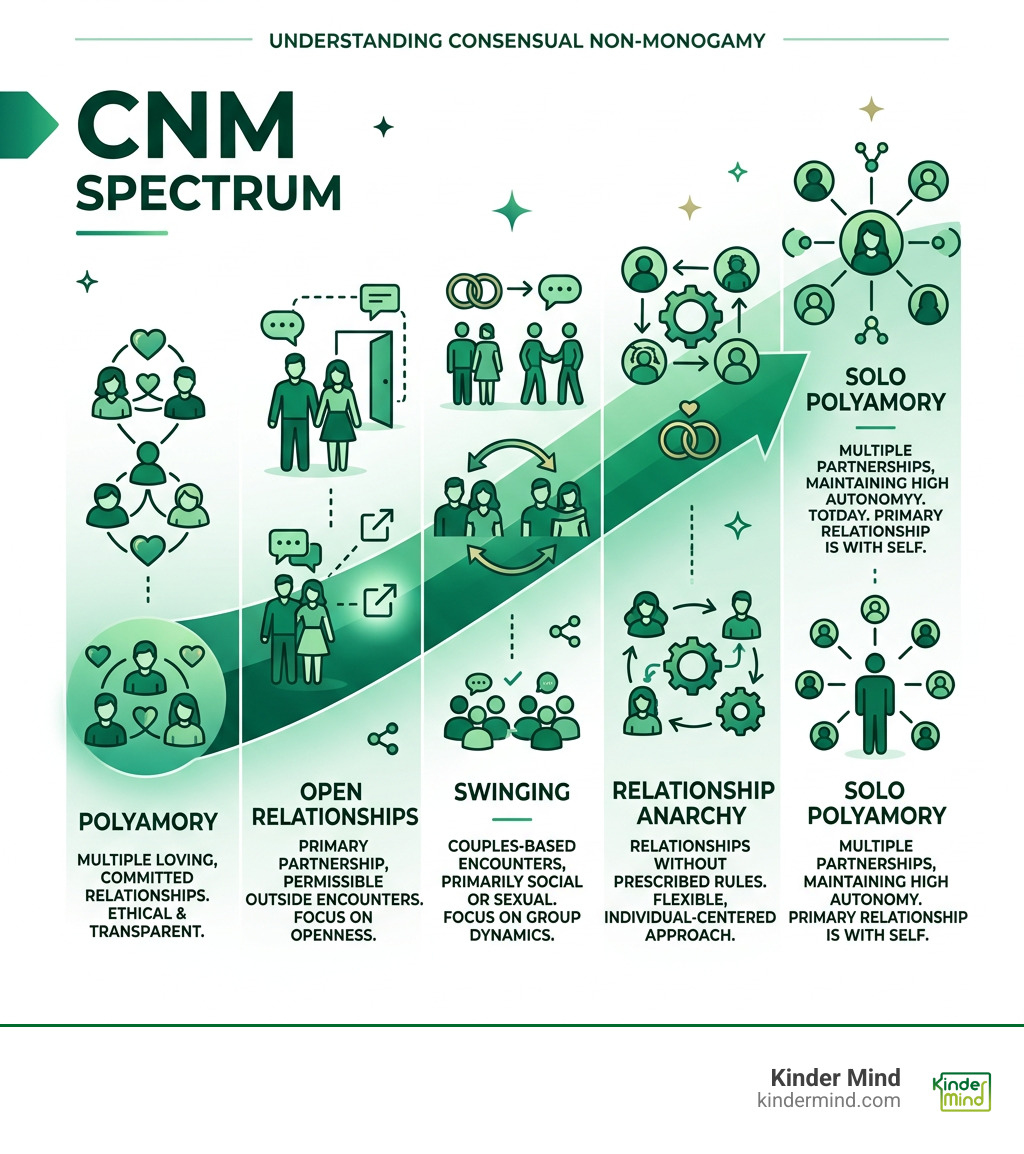
| Relationship Style | Primary Focus | Emotional Connection | Sexual Exclusivity |
|---|---|---|---|
| Polyamory | Multiple romantic/loving relationships | High; emotional intimacy is central | No |
| Swinging | Sexual variety as a couple activity | Low; usually focused on the “dyad” | No |
| Open Relationship | Primary dyad with outside sexual flings | Low to Moderate; often “sex only” | No |
| Relationship Anarchy | No inherent hierarchy or rules | Varies; based on individual autonomy | No |
Essential Polyamory Resources for Therapists and Clinical Practice
Clinical competence starts with humility and a willingness to unlearn. Therapists don’t need to be polyamorous themselves, but they do need a solid clinical toolkit to avoid making “Poly 101” mistakes in session. Cultural competence in this field means understanding the specific vocabulary (like metamours and compersion) and the unique stressors these clients face, such as the lack of legal protection or family rejection.
For those just starting, using a guide to finding poly-informed therapists can help you see what clients are looking for and how to present your own practice as a safe space.
Top Books and Polyamory Resources for Therapists
If you only read two books this year, make them these:
- Polysecure by Jessica Fern: This is the gold standard for blending polyamory and attachment. Fern challenges the idea that “secure attachment” only happens in a pair. She introduces the HEARTS model for building security within yourself and multiple partners, which is for trauma-informed care.
- Polyamory: A Clinical Toolkit for Therapists by Martha Kauppi: This book is essentially a “boot camp” for clinicians. It includes worksheets for identifying needs, desires, and biases, and it provides a roadmap for helping couples transition from monogamy (or even infidelity) to a healthy open structure.
For more interactive learning, the Trauma Informed Polyamory workshop by Clementine Morrigan is an excellent deep dive into how past wounds show up in non-monogamous dynamics.
Digital Media and Polyamory Resources for Therapists
Staying current means listening to the community. The Multiamory podcast is an invaluable resource, with over 350 episodes covering everything from “Relationship Anarchy” to “Safer Sex Education.” It’s often the first place clients go for advice, so knowing their approach to communication helps you speak the same language as your clients.
Another standout is Curious Conversations About Sex, which explores the intersections of pleasure, consent, and identity. For therapists, these podcasts function as a form of informal peer support and “immersion therapy” to get comfortable with the realities of ENM life.

Clinical Strategies for Common Polyamorous Dynamics
When a polyamorous client enters the room, the “presenting problem” is rarely polyamory itself. However, the dynamics of polyamory can amplify certain issues.
Jealousy and Compersion
Polyamory and jealousy are often linked in the public imagination, but in therapy, we treat jealousy as a secondary emotion — a “smoke detector” for underlying fears like abandonment or exclusion. Conversely, therapists can help clients cultivate compersion, which is the joy felt when seeing a partner happy with someone else. Research on compersion suggests it isn’t just a “natural gift” but a skill that can be developed through mindfulness and shifting from a “scarcity” to an “abundance” mindset regarding love.
New Relationship Energy (NRE)
NRE is the “honeymoon phase” on steroids. In polyamory, NRE with a new partner can sometimes lead to the neglect of an existing partner. Therapists can help clients manage this by setting “NRE boundaries” — ensuring they aren’t texting the new partner during dedicated date nights with their nesting partner.
Navigating the Polycule and Multi-Partner Sessions
A polycule is the entire network of interconnected people (partners, their partners’ partners, etc.). Working with these networks requires a high level of clinical flexibility.
- Metamours: These are your partner’s other partners. Conflict between metamours can be a major source of stress.
- Nesting Partners: These are partners who live together. They often have different “hierarchical” needs than non-nesting partners.
- Multi-Partner Sessions: While traditional polyamorous couples counseling focuses on two people, you may be asked to facilitate a session with three or four. It’s essential to set clear ground rules about confidentiality and “taking sides.” Ethical codes (like the ACA or AAMFT) suggest that if a conflict becomes too entrenched, it may be best to refer individuals out for their own support while you maintain the relational focus.
Transitioning from Monogamy to Polyamory
Many clients come to therapy during the “opening up” phase. This is a high-risk, high-reward time. Therapists can support this by:
- Slowing down the process: Encouraging the “Most Skipped Step” (developing individual autonomy) before dating others.
- Drafting Relationship Agreements: Moving away from “rules” (which are often about control) and toward agreements (which are about mutual consent).
- Discussing De-escalation: Sometimes, opening up a relationship means a marriage de-escalates into a co-parenting friendship while both parties seek romance elsewhere.
- Prioritizing Consent: Ensuring that consent in polyamory is ongoing, enthusiastic, and revocable.
Therapeutic Modalities and Ethical Considerations
You don’t need a brand-new modality to work with polyamory; you just need to adapt the ones you already use.
- The PACT Model: Stan Tatkin’s Psychobiological Approach to Couple Therapy is excellent for polyamory because it focuses on “secure-functioning.” In a poly context, this means all partners agree to protect each other’s safety and security, regardless of the number of people involved.
- EFT and Attachment: Emotionally Focused Therapy can be adapted to help partners identify the “protest anguish” that occurs when an attachment bond feels threatened by a new partner. By focusing on polyamory and attachment, therapists can help clients move from “insecure-anxious” to “poly-secure.”
Distinguishing Kink and BDSM from Abuse
There is a significant overlap between the polyamory and Kink/BDSM communities. A poly-competent therapist must be able to distinguish between Risk-Aware Consensual Kink (RACK) and domestic abuse.
In a trauma-informed care framework, the focus is on consent. If a client describes a power-exchange dynamic that is negotiated, has clear “safe words,” and leaves both parties feeling empowered, it is not abuse — even if it involves activities that would be harmful in a non-consensual context. Conversely, therapists must be vigilant about “poly-under-duress,” where one partner is forced into non-monogamy against their will; this is a violation of the core ENM principle of consent.
Frequently Asked Questions about Polyamory Therapy
How do I find or get listed in poly-friendly professional directories?
The most popular directory is Polyfriendly.org, which allows therapists, doctors, and lawyers to self-register as poly-affirming. You can also use the “Open Relationships/Non-Monogamy” filter on Psychology Today. However, many clients prefer specialized directories like the Kink Aware Professionals (KAP) list at kapprofessionals.org. When listing yourself, be specific about your training (e.g., “Completed Martha Kauppi’s clinical toolkit”) to build trust.
What role does attachment theory play in polyamorous relationships?
Attachment theory is the backbone of modern polyamory therapy. While traditional theory often suggests we can only “pair-bond” with one person, modern clinicians like Jessica Fern argue that we can have multiple secure attachments. Therapy often involves helping “anxiously attached” clients build self-soothing skills and helping “avoidantly attached” clients lean into the intimacy that multiple relationships require.
How should therapists handle “mono-poly” relationship mismatches?
A “mono-poly” relationship is one where one partner identifies as monogamous and the other as polyamorous. These are challenging but not impossible. Therapy focuses on “bridge-building”: finding ways for the monogamous partner to feel secure and prioritized while the polyamorous partner has the freedom they need. This often requires heavy work on boundaries, time management, and “intentional monogamy” during shared time.
Conclusion
The demand for polyamory resources for therapists is only going to grow. As the stigma around diverse relationship st