
Finding the Best Virtual Marriage Counseling Across the Country
Dr. Elizabeth Barlow, LCSW-S · 4/28/2026

Why More Couples Are Turning to Virtual Marriage Counseling Nationwide
Virtual marriage counseling nationwide is more accessible than ever — and for many couples, it’s the most practical way to get real help for their relationship. According to the American Psychological Association, telepsychology is an effective way to provide mental health services, offering a flexible alternative to traditional office visits.
Whether you’re dealing with communication issues, trust problems, or just feeling disconnected, virtual therapy gives you access to a licensed therapist — from your own home, on your schedule.
The reality is that many couples wait too long to get help. Busy schedules, limited local options, and the stigma around therapy all get in the way. Virtual counseling removes most of those barriers.
Research backs this up. A growing body of evidence shows that online therapy can be just as effective as in-person sessions. One study found that many couples actually felt more comfortable opening up in a virtual setting — less pressure, more honesty.
And it’s not just for couples in crisis. Plenty of people use online marriage counseling as a regular “relationship check-up” — before problems get bigger.
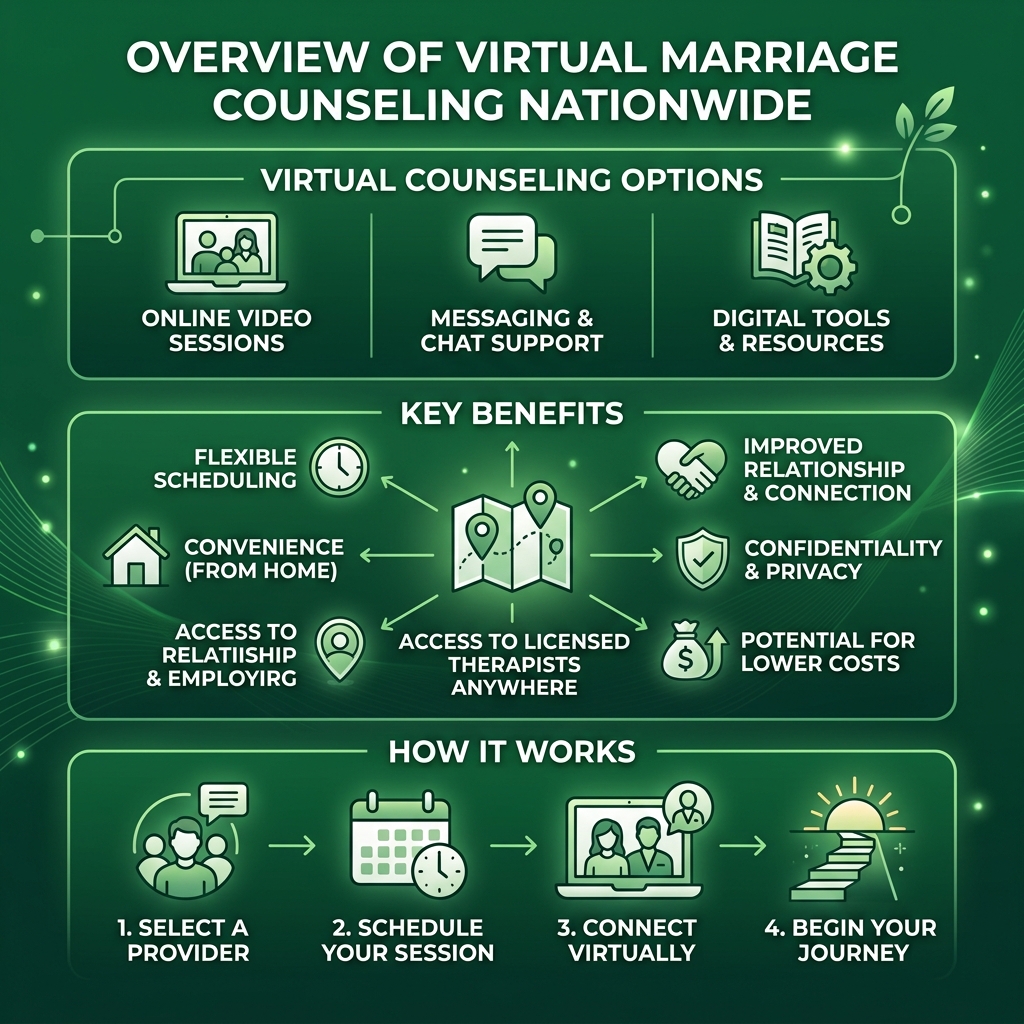
The Efficacy of Virtual Marriage Counseling Nationwide
When couples first consider virtual marriage counseling nationwide, the biggest question is usually: “Does it actually work as well as sitting on a therapist’s couch?” The short answer, backed by a significant body of medical research, is a resounding yes.
Studies involving more than 300 couples have shown that digital relationship programs significantly improve relationship functioning, boosting both satisfaction and confidence. Furthermore, research published by the National Institutes of Health indicates that virtual therapy is highly effective for treating anxiety and depression, which often go hand-in-hand with marital distress. In fact, many participants in these studies report that the digital format creates a less threatening environment, making it easier to dive into difficult topics without the “hot seat” feeling of a traditional office.
For those interested in the specifics of the digital shift, you can explore more info about virtual therapy for couples to see how these dynamics play out in real-time. The goal of any session, whether digital or physical, is to simulate face-to-face interaction so effectively that the technology fades into the background, leaving only the connection between the partners and their therapist.
Communication Methods in Virtual Care
One of the reasons virtual marriage counseling nationwide has become so successful is the sheer variety of ways couples can connect. Modern platforms don’t just offer a “one-size-fits-all” video call; they provide a multi-channel approach to healing.
- Video Conferencing: The gold standard for picking up on facial expressions and tone of voice.
- Live Chat: Perfect for couples who express themselves better through writing or need a lower-pressure entry point.
- Phone Sessions: Ideal for those with “Zoom fatigue” or those who want to focus entirely on the spoken word.
- Messaging Apps: Some services offer “unlimited messaging,” allowing you to reach out to your therapist the moment a conflict arises rather than waiting for next Tuesday at 4:00 PM.
| Method | Best For | Level of Intimacy |
|---|---|---|
| Video | Deep emotional work | High |
| Phone | Busy schedules/Privacy | Medium |
| Text/Chat | Quick check-ins/Anxious partners | Low/Moderate |
Comparing Online and In-Person Outcomes
While some worry that the lack of physical presence might hinder the “therapeutic alliance” (the bond between therapist and client), research suggests otherwise. In many cases, session retention is actually higher with virtual care because the barriers to attending—like traffic or childcare—are removed. For a deeper dive into what to expect during your first login, check out more info about virtual therapy appointments.
Core Benefits of Online Couples Therapy

The move toward virtual marriage counseling nationwide isn’t just about efficacy; it’s about lifestyle. Modern relationships are , and traditional therapy models don’t always keep up.
The primary benefit is the total elimination of travel. For couples in rural areas or states like Alaska, Montana, or Wyoming, finding a specialist in the Gottman Method or Emotionally Focused Therapy (EFT) locally might be impossible. Virtual care brings the expert to your living room. Additionally, there is a significant reduction in social stigma. You don’t have to worry about running into a neighbor in a waiting room; your privacy is entirely within your control.
Improving your bond also requires specific tools. You can learn more info about couples communication skills to supplement your sessions. Having a virtual relationship therapist means you can work on these skills in the very environment where you use them most: your home.
Accessibility and Scheduling
Traditional offices usually run 9-to-5. But when do most marital arguments happen? Often in the evenings or on weekends when work stress bleeds into home life. Virtual marriage counseling nationwide providers frequently offer:
- On-demand sessions for acute crises.
- Evening and weekend availability to accommodate working professionals.
- Multi-state licensure, ensuring that even if you travel for work, you can stay consistent with your provider.
User Experiences and Satisfaction
Real-world feedback highlights a common theme: comfort. When couples are in their own “territory,” they often feel more empowered to speak their truth. For those who feel anxious about starting therapy, the ability to have your favorite pet nearby or a cup of tea in your own mug can be a game-changer for emotional regulation.
Addressing Relationship Challenges Remotely
There is a misconception that virtual therapy is only for “light” issues. In reality, virtual marriage counseling nationwide is equipped to handle the heaviest of relationship burdens.
From marriage and divorce counseling to recovering from infidelity, licensed therapists use evidence-based frameworks to guide couples through the storm. Whether you are dealing with mismatched intimacy desires, parenting friction, or the crushing weight of financial stress, a remote setting provides a neutral ground to start resolving marital conflict.
It is also an excellent resource for those just starting out. Engaging in virtual premarital sessions can help “tie the knot without the tangle” by addressing expectations before they become resentments.
Preventing Divorce and Improving Satisfaction
Can a screen really save a marriage? Statistics suggest it can. With 70-80% of actively engaged couples acknowledging deeper connections and enhanced trust after therapy, the medium matters less than the commitment to the process. Consistent sessions help partners move beyond the blame game and focus on long-term relationship health.
Specialized Support Options
Not every couple needs traditional weekly therapy. Some require specialized interventions:
- Discernment Counseling: For couples where one person is “leaning out” of the marriage and the other is “leaning in.” You can find a complete guide to discernment counseling to help navigate this crossroads.
- LGBTQ+ Affirming Care: Specialized support that understands the unique societal and familial pressures faced by the LGBTQ+ community.
- Solution-Focused Sessions: Targeted, short-term sessions designed to solve a specific problem, like a move or a career change.
Understanding the difference between discernment counseling and couples therapy is crucial for choosing the right path for your specific situation.
Navigating Costs and Insurance Coverage
One of the biggest hurdles to seeking help is the perceived cost. However, virtual marriage counseling nationwide has introduced more flexible financial models than ever before.
Many providers now function as out-of-network entities but provide “superbills.” These are detailed receipts you can submit to your insurance for potential reimbursement. For those looking for specific couples therapy services, it’s important to check if your plan covers “Behavioral Health” or “Telehealth.”
Cost and Insurance for Virtual Marriage Counseling Nationwide
Affordability is a core pillar of modern care. Depending on your location—whether you’re in New York, Texas, or Florida—payment options often include:
- Employer Benefits: Many Employee Assistance Programs (EAPs) cover a set number of therapy sessions for free.
- Co-pay Structures: If your provider is in-network, you might only owe a small co-pay per session.
- Reduced-Rate Plans: Some organizations, like Kinder Mind, focus on providing accessible care through sliding scales or insurance-friendly models to ensure that marital and premarital specialties are available to everyone, regardless of budget.
How to Choose the Right Provider
With so many options for virtual marriage counseling nationwide, picking the right person can feel overwhelming. You aren’t just looking for a “nice person”; you’re looking for a clinical expert.
Start by checking credentials. A Licensed Marriage and Family Therapist (LMFT) has specific training in relationship dynamics that a general counselor might not. Look for experience in evidence-based couples therapy modalities such as:
- The Gottman Method: A science-based approach focused on “The Sound Relationship House.”
- Emotionally Focused Therapy (EFT): Focusing on attachment bonds and emotional security.
How to Choose the Right Virtual Marriage Counseling Nationwide
Most platforms use matching algorithms to suggest therapists based on your specific needs (e.g., “we need help with infidelity” or “we are a multicultural couple”). However, don’t rely solely on the algorithm. Take advantage of initial consultations to see if you “click” with the therapist.
Security is also paramount. Ensure the platform is HIPAA-compliant. This means they use bank-level encryption to keep your video calls and messages private.
Technology and Privacy Requirements
To get the most out of your sessions, you’ll need:
- Reliable Internet: A stable connection prevents awkward “frozen face” moments during deep emotional breakthroughs.
- A Private Space: Both partners need to feel they can speak freely without being overheard by children or roommates.
- Device Compatibility: Most services work on smartphones, but a laptop or tablet is often better for seeing your therapist’s non-verbal cues.
Frequently Asked Questions about Virtual Couples Therapy
Is online marriage counseling as effective as in-person sessions?
Yes. Research consistently shows that the outcomes for relationship satisfaction and conflict resolution are comparable. Some couples actually prefer it because they feel more relaxed in their own environment.
Can we attend sessions from different physical locations?
Absolutely. This is one of the standout features of virtual marriage counseling nationwide. If one partner is traveling for work or the couple is currently trial-separating in different homes, you can both log into the same secure “room” with your therapist.
How do we know if our therapist is properly licensed?
Reputable platforms vet their therapists rigorously. You should be able to see their license type (LMFT, LCSW, PhD) and their state of licensure on their profile. Most “nationwide” services employ therapists who hold licenses in multiple states to ensure they can legally practice wherever you are located.
Conclusion
The journey to a healthier relationship doesn’t require a long commute or a crowded waiting room. Virtual marriage counseling nationwide has transformed relationship support into something that fits into your life, rather than something you have to schedule your life around.
By choosing a provider that prioritizes both clinical expertise and accessibility, you are taking a proactive step toward long-term happiness. Whether you are in Alabama, California, or anywhere in between, help is just a click away.
If you’re ready to strengthen your bond, explore
