
Online Couples Counseling: Your Guide to Virtual Support
Kinder Mind · 12/22/2025

Why Virtual Relationship Therapy Is Changing How Couples Get Support
A virtual relationship therapist is a licensed mental health professional providing couples counseling via secure video, messaging, or phone. This modern approach allows you to access evidence-based treatment for communication issues, trust rebuilding, and other challenges from home, often at a lower cost than in-person visits.
Key Facts About Virtual Relationship Therapists:
- Licensed professionals – LMFTs, LCSWs, or psychologists with specialized couples training.
- Same effectiveness – Research shows online therapy is as effective as in-person sessions.
- Multiple formats – Video sessions, messaging, phone calls, or a combination.
- Flexible scheduling – Evening and weekend appointments are more available.
- Privacy-focused – Uses HIPAA-compliant platforms with encrypted communication.
- Accessible pricing – Often covered by insurance; self-pay rates are typically lower.
The shift to online therapy revealed a surprising benefit: for many couples, it’s more convenient, private, and effective than traditional office visits. You can skip the commute and childcare arrangements, attending sessions from your living room or even different locations if you’re long-distance. Many couples feel more comfortable discussing sensitive topics from their own space.
Research confirms its success. The American Association of Marriage and Family found over 97% of clients felt they got the help they needed from couples therapy. Studies also show 90% of couples report improved emotional health, with nearly two-thirds seeing better physical health.
Whether you’re facing communication breakdowns, rebuilding trust, or simply want to strengthen your connection, a virtual relationship therapist offers expert guidance without the logistical hassles of traditional therapy.
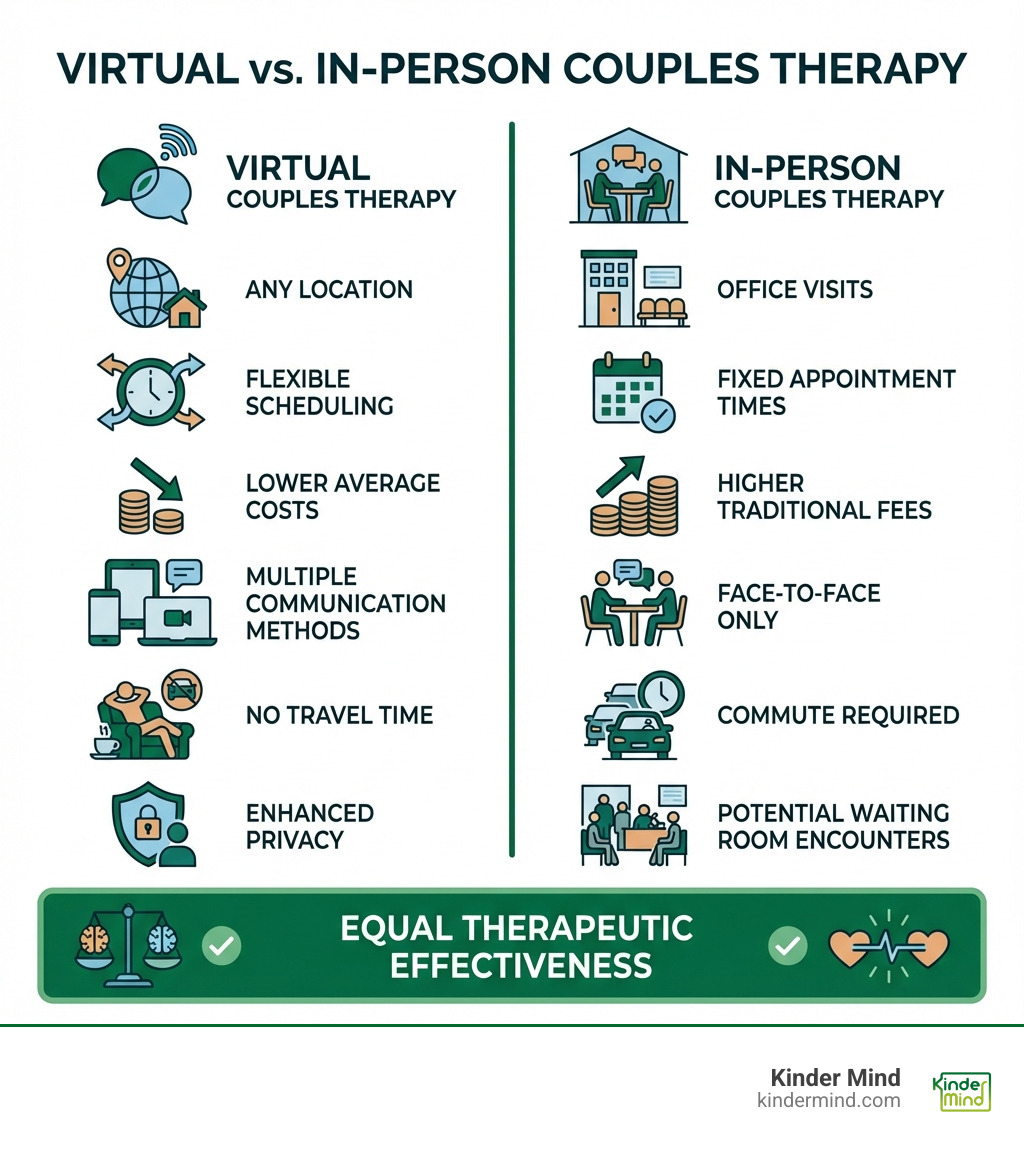
The Effectiveness and Benefits of Online Couples Therapy
Online couples therapy removes common obstacles to getting help. Instead of fighting traffic for an appointment, a virtual relationship therapist allows you to connect during a lunch break, after the kids are asleep, or even while traveling. This convenience makes it possible for busy professionals, parents, and those with demanding schedules to get consistent support without adding more stress.
The flexibility extends to scheduling, with many virtual therapists offering evening and weekend appointments. If you’re in a long-distance relationship, you can join from different locations. Financially, online therapy is often more affordable due to lower overhead for therapists. Many platforms accept insurance, and you can often use HSA or FSA accounts.
A significant, unexpected benefit is privacy. With no waiting rooms, many couples feel more comfortable and open up more honestly from their own homes. This sense of safety can lead to deeper, more productive sessions.
Here’s how virtual and in-person therapy compare:
| Feature | Virtual Couples Therapy | In-Person Couples Therapy |
|---|---|---|
| Location | Anywhere with internet access | Therapist’s physical office |
| Convenience | High; no travel time, flexible scheduling | Moderate; requires travel to and from office |
| Cost | Often more affordable; lower overhead for providers | Generally higher |
| Communication | Video, audio, messaging, shared digital spaces | Primarily face-to-face verbal communication |
| Privacy | Improved; no waiting rooms, discreet access from home | Moderate; potential for encounters in waiting rooms |
| Accessibility | High; overcomes geographical barriers, physical limitations | Limited by location and physical access |
| Flexibility | High; easier to schedule around busy lives, different time zones | Moderate; fixed appointments, less adaptable |
| Effectiveness | Just as effective for many concerns | Highly effective |
Is Online Couples Counseling Really Effective?
Yes. Research consistently shows that online couples counseling is just as effective as traditional in-person therapy. The quality of the therapeutic relationship and your commitment are what drive change, not the location.
The American Association of Marriage and Family found that over 97% of clients felt they received the help they needed. Furthermore, studies show 90% of couples report improved emotional health, and nearly two-thirds see better physical health as relationship stress decreases. Many couples prefer virtual sessions, feeling more comfortable and engaged in their own space, which can lead to faster progress.
What Issues Can Be Addressed?
A virtual relationship therapist can help with nearly any challenge a couple faces. The goal is to identify unhealthy patterns, learn new skills, and strengthen your connection. Common issues include:
- Communication Breakdown: Learn to express needs and listen effectively without discussions turning into arguments.
- Conflict Resolution: Develop healthy strategies for managing disagreements without yelling or shutting down.
- Rebuilding Trust: Get structured support to process betrayal (infidelity, financial issues) and decide how to move forward.
- Intimacy Issues: Address challenges with emotional and physical closeness in a private, comfortable setting.
- Premarital Counseling: Align on major life topics like finances, family, and careers before getting married.
- Navigating Life Transitions: Get support for major changes like a move, career shift, or becoming empty nesters.
- Parenting Differences: Find common ground on discipline, screen time, and other parenting challenges to create a united front.
- Feeling Disconnected: Rekindle the spark when you feel more like roommates than partners.
- External Stressors: Learn to protect your relationship from the impact of job pressure, financial strain, or health issues.
How to Find and Choose a Virtual Relationship Therapist
Finding the right virtual relationship therapist is a straightforward process on most online platforms.

You’ll typically start with a questionnaire about your relationship and goals, which helps match you with therapists specializing in your concerns. You can then browse therapist profiles, which detail their background, training, and approach. Many offer video introductions to give you a sense of their style.
Take advantage of initial consultations to “interview” a few therapists and find someone you both connect with. Verifying insurance is also a key step. Many platforms work with major providers, and you can often check your coverage directly on the site. If you’re self-paying, ask about rates and consider using your HSA or FSA accounts.
What Qualifications Should a Virtual Relationship Therapist Have?
When trusting someone with your relationship, ensure they have the right expertise. Couples therapy requires specialized training.
First, your therapist must have state licensing in the state where you are located during your session. This is a legal and professional standard. Kinder Mind operates in many states, including Alabama, Alaska, Arizona, Arkansas, California, Colorado, Connecticut, Delaware, Florida, Georgia, Hawaii, Idaho, Illinois, Indiana, Iowa, Kansas, Kentucky, Louisiana, Maine, Maryland, Massachusetts, Michigan, Minnesota, Mississippi, Missouri, Montana, Nebraska, Nevada, New Hampshire, New Jersey, New Mexico, New York, North Carolina, North Dakota, Ohio, Oklahoma, Oregon, Pennsylvania, Rhode Island, South Carolina, South Dakota, Tennessee, Texas, Utah, Vermont, Virginia, Washington, West Virginia, Wisconsin, and Wyoming.
Look for credentials like LMFT (Licensed Marriage and Family Therapist), the gold standard for relationship dynamics. LCSWs (Licensed Clinical Social Workers) and Psychologists with extra couples therapy training are also excellent choices.
Also, consider their training in evidence-based approaches like the Gottman Method (practical communication tools) or Emotionally Focused Therapy (EFT) (building emotional bonds). Most importantly, find a therapist with experience in your specific concerns, whether it’s infidelity, premarital counseling, or LGBTQ+ relationship issues. Avoid unlicensed “relationship coaches” for clinical issues, as they lack the necessary mental health training.
Understanding Costs and Insurance
Online therapy is often more affordable than traditional office visits. If you have insurance, many platforms partner with major providers, meaning you may only owe a standard copay. Check if a therapist is in-network (lower cost) or out-of-network (you may pay upfront and seek reimbursement).
For those using self-pay rates, online therapy is still typically more accessible. You can also use HSA (Health Savings Account) and FSA (Flexible Spending Account) funds to cover therapy, making it a tax-advantaged expense.
The best way to understand your costs is to use the verification tools on therapy platforms or contact your insurance provider directly. Don’t let cost be a barrier; there are many ways to make quality couples therapy fit your budget.
Your Virtual Therapy Journey: What to Expect and How to Prepare
A little preparation can help you get the most out of virtual couples therapy. Creating the right environment is key for meaningful conversations.

Find a neutral, private space where you won’t be interrupted. This creates a safe zone where you both can be vulnerable. Using headphones helps maintain privacy and focus. On the tech side, you just need a reliable internet connection and a device with a camera. Ensure your device is charged and close other apps to prevent distractions and improve performance. Most platforms are simple to use, often requiring just a click on a link to join.
What Happens During the First Session?
Your first session is a welcoming introduction. Your virtual relationship therapist will explain how therapy works, cover confidentiality, and outline their approach.
You’ll be invited to share your relationship history—how you met, your strengths, and current challenges. It’s normal for partners to have different perspectives. You’ll also discuss your individual goals for therapy.
This session is also about checking for a good fit. Do you feel heard and comfortable with the therapist’s style? By the end, the therapist will outline a preliminary treatment plan, giving you a roadmap for the work ahead.
How to Make the Most of Your Sessions
Active engagement is crucial for success.
- Set the right environment: Choose a quiet, comfortable, and private space.
- Minimize distractions: Silence your phone and close unnecessary tabs. Give the session your full attention.
- Use headphones: They improve privacy and help you focus on the conversation.
- Show up consistently: Regular attendance builds momentum and leads to better outcomes.
- Do the homework: The real change happens when you practice the skills you learn between sessions.
- Be open and honest: Your therapist is a neutral party. The more transparent you are, the more they can help.
How Platforms Ensure Privacy and Confidentiality
Reputable virtual therapy platforms prioritize your privacy. They are legally required to be HIPAA compliant, following strict standards for protecting your health information, as detailed by the HHS.
Data encryption scrambles your information, making video calls and messages unreadable to outsiders. Platforms use secure video and messaging systems designed for healthcare, which are far more secure than standard chat apps.
Additionally, licensed therapists are bound by strict ethical obligations of confidentiality, just as they are in an office. These layers of security create a safe environment for you to speak freely and honestly.

