
A Comprehensive Guide to Therapy Payment Plans
Dr. Elizabeth Barlow, LCSW-S · 5/26/2026

Why Therapy Payment Plans Matter for Your Mental Health Access
Therapy payment plans are structured arrangements that let you spread the cost of mental health care over time — instead of paying everything upfront.
Here’s a quick overview of your main options:
| Payment Plan Type | How It Works | Best For |
|---|---|---|
| Short-term installment | Split balance into payments over a few weeks or months, often 0% interest | One-time or unexpected balances |
| Extended plan | Spread costs over 24–60 months, typically interest-free | Ongoing or long-term therapy needs |
| Sliding scale | Fees adjusted based on your income level | Uninsured or low-income clients |
| Insurance + payment plan | Pay remaining balance (copay, deductible) in installments | Insured clients with high out-of-pocket costs |
| HSA/FSA | Use pre-tax dollars to cover therapy costs | Clients with employer benefits |
Getting mental health care should never come down to whether you can afford it this month. But for millions of people, that’s exactly the reality.
A 2023 survey found that 42% of Americans said cost was a major barrier to accessing mental health care. High out-of-pocket expenses and gaps in insurance coverage were the top reasons people went without support they needed.
Even people with insurance aren’t always protected. Deductibles, copays, and out-of-network fees can stack up fast — turning what feels like “covered” care into a serious financial strain.
The good news? There are more flexible options than most people realize. Payment plans, sliding scale fees, tax-advantaged accounts, and other alternatives have made it possible for far more people to access consistent therapy — on terms that actually fit their lives.
This guide walks you through all of it, clearly and without jargon.
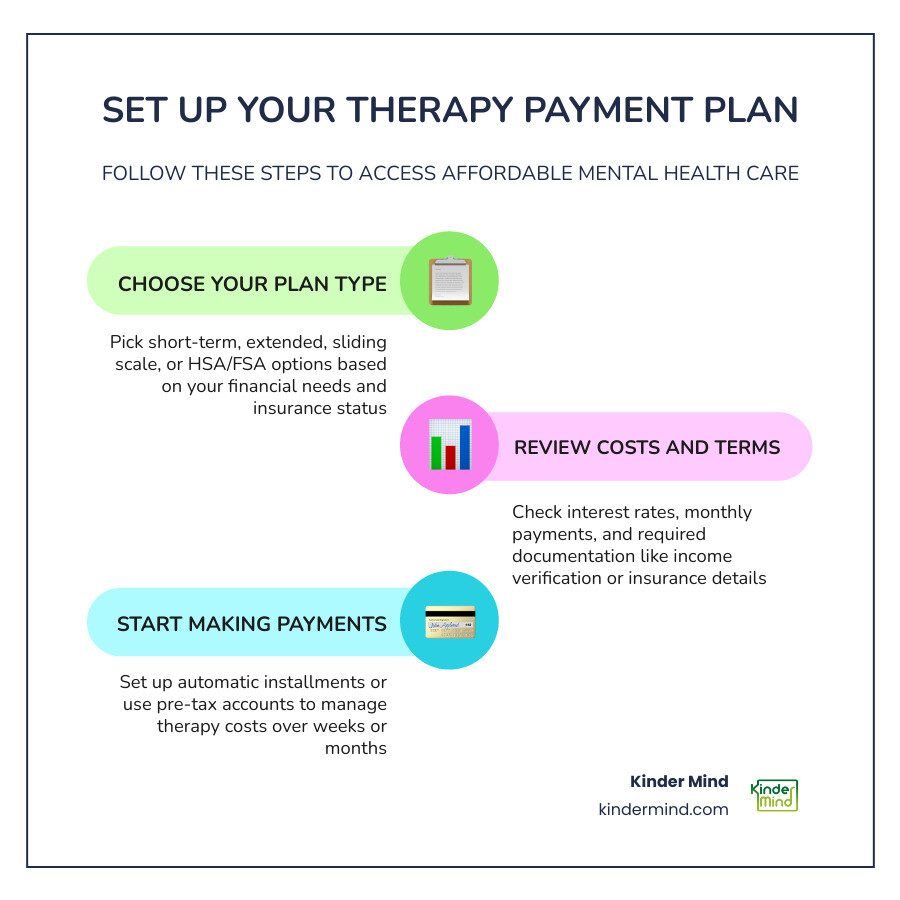
Therapy payment plans definitions:
Understanding the Main Types of Therapy Payment Plans

When you start looking into how to manage the costs of care, you’ll find that therapy payment plans aren’t one-size-fits-all. Providers often offer different “tracks” depending on how much you owe and how long you need to pay it back.
The primary goal of these plans is to ensure that a sudden change in your financial situation—or a high deductible—doesn’t force you to stop your sessions. Research indicates that 58% of mental health providers offer some form of payment plan or sliding scale option to make their services more accessible.
| Plan Feature | Short-Term Plans | Extended Plans | Sliding Scale |
|---|---|---|---|
| Duration | 2–6 weeks or up to 24 months | 24 to 60 months | Ongoing |
| Interest Rate | Typically 0% | Often 0% (in-house) | N/A (Reduced fee) |
| Credit Check | Rarely required | Sometimes required | No |
| Best Used For | Catching up on a few missed invoices | Large balances or specialized treatments | Long-term affordability |
Specialized treatments, such as TMS therapy financing, often utilize these structured plans to help patients manage the costs of more intensive clinical protocols.
Short-Term and Extended Therapy Payment Plans
Short-term plans are designed for speed and simplicity. Many modern practices use systems that mirror services like Klarna or Affirm, allowing you to split a balance into biweekly or monthly installments. These are excellent for handling “invoice lag”—those times when insurance claims take 30 to 45 days to process and suddenly three invoices hit your portal at once.
Extended plans are the “marathon” version of financing. Some healthcare organizations offer terms reaching up to 60 months with 0% interest. These plans often require only a verbal commitment and no setup fees, making them a low-stress way to manage larger balances. If you are paying out of pocket, you can explore Payment Plan options for self-pay to see how these installments can be customized to your monthly budget.
Sliding Scale and Membership Models
If a standard payment plan still feels out of reach, a sliding scale might be the answer. This is where a therapist adjusts their hourly rate based on your household income and family size, often using the Federal Poverty Level as a guide. For example, a therapist might charge their full rate to someone earning a high salary but offer a significantly reduced rate to a student or someone between jobs.
Membership models are a newer trend. Similar to a gym membership, you pay a set monthly fee that covers a specific number of sessions (e.g., 4 sessions per month). This provides predictable monthly costs and often comes at a lower “per-session” price than paying as you go. You can find more details on these and other methods in our guide on 7 Ways to Find Affordable Mental Health Care Today.
How Payment Plans Work with Insurance and Private Pay

Many people assume that if they have insurance, they don’t need a payment plan. However, the reality of modern healthcare involves premiums, copays, and high deductibles. In 2023, approximately 35% of therapy clients used out-of-network benefits or self-pay options with payment plans, which actually led to an average savings of 25% compared to standard rates.
Understanding how your plan interacts with mental health benefits is crucial. You can find resources through state agencies like DORA in Colorado to understand your rights regarding behavioral health coverage. If you find that your deductible is higher than expected, you can often set up Payment Plan options for insurance to pay off that deductible in smaller chunks throughout the year.
Navigating Out-of-Network Benefits and Superbills
If your therapist doesn’t accept your specific insurance, you aren’t necessarily stuck paying the full price forever. Many plans offer out-of-network (OON) benefits. In this scenario, you pay the therapist’s fee upfront and they provide you with a superbill—an itemized receipt with all the clinical codes your insurance needs.
You then submit this superbill to your insurance company for reimbursement. Depending on your plan, they might mail you a check for 50% to 80% of the cost. To make this work, it’s vital to know the Questions to Ask Your Insurance Provider About Therapy before you start, so you aren’t surprised by a denied claim later.
Good Faith Estimates and Transparency
Thanks to the “No Surprises Act,” providers are now required to give “Good Faith Estimates” to clients who are uninsured or self-paying. This document outlines the expected costs of your treatment before you even begin. This level of transparency in insurance and self-pay options ensures you can plan your finances without fear of “hidden fees” appearing on your bill three months down the line.
Benefits and Drawbacks of Financing Mental Health Care
The most significant benefit of therapy payment plans is improved health. A 2024 study found that 67% of therapy clients who used payment plans or sliding scale fees reported improved adherence to treatment compared to those paying full fees upfront. When you aren’t stressed about how to pay for next Tuesday’s session, you’re more likely to show up and do the work.
Benefits:
- Consistency: You don’t have to “pause” therapy when money is tight.
- Privacy: Private pay options (often used with payment plans) mean your insurance company doesn’t always have access to your clinical notes or diagnosis.
- Flexibility: You can choose the therapist that fits you best, rather than just the one who is in-network.
Potential Drawbacks:
- Debt Accumulation: If you aren’t careful, small monthly payments can add up over time.
- Credit Impact: While many in-house plans don’t require credit checks, failing to pay a third-party financing plan (like a medical credit card) could negatively impact your credit score.
- Commitment: Some plans might require you to commit to a certain number of sessions upfront.
For a deeper dive into balancing your budget with your well-being, check out Mind Over Money: Your Guide to Affordable Mental Health Care.
Alternatives to Traditional Payment Arrangements
If a standard installment plan doesn’t feel right for you, there are several other ways to make care affordable. Many people overlook benefits they already have through their employers or specialized programs.
For instance, paying for services at community centers often involves different grant-funded subsidies that function differently than a standard bank-style payment plan.
- Health Savings Accounts (HSA) & Flexible Spending Accounts (FSA): These allow you to use pre-tax dollars to pay for therapy. Since the money is taken out of your paycheck before taxes, it’s like getting a 20-30% discount on every session.
- Employee Assistance Programs (EAP): Many companies offer 3 to 10 free therapy sessions per year. These are completely separate from your health insurance and are a great way to bridge the gap while you set up a long-term payment arrangement.
Intern Programs and Reduced-Rate Care
One of the best-kept secrets in affordable mental health is the use of therapy interns. These are graduate students in the final stages of their Master’s or Doctoral degrees. They are heavily supervised by experienced, licensed clinicians and often offer sessions at a fraction of the standard cost—sometimes as low as a typical insurance copay. This is one of the best free or low-cost online therapy options for those on a strict budget.
Digital Tools for Managing Therapy Payment Plans
In 2026, managing your healthcare costs is easier than ever thanks to patient portals. Platforms like MyChart allow you to self-enroll in payment plans with just a few clicks. You can consolidate all your balances into one monthly payment and set up “Autopay” so you never have to think about it. If you’re looking for a seamless experience, you can explore Payment Plan options for Kinder Care to see how digital integration makes paying for therapy as simple as paying for a streaming service.
Frequently Asked Questions about Therapy Financing
Can I use a payment plan if I have a high-deductible insurance plan?
Yes! In fact, this is one of the most common uses for therapy payment plans. If you have a $3,000 deductible, you might owe the full cost of your sessions until that amount is met. A payment plan allows you to spread that $3,000 over 12 months rather than trying to pay it all in the first few months of the year.
Do therapy payment plans typically require a credit check?
It depends on the provider. “In-house” plans (where you pay the clinic directly) rarely require a credit check and usually have 0% interest. However, third-party medical financing companies or specialized medical credit cards will perform a credit check and may charge interest if the balance isn’t paid within a certain window.
What happens if I miss a payment on my therapy installment plan?
Most therapists are compassionate and will work with you if you miss a payment. However, consistent missed payments might lead to a pause in treatment or the balance being sent to a collections agency. It is always best to communicate with the billing department early if you think you’ll miss a due date.
Conclusion
At Kinder Mind, we believe that mental health support should be a fundamental right, not a luxury reserved for those who can pay upfront. By offering accessible, in-person and virtual services across the United States—from Alabama to Wyoming—we aim to destigmatize care and remove the financial barriers that stand in your way.
Whether you are looking for sliding scale options, need help navigating your insurance deductible, or want to set up an interest-free installment plan, there is a path forward. You don’t have to choose between your financial stability and your mental well-being.
Ready to take the next step? Start your journey with affordable children and teen therapy today and find a plan that works for your family.
