
Mind Over Money: Your Guide to Affordable Mental Health Care
Dr. Elizabeth Barlow, LCSW-S · 5/1/2026

Therapy Is More Affordable Than You Think
Reduced cost therapy is real, it’s widely available, and it can work just as well as full-price care.
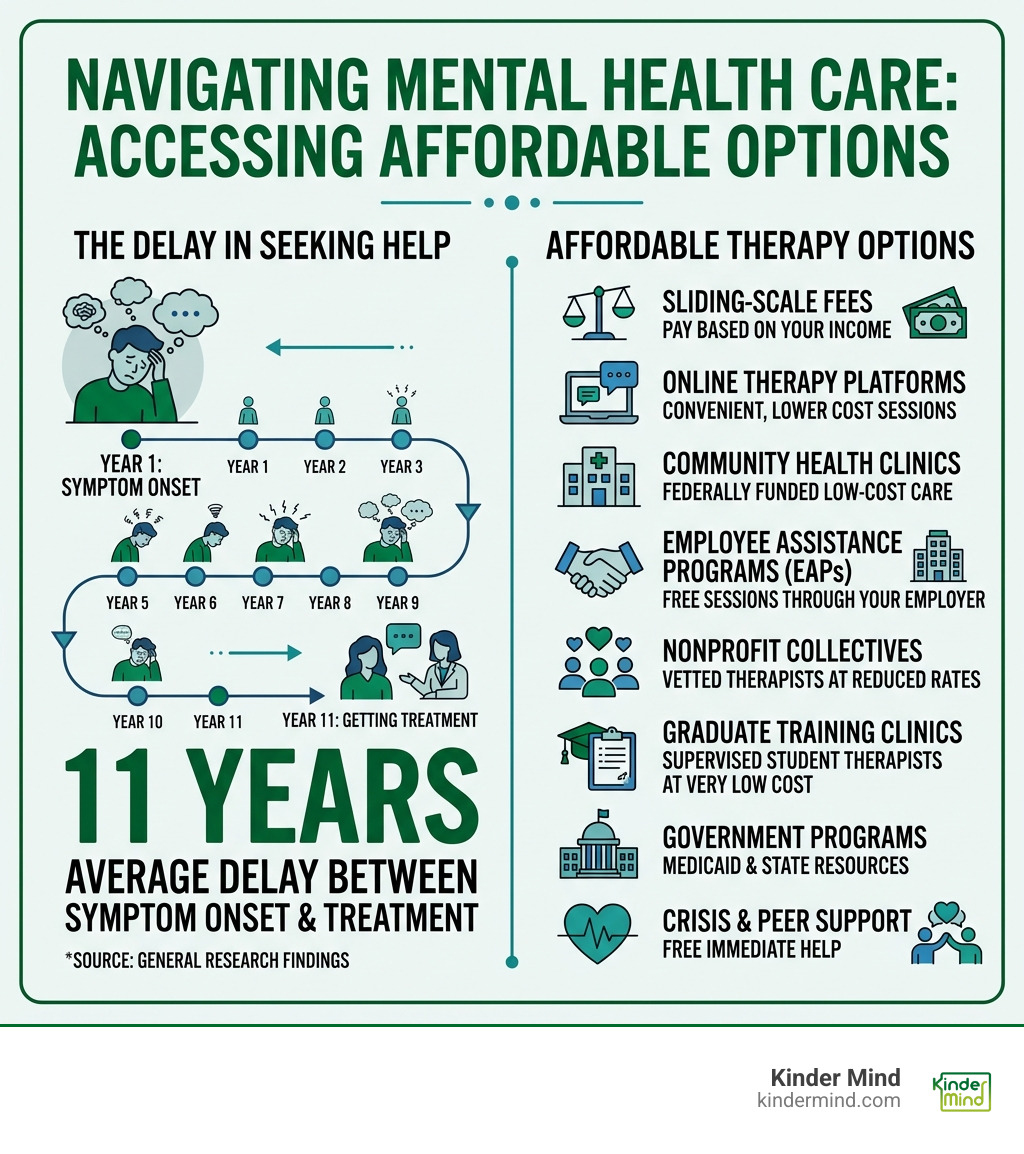
Here are the main ways to access it:
- Sliding-scale fees — pay based on your income, not a fixed rate
- Online therapy platforms — often significantly cheaper than in-person sessions
- Community health clinics — federally funded centers that offer low or no-cost care
- Employee Assistance Programs (EAPs) — free sessions through your employer
- Nonprofit collectives — networks of vetted therapists offering reduced rates
- Graduate training clinics — supervised student therapists at very low cost
- Government programs — Medicaid, state mental health agencies, and SAMHSA resources
- Crisis and peer support — free, immediate help when you need it most
Getting mental health support shouldn’t depend on the size of your paycheck. But for millions of people, cost is the single biggest reason they don’t get help.
Over 60 million U.S. adults received mental health care in 2024 — yet only 47% of adults with mental health conditions actually got treatment in 2021. The gap isn’t about awareness. It’s mostly about money and access.
What makes this especially serious? Research shows there’s an average delay of 11 years between when someone first experiences mental health symptoms and when they finally get treatment. That’s more than a decade of struggling — often simply because care feels out of reach financially.
The good news is that the landscape has changed. There are now more pathways to affordable mental health care than ever before, from income-based fee structures to online platforms to community programs built specifically for people without insurance.
This guide walks you through all of them — clearly, without jargon.
Reduced cost therapy terms you need:
Understanding the Financial Landscape of Mental Health Care
To navigate reduced cost therapy, one must first understand why the “sticker price” of mental health care looks the way it does. For many, seeing a therapist in a private practice setting can feel like a luxury reserved for the wealthy.
The average cost of a single therapy session in the United States typically falls within a broad range, often starting around sixty dollars and climbing well over two hundred dollars per hour. In high-cost-of-living areas like New York City, these rates can even double. These prices aren’t arbitrary; they reflect the therapist’s extensive training, the overhead of maintaining a private office, and the specialized nature of their expertise.
However, these market rates often create a barrier for the average person. This is where the distinction between in-person and online therapy becomes vital. Traditional in-person sessions usually carry higher fees due to the physical space required. In contrast, online therapy models often provide a more budget-friendly alternative. By eliminating the need for a physical office and reducing administrative paperwork, virtual platforms can offer care at a fraction of the traditional cost.
When exploring these options, it is helpful to understand the different payment structures available. Many providers offer a Payment Plan / Self-Pay option for those who do not have insurance or prefer to keep their mental health records outside of an insurance company’s database. Conversely, utilizing a Payment Plan / Insurance can drastically reduce out-of-pocket expenses to a simple copayment.
How to Access Reduced Cost Therapy Through Sliding Scales
One of the most effective ways to secure reduced cost therapy is through a “sliding scale” fee structure. This is not a “discount” in the traditional sense; rather, it is an equity-based payment model designed to make care accessible regardless of an individual’s financial standing.
In a sliding scale model, the therapist adjusts their hourly rate based on the client’s income and household size. This means a person earning a modest salary might pay significantly less for the exact same session as someone with a high-income corporate job. Many therapists and clinics use the Federal Poverty Guidelines as a benchmark to determine these rates fairly.
For example, a therapist might have a standard rate, but for a client living at or near the poverty line, they may lower that rate to a level that fits within a tight monthly budget. This ensures that the therapist can still sustain their practice while fulfilling a mission to help those in need.
In some states, providers are specifically recognized for their commitment to these models. For instance, individuals in the Southwest can look into Arizona Sliding Fee Scale Providers to find clinics that are legally required or mission-driven to offer these adjusted rates.
Qualifying for a Reduced Cost Therapy Plan
Qualifying for a sliding scale or a reduced cost therapy plan is usually a straightforward process, though it does require some transparency. Most providers will ask for basic information regarding household income and the number of dependents.
The verification process might involve showing a recent pay stub, a tax return, or a simple self-declaration of income if the individual is currently unemployed or working in the gig economy. The goal is not to be intrusive, but to ensure that the limited number of reduced-fee slots are going to those who truly need them.
For those looking for a structured approach to this, the Payment Plan / Kinder Care offers a clear path toward accessing care that respects the client’s financial reality without sacrificing the quality of the clinical experience.
Finding Reduced Cost Therapy in Your Local Area
Locating these services requires a bit of detective work, but the resources are often closer than they appear. Community mental health clinics are a primary source of reduced cost therapy. These centers often receive government funding to provide services to the local population, regardless of their ability to pay.
Training centers and university clinics are another “hidden gem.” These are facilities where graduate students, who are in the final stages of their clinical training, provide therapy under the close supervision of licensed, experienced professionals. Because the therapists are still in training, the rates are often incredibly low.
Furthermore, local government mental health services and state mental health departments maintain directories of providers who offer financial assistance. If someone is unsure where to start, calling a state’s 2-1-1 line or visiting their department of health website can provide a list of local clinics that operate on a nonprofit or subsidized basis.
Leveraging Insurance and Employee Benefits for Affordable Care
Many people sit on a goldmine of mental health benefits without even realizing it. If an individual has health insurance through an employer or a private plan, the cost of therapy may already be largely covered.
Employee Assistance Programs (EAPs)
Before dipping into personal savings, one should check if their employer offers an Employee Assistance Program (EAP). EAPs are separate from standard health insurance. They typically offer a set number of free counseling sessions (often ranging from three to ten) per issue, per year. These sessions are completely confidential and are paid for entirely by the employer. It is an excellent way to bridge the gap while looking for long-term reduced cost therapy options.
Maximizing Your Mental Health Coverage
When using traditional insurance, the key is to understand the difference between in-network and out-of-network providers. An in-network provider has a contract with the insurance company to provide services at a pre-negotiated rate, which usually results in a much lower copay for the client.
It is essential to ask the right questions to avoid surprise bills. Using a guide like Questions to Ask Your Insurance Provider About Therapy can help individuals clarify their deductible, their copay, and whether they need a referral from a primary care doctor first.
For those who prefer the convenience of their own home, exploring Online Therapy That Takes Insurance can combine the affordability of insurance with the accessibility of virtual care. Major carriers often provide extensive coverage for these services:
Utilizing Specialized Military and Veteran Benefits
Veterans and active-duty military members have access to some of the most robust mental health resources available. Tricare, the healthcare program for uniformed service members and their families, offers comprehensive mental health coverage with various tiers depending on the plan:
Beyond Tricare, the Department of Veterans Affairs (VA) and various veteran-focused nonprofits provide specialized care for PTSD, transition stress, and other service-related concerns, often at no cost to the veteran.
Community, Government, and Nonprofit Resources
When private insurance isn’t an option, community and government resources step in to fill the gap. Federally Qualified Health Centers (FQHCs) are community-based organizations that provide comprehensive primary care and mental health services. They are required by law to offer a sliding fee scale based on a patient’s ability to pay.
State agencies also play a massive role. For example, the Free and low-cost help – Colorado page is a perfect example of how state governments aggregate resources for their residents. Similar resources exist across the country, such as:
- Free or Low-Cost Counseling in Alabama
- Free or Low-Cost Counseling in Alaska
- Free or Low-Cost Counseling in Arkansas
- Free or Low-Cost Counseling in Connecticut
- Free or Low-Cost Counseling in Delaware
Graduate Student Training Clinics
As mentioned earlier, university-based clinics are a powerhouse for reduced cost therapy. These clinics are where the next generation of psychologists and counselors cut their teeth. Because the students are being graded and supervised by senior faculty, the quality of care is often exceptionally high. They are often more up-to-date on the latest evidence-based practices than clinicians who have been out of school for decades.
Support for Marginalized and Priority Groups
Specific communities often face unique barriers to care, from cultural stigma to a lack of representative providers. Fortunately, many nonprofits focus exclusively on these groups.
For BIPOC (Black, Indigenous, and People of Color) communities, finding culturally competent care is essential. Statistics show that 77% of mental health counselors identify as White, which can make finding a therapist who understands specific cultural nuances difficult. Organizations like the Open Path Psychotherapy Collective and others work to connect marginalized individuals with therapists who offer reduced rates and culturally responsive care.
Students and educators also have unique pathways to support. Between the stresses of the classroom and the financial constraints of academia, accessing help is vital. Resources like How Students and Teachers Can Find Affordable Therapy Today highlight campus-specific programs and educator-focused grants.
Immediate Support and Crisis Intervention
Sometimes, the need for support is too urgent to wait for a sliding-scale application to be processed. In these moments, crisis intervention services provide a vital, free safety net.
The 988 Suicide & Crisis Lifeline is available 24/7 across the United States. It is a free, confidential resource for anyone experiencing emotional distress or a suicidal crisis. Beyond 988, peer support groups offer a way to connect with others who have “been there.” These groups, often led by trained volunteers with lived experience, provide a sense of community that professional therapy sometimes lacks.
For those on a tight budget who need ongoing but low-intensity support, exploring The Best Free Online Therapy Options on a Budget can reveal apps and peer-led platforms that provide immediate relief.
The Effectiveness of Reduced Cost Therapy and Online Platforms
A common concern is whether “cheaper” therapy is “worse” therapy. The data is clear: reduced cost therapy, especially when delivered through online platforms, is clinically effective.
Research consistently shows that virtual therapy matches the outcomes of in-person sessions for conditions like depression and anxiety. In fact, some studies suggest that the convenience of online care leads to higher satisfaction rates because people are less likely to miss appointments.
For those specifically dealing with low mood, a Your Guide to Affordable Virtual Counseling for Depression can explain how targeted virtual interventions work. Additionally, for those who may
