
7 Ways to Find Affordable Mental Health Care Today
Dr. Elizabeth Barlow, LCSW-S · 5/15/2026

Why Sliding Scale Therapy Fees Matter When Cost Stands Between You and Help
Sliding scale therapy fees are a flexible pricing model where therapists charge clients based on their income and ability to pay — not a flat rate.
Here’s a quick look at how they work:
- What they are: Session fees that adjust up or down based on your income, household size, and financial situation
- Who they’re for: Anyone who can’t afford standard therapy rates, with or without insurance
- How fees are set: Often based on your gross annual income, number of dependents, and sometimes the Federal Poverty Level guidelines
- What to expect: You may need to provide proof of income (like a pay stub or tax return) to qualify
- Where to find them: Private therapists, community health centers, and nonprofit collectives all offer sliding scale options
Therapy works. Most people know that. But the cost? That’s where things get hard.
Standard therapy sessions can run anywhere from around $100 to well over $250 per hour. For someone juggling rent, groceries, and other bills, that price tag can feel completely out of reach.
The good news is that cost doesn’t have to be a dead end. There are real, practical ways to access quality mental health care without draining your bank account — and sliding scale fees are one of the most powerful tools available.
In this guide, we’ll walk you through seven concrete options, starting with sliding scale therapy and moving through insurance, community programs, and more.
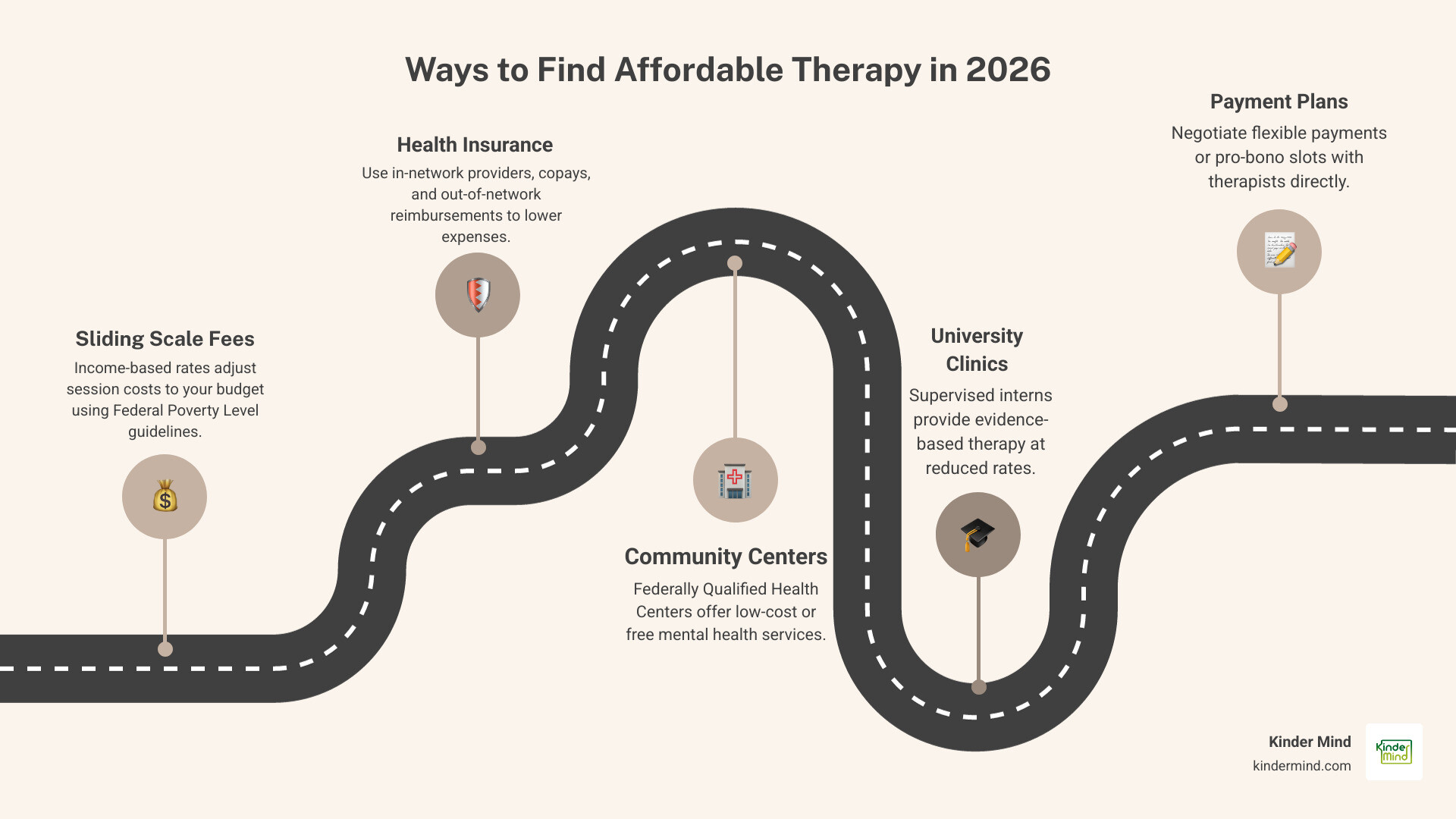
Handy sliding scale therapy fees terms:
1. Utilize Sliding Scale Therapy Fees to Match Your Income
When you start looking for a therapist, you might see a “standard rate” listed on their website. For many, that number is just a starting point. Sliding scale therapy fees are designed to bridge the gap between what a therapist needs to earn to keep their lights on and what a client can realistically afford.
In many specialized practices, nearly 90% of clients utilize some form of adjusted fee scale. This isn’t just a “discount”—it is a structured approach to financial equity in healthcare. By offering these rates, therapists ensure that high-quality care isn’t reserved only for the wealthy. If you are looking for a way to manage costs while paying out of pocket, exploring a Payment Plan: Self-Pay that incorporates a sliding scale is often the most direct route to affordable care.
According to experts at Psychology Today, these fees are negotiated agreements. While it might feel awkward to talk about money in a therapy setting, therapists are used to it. They understand that financial stress is often a primary reason people seek help in the first place!
How Sliding Scale Therapy Fees Are Calculated
There isn’t one universal “calculator” that every therapist uses, but most follow a logical formula to keep things fair. Many providers look at the Federal Poverty Level (FPL) guidelines, which are updated annually.
A common method mentioned by Choosing Therapy involves using a “0.001 formula.” For example, if a client’s gross annual income is $40,000, the therapist might set the session fee at $40. Others use income brackets—for instance, someone earning between $30,000 and $50,000 might pay one rate, while someone earning $50,000 to $70,000 pays another.
Therapists also consider:
- Gross annual household income: Your total earnings before taxes.
- Household size: How many people (dependents) that income needs to support.
- Liquid assets: Sometimes, resources beyond just a monthly paycheck are considered.
Who Qualifies for Sliding Scale Therapy Fees?
Eligibility is usually based on demonstrated financial hardship. However, “hardship” is relative. You don’t necessarily need to be at the poverty line to qualify; you just need to show that the standard market rate would prevent you from receiving consistent care.
To keep their practices sustainable, many therapists follow a “20% caseload guardrail.” This means they reserve about 20% of their total appointment slots for sliding scale clients. Because these spots are limited, they are often filled on a first-come, first-served basis.
When you apply, be prepared to provide:
- Recent tax returns: To verify annual earnings.
- Pay stubs: To show current monthly cash flow.
- An honest conversation: Explain your situation clearly. Most therapists appreciate transparency and will work with you if they have an open slot.

2. Maximize Your Health Insurance Benefits
In April 2026, mental health parity laws mean that most insurance plans are required to cover mental health services similarly to how they cover physical health. If you have insurance, this is often your most cost-effective path.
The first step is identifying “in-network” providers. These are therapists who have a contract with your insurance company to provide services at a pre-negotiated rate. When you stay in-network, you usually only owe a copayment (a fixed fee per session) or coinsurance (a percentage of the fee).
If you prefer the convenience of your own home, you can look for Online Therapy That Takes Insurance. This combines the affordability of your plan with the flexibility of virtual visits.
Before you book your first session, it is vital to do some homework. Use this guide on Questions to Ask Your Insurance Provider About Therapy to ensure you aren’t surprised by a high deductible. You’ll want to know:
- Does my plan cover “outpatient mental health”?
- What is my deductible, and has it been met?
- Do I need a referral from a primary care doctor?
For those with plans that offer out-of-network benefits, you might pay the therapist upfront and then submit a “superbill” to your insurance for partial reimbursement. You can learn more about these different structures by reviewing a Payment Plan: Insurance overview.
3. Access Community Health Centers and State Resources
For those without traditional private insurance, Federally Qualified Health Centers (FQHCs) and Community Mental Health Centers (CMHCs) are lifesavers. These facilities receive government funding to provide integrated care—meaning they often house primary care, dental, and mental health services under one roof.
In states like Arizona, the Department of Health Services maintains a specific directory of Arizona Sliding Fee Scale Providers. These providers are legally required to offer a sliding fee scale based on federal poverty guidelines.
| Feature | Private Practice | Community Health Center |
|---|---|---|
| Average Cost | $100 – $250+ | $0 – $75 (Sliding Scale) |
| Wait Times | Usually shorter | Can be longer |
| Specialization | High (Specific niches) | General (Broad range of issues) |
| Integration | Standalone | Often linked with medical care |
Public health clinics are excellent resources for low-cost psychiatric services and medication management. If you live in a rural area or an underserved urban neighborhood, these centers are often the primary hub for affordable mental health support.
4. Seek University Training Clinics and Intern Programs
If you live near a university with a graduate program in psychology, social work, or counseling, you have access to one of the best-kept secrets in affordable care.
University training clinics are staffed by graduate students who are in the final stages of their degrees. Don’t let the “student” label scare you—these interns are supervised by licensed, veteran professionals who review their cases weekly. Because the students are gaining “clinical hours” for licensure, the fees are often significantly lower than market rates.
This is a great way to access evidence-based practice on a budget. These clinics often use the latest research-backed methods. If you are specifically looking for virtual options, you can check out Your Guide to Affordable Virtual Counseling for Depression or explore The Best Free Online Therapy Options on a Budget to see if any local universities offer remote sessions.
The vetting process for these students is rigorous, and the high level of supervision often means you get two “brains” for the price of one low-cost session.
5. Negotiate Payment Plans and Pro-Bono Options
Never underestimate the power of a direct inquiry. If you find a therapist you really connect with but their fee is out of reach, ask them about their flexibility.
Therapists have a lot of discretion. While the standard range is $100 to $250, many providers are willing to offer a temporary “hardship rate” or a specific Kinder Care Plan for clients in transition.
Tips for negotiating:
- Target newer therapists: Providers who are just starting their private practice often have more open sliding scale slots as they build their caseload.
- Adjust frequency: Instead of once a week, ask if you can meet every other week to cut your monthly cost in half.
- Be transparent: Explain your budget upfront. “I can afford $X per session; do you have any flexibility or a payment plan?”
Ethically, many therapists feel a responsibility to provide some pro-bono (free) or near-free care. While these slots are very rare, they do exist for those in extreme circumstances.
6. Explore Non-Profit Collectives and Support Groups
Non-profit collectives are organizations that vet therapists and require them to offer a certain number of low-cost slots. These networks act as a middleman, connecting underinsured clients with professionals who have agreed to a capped fee.
Support groups are another fantastic alternative. While not the same as one-on-one therapy, they offer:
- Peer support: Connecting with others who have shared experiences.
- Cost-sharing: The cost of the therapist’s time is split among 6–10 people, making it much cheaper.
- Community: Reducing the isolation that often accompanies mental health struggles.
For more insights into how these community models help manage the Cost of Therapy, you can explore various resource tags that highlight group and collective options in your area.
Frequently Asked Questions about Affordable Therapy
Do sliding scale fees work with health insurance?
Usually, it is an “either/or” situation. If a therapist is in-network with your insurance, they are contractually obligated to charge the rate set by the insurance company. Waiving or “sliding” a copay for an insured client can actually be considered insurance fraud in some cases.
However, if you have a very high deductible (e.g., $5,000), it might actually be cheaper to pay a therapist’s sliding scale out-of-pocket than to pay their full “contracted rate” toward a deductible you’ll never reach. Always discuss this with the provider to see which path makes more financial sense for you.
What are the legal and ethical considerations for therapists?
Therapists must follow the No Surprises Act, which requires them to provide a “Good Faith Estimate” of how much therapy will cost before you start.
Ethically, therapists must apply their sliding scale consistently. They cannot charge one person more just because they like them less, or offer a discount based on anything other than financial need. Proper documentation—like keeping those pay stubs on file—helps the therapist stay compliant with non-discrimination laws.
How can I find a therapist who offers reduced rates?
- Online Directories: Use sites like Psychology Today and use the “Sliding Scale” filter.
- Direct Outreach: Email therapists even if they don’t list a sliding scale. The worst they can say is “no” or offer a referral to someone who does.
- Referral Networks: Ask your primary care doctor or a local community center for a list of low-cost providers.
- University Clinics: Search for “[Your City] + Psychology Training Clinic.”
Conclusion
Finding affordable mental health care in 2026 is about knowing where to look and being brave enough to ask. Whether you utilize sliding scale therapy fees, maximize your insurance, or visit a communi
