An Essential Guide to ENM Therapy
Dr. Elizabeth Barlow, LCSW-S · 1/26/2026

Why Ethical Non-Monogamy Therapy is Growing in Importance
Ethical non-monogamy therapy offers specialized mental health support for individuals and couples in consensually non-monogamous (CNM) relationships. It helps people steer the unique dynamics of having multiple partners.
ENM Therapy Addresses:
- Managing jealousy and building compersion
- Setting and maintaining healthy boundaries
- Improving communication across multiple relationships
- Navigating social stigma and minority stress
- Time management and relationship prioritization
Who Benefits:
- Couples considering opening their relationship
- Individuals in polyamorous or open relationships
- Anyone experiencing relationship challenges within ENM
About 4-5% of Americans are in CNM relationships—similar to the LGBTQ+ population—and over one in five adults have tried non-monogamy. Despite this prevalence, finding supportive care is a struggle. Research shows over half of CNM clients report their therapists held judgmental beliefs. One in five had to educate their therapist on basic concepts, creating a serious barrier to care that can leave clients feeling misunderstood or harmed.
However, studies show that consensual CNM relationships have similar levels of satisfaction and love as monogamous ones, often with higher trust and lower jealousy. With the right therapeutic support, people in ENM can steer its unique challenges while building stronger connections.
Finding an affirming therapist who understands ENM dynamics is essential, whether you’re just starting, already practicing, or simply curious.
Understanding Ethical Non-Monogamy (ENM)
What is ENM and How is it Different from Cheating?
Ethical non-monogamy (ENM), or Consensual Non-Monogamy (CNM), is a relationship structure where all partners openly agree to have multiple romantic or sexual connections. It’s made ethical by three core principles: consent, honesty, and communication.
In ENM, all partners know and agree to the relationship structure. Ongoing conversations about desires, comfort, and boundaries replace secrecy. Cheating, or infidelity, involves breaking relationship agreements without a partner’s knowledge or consent. The harm stems from the betrayal of trust and deception. ENM is the opposite: it builds trust through transparency and openly expands connections, rather than hiding them.
If you’re working through challenges in any relationship structure, exploring relationship issues with a therapist can help.
The Spectrum of ENM: Common Relationship Structures
Ethical non-monogamy is an umbrella term for many different relationship styles. Here are some common models:
-
Polyamory (“many loves”) involves having multiple consensual romantic relationships simultaneously, often with varying levels of emotional connection and commitment.
-
Open relationships typically involve a primary couple who agree to have sexual relationships with others, with the core romantic bond remaining central.
-
Monogamish relationships are mostly monogamous but permit specific, agreed-upon sexual activity with others.
-
Swinging involves couples engaging in sexual activities with other couples or individuals, often together and with a recreational focus.
-
Relationship Anarchy rejects hierarchies between relationship types (romantic, sexual, platonic). It values autonomy, allowing each connection to develop organically.
-
Solo polyamory describes individuals who have multiple relationships but do not have a primary partner or cohabitate, prioritizing their independence.
-
Polyfidelity is a closed relationship among three or more people who are all involved with each other but not with people outside the group.
Each structure requires clear communication and boundaries, and understanding these models is often a first step in ethical non monogamy therapy. Learn more by exploring ENM and polyamory.
The Four Pillars of Ethical Practice
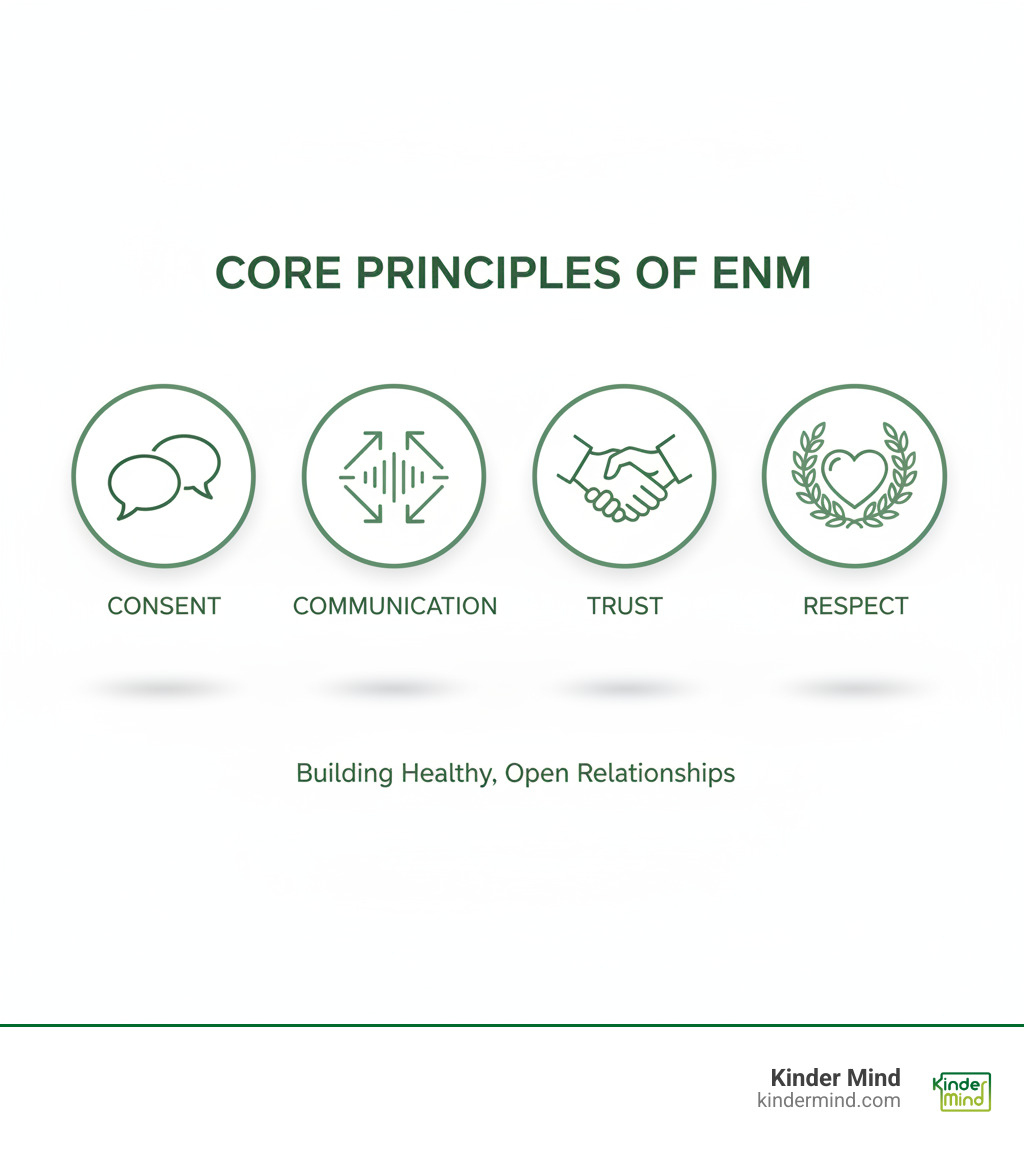
Healthy ENM relationships are built on four pillars: consent, communication, trust, and respect.
Enthusiastic consent must be genuine, ongoing, and freely given by all partners. It’s not a one-time agreement but a continuous process of checking in, and it can be withdrawn or renegotiated at any time. For a comprehensive look at this topic, read a guide to consent in polyamory.
Radical honesty and open communication are vital. Partners must commit to transparent dialogue about feelings, desires, boundaries, and new connections. Avoiding difficult conversations erodes trust. Learning effective communication in polyamory is a skill you can develop.
Building and maintaining trust comes from consistency: honoring agreements, respecting boundaries, and being transparent even when it’s hard. Solid trust creates the security needed for ENM.
Mutual respect and autonomy means honoring each person’s individuality, needs, and choices. It involves respecting your partner’s other relationships and the people in them, moving beyond tolerance to genuine support.
The Role of Ethical Non-Monogamy Therapy
Navigating Common ENM Challenges with a Therapist

Even with a strong foundation, ENM presents unique challenges. This is normal, and it’s where ethical non monogamy therapy can make a real difference.
-
Jealousy: This isn’t a sign of failure but valuable information about unmet needs or insecurities. A therapist can help you understand its roots and communicate your feelings constructively.
-
Compersion: Feeling joy for a partner’s happiness with another is a goal for some but not a requirement. Therapy provides a non-judgmental space to explore these feelings.
-
Time Management: Balancing the needs and schedules of multiple relationships is a logistical challenge. A therapist can help you develop strategies for prioritization to ensure all connections are nurtured.
-
Social Stigma & Minority Stress: People in ENM relationships often face judgment, which takes a mental health toll. Research on minority stress shows this burden. An understanding therapist can help you build resilience and cope.
-
Boundary Setting: This becomes more complex with multiple partners. Therapy is invaluable for facilitating conversations to define and communicate your limits clearly.
-
New Relationship Energy (NRE): The exciting rush of a new connection can destabilize existing relationships. Therapy helps you manage NRE mindfully to honor all your partners. Effective communication in polyamory is especially important here.
The Unique Benefits of Exploring ethical non monogamy therapy
Beyond problem-solving, ethical non monogamy therapy offers transformative benefits.
It provides a crucial safe space where you don’t have to defend your choices, allowing you to dive directly into exploring your emotions. Therapy also helps you develop essential skills for successful ENM, such as effective communication, negotiation, and conflict resolution.
Perhaps most valuable is the self-awareness you gain. Understanding your motivations, triggers, and patterns can lead to more secure attachment, benefiting all your connections. The link between polyamory and attachment styles is significant. You’ll also develop self-soothing techniques, building emotional resilience by learning to process difficult feelings independently.
This work strengthens your capacity for love and intimacy, helping you grow into a more authentic, emotionally intelligent version of yourself.
Adapting Couples Therapy for ENM Dynamics
Traditional couples therapy is designed for two people, which doesn’t fit many ENM dynamics. Specialized ethical non monogamy therapy adapts these models for multi-partner systems.
One key adaptation is moving beyond dyadic models to offer multi-partner sessions. Including everyone in a constellation ensures all voices are heard. Approaches like Emotionally Focused Therapy (EFT) are also being adapted for polyamorous relationships to strengthen attachment bonds across more complex dynamics.
An ENM-affirming therapist also helps partners steer hierarchy (e.g., primary/secondary partners). The goal is to facilitate conversations that ensure the structure is consensual, fair, and respectful to everyone. The ultimate aim is to support the entire relationship system, recognizing that all partnerships are interconnected.
Polyamorous couples counseling can provide the specialized guidance needed to build healthier relationships for everyone involved.
Finding the Right ENM-Affirming Therapist
Why a “Poly-Friendly” Therapist is Crucial

Choosing an ENM-affirming therapist is essential. The mental health field often operates from mononormativity—the assumption that monogamy is the only healthy model. This bias can harm clients seeking ethical non monogamy therapy.
Research shows the problem: one in five CNM clients had to educate their therapist, and over half faced judgmental beliefs. Biased therapists may wrongly blame ENM for issues instead of exploring underlying causes. This can cause serious harm, making stigmatizing comments or pressuring clients to become monogamous, often leading people to abandon therapy feeling more isolated.
You shouldn’t have to spend therapy sessions defending your relationship. An affirming therapist provides support, not judgment. This is highlighted in a study on CNM clients in therapy, underscoring why inclusive therapy approaches are vital.
What to Look for in an ethical non monogamy therapy Provider
Finding the right provider is worth the effort. Here’s what to look for:
- Affirming Language: Look for terms like “polyamory” or “ENM” used comfortably on their website and in conversation, showing they view your relationship as valid.
- Experience and Training: Ask about their experience with ENM clients and any specialized training in relationship diversity.
- Willingness to Learn: A good therapist is curious and open, but they shouldn’t expect you to educate them on the basics during your sessions.
- Inclusive Intake Forms: Forms that allow you to accurately describe your relationship structure show they’ve considered diverse clients.
- Therapeutic Approach: Ask how they adapt therapy for multi-partner dynamics and if they understand concepts like NRE or compersion.
Use free consultation calls to ask these questions directly. You need a supportive partner, not a critic. At Kinder Mind, we have a team of polyamory-affirming therapists ready to help.
Resources for Finding Support and Information
A growing network of resources exists to help you find information and affirming care.
Professional organizations like the American Psychological Association’s Division 44 Committee on Consensual Non-monogamy are promoting therapist education and developing practice guidelines for CNM clients.
Recommended books like “The Handbook of Consensual Non-Monogamy” and “The Clinician’s Guide to Ethical Non-Monogamous Relationships” offer valuable perspectives for clients and therapists alike.
Online communities and forums dedicated to ENM provide peer support and a space to share experiences.
When using therapist directories, filter for specialties like “polyamory” or “open relationships,” but always follow up with a consultation call to ensure a good fit.
At Kinder Mind, we’re committed to making mental health care accessible and inclusive. We serve clients in dozens of states nationwide, connecting you with affirming professionals who understand your experiences. For more guidance, explore our insights on finding a polyamory therapist.
Frequently Asked Questions about ENM and Therapy
Is choosing ENM a sign that my primary relationship is failing?
No. This common question in ethical non monogamy therapy comes from the misconception that a good relationship should meet all needs. For many, ENM is about expansion and exploration, not filling a void. When done ethically, it can strengthen relationships. In fact, research on relationship quality shows CNM relationships have similar satisfaction levels to monogamous ones, often with higher trust.
However, ENM is not a fix for a broken relationship. Opening up a partnership with existing issues like broken trust or poor communication will likely worsen them. A therapist can help you assess if your relationship is healthy enough to open, ensuring the choice is made from a place of strength.
Can therapy help us decide if opening our relationship is a good idea?
Absolutely. Ethical non monogamy therapy is an invaluable tool for couples exploring this possibility. A therapist provides a neutral space to explore your motivations, fears, and hopes. Therapy helps you understand your “why”—are you seeking expansion, addressing a specific need, or trying to fix a problem?
It’s also a place to build the non-negotiable communication skills for ENM. You can practice setting boundaries, negotiating agreements, and developing strategies for challenges before they become crises. This process helps you make a conscious, informed choice together. For more, see our article on opening up a relationship.
How does ENM intersect with LGBTQ+ identities?
ENM and LGBTQ+ communities have a significant overlap, as both groups steer a world that privileges heteronormative and mononormative structures. People in CNM relationships are a sexual minority and often experience similar forms of minority stress as LGBTQ+ individuals, including stigma and judgment.
This makes intersectional care vital in ethical non monogamy therapy. A therapist must under