
When Therapy Leads to ‘I Do’ (or ‘I Don’t’): Navigating Counseling’s Impact on Your Marriage
Dr. Elizabeth Barlow, LCSW-S · 2/20/2026

Understanding the Reality Behind Couples Therapy and Relationship Outcomes
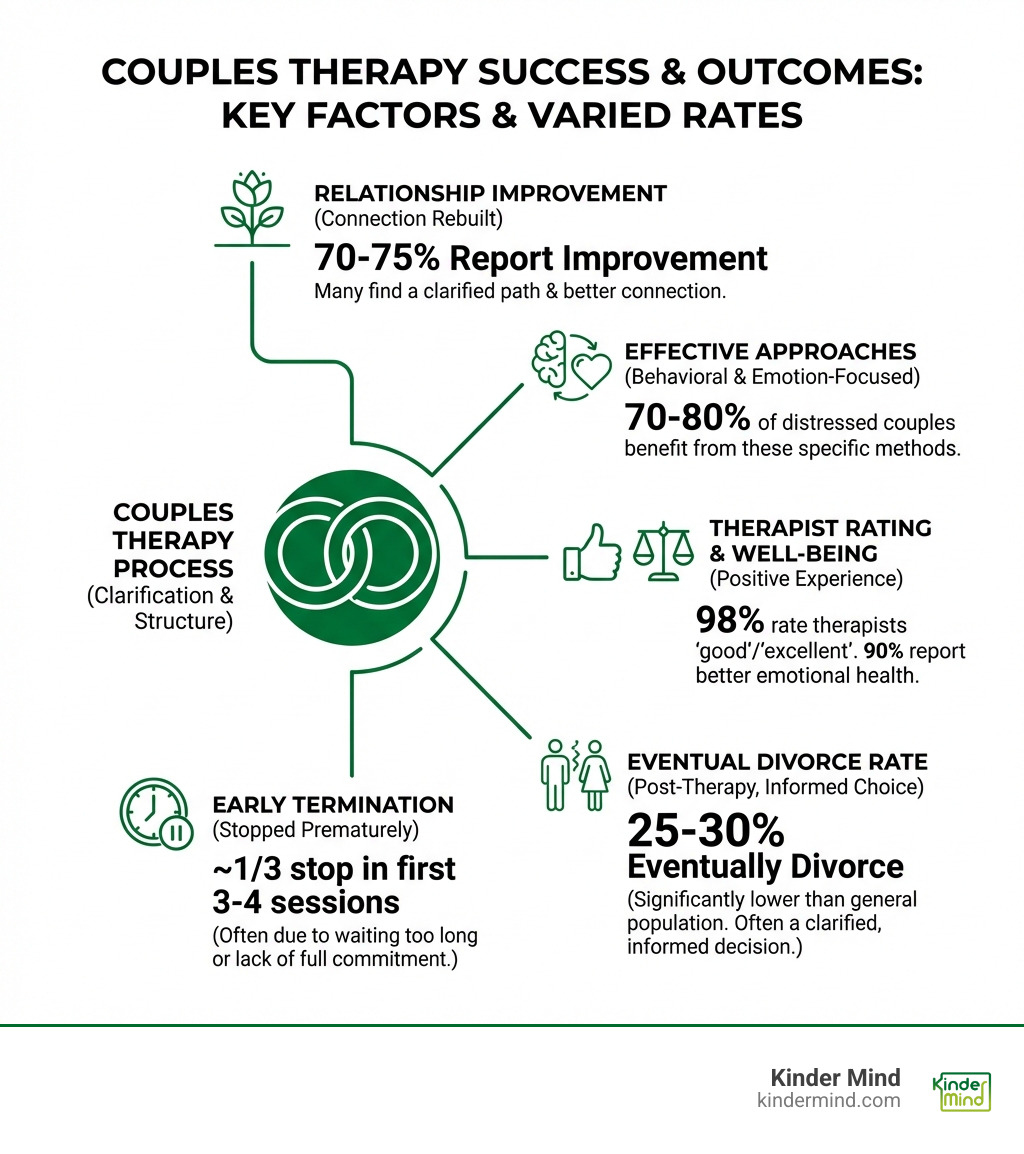
Does couples therapy lead to divorce? No, couples therapy does not inherently lead to divorce. Research shows that approximately 70-75% of couples experience relationship improvement after therapy. However, therapy can sometimes clarify fundamental incompatibilities, leading some couples to make an informed decision to separate. This isn’t a failure of therapy—it’s therapy providing the clarity needed to make the best choice for both partners.
Key Facts About Couples Therapy Outcomes:
- 70-80% of distressed couples benefit from behavioral or emotion-focused approaches
- 98% of couples rate their therapists as “excellent” or “good”
- 90% report improvement in emotional health
- Only 25-30% of couples who complete therapy eventually divorce (significantly lower than the general population)
- About one-third of couples stop therapy in the first 3-4 sessions, often because they waited too long to seek help
When Alice called to discuss leaving her marriage after years of feeling miserable, she wondered if couples therapy could save her relationship—or if it would simply confirm what she already feared. This dilemma captures the core anxiety many couples face: Will therapy help us reconnect, or will it reveal that we’re better off apart?
The truth is more nuanced than a simple yes or no.
Couples therapy doesn’t cause divorce any more than going to the doctor causes illness. What it does is provide a safe, structured environment to examine your relationship honestly. Sometimes that examination reveals fixable patterns. Sometimes it reveals irreconcilable differences. Both outcomes have value.
Research shows couples wait an average of six years after problems begin before seeking help. By that point, significant damage has often occurred. About a third of couples stop therapy early—not because therapy failed, but because they started too late or one partner wasn’t truly committed to the process.
The question isn’t really whether therapy leads to divorce. The question is: Can therapy help us understand what we truly need—whether that’s healing our relationship or consciously choosing to part ways?
Understanding the Success Rates and Key Influencing Factors
When couples contemplate counseling, they often ask about its effectiveness. The answer is largely positive, though success depends on several factors.
While general marriage and family therapy reports a 40-50% success rate, specific, evidence-based approaches show much higher efficacy. For instance, Emotionally Focused Couples Therapy (EFT) has a 70-73% success rate, with a 90% improvement rate. Data from the American Association for Marriage and Family Therapy (AAMFT) is also compelling:
- 98% of couples rate their therapists as “excellent” or “good.”
- 90% report improved emotional health.
- Almost 75% of couples see improvements in their relationships.
The consensus among qualified professionals is that therapy offers a high potential for positive outcomes when approached with dedication.
What Influences the Success or Failure of Marriage Counseling?
The effectiveness of couples therapy depends on several critical factors:
- Commitment Level of Both Partners: This is the most crucial factor. When both partners willingly engage, success rates are high. If one partner is resistant or only attends to say they “tried,” meaningful change is difficult.
- Willingness to Change: Therapy requires introspection and a readiness to alter one’s own behaviors. Couples who are open to growth and examining their own contributions to problems are far more likely to see positive results.
- Timing of Intervention: Many couples wait too long—an average of six years after problems begin. By then, significant damage may have occurred. Seeking help sooner dramatically improves the chances of success.
- Presence of Abuse or Active Infidelity: In cases of ongoing abuse or an active affair, traditional couples therapy is often not suitable. The primary focus must first be on safety and addressing the foundational betrayal.
- Therapist-Client Fit: A strong therapeutic alliance is vital. A good therapist creates a safe, neutral space. It’s wise to find a therapist whose approach resonates with both partners.
- Communication Patterns: Therapy aims to replace dysfunctional communication with constructive ways to express needs, listen, and resolve conflict. A couple’s ability to learn and practice these new skills is paramount.
- Individual Mental Health Issues: Unaddressed individual issues like severe depression or substance use disorders can hinder progress. These often need to be addressed concurrently with, or even before, couples work.
In short, success is most likely with early intervention, mutual commitment, openness to change, a good therapist fit, and the absence of severe, unmanaged issues like abuse or active infidelity.
So, Does Couples Therapy Lead to Divorce?
The short answer is no, couples therapy doesn’t cause divorce. Instead, it acts as a catalyst for clarity, bringing underlying issues into sharp focus. Like a mechanic diagnosing a car, therapy helps you understand the problem. Sometimes it’s a simple fix, and sometimes the diagnosis reveals that moving on is the most sensible choice.
Signs a Couple Might Be Headed for Divorce, Even with Counseling
Certain dynamics can signal that a relationship is heading toward separation, even with professional help. These aren’t failures of therapy but acknowledgments of deep-seated issues.
One key indicator is how a couple recounts their shared past. If they describe their early years with negativity or cynicism, it’s a significant red flag. Therapists also watch for specific destructive behaviors, famously identified by Dr. John Gottman as the “Four Horsemen”:
- Contempt: The most destructive, this includes insults, sarcasm, mocking, and eye-rolling, signaling a deep lack of respect.
- Criticism: Attacking a partner’s character (“you always…” or “you never…”) rather than a specific behavior.
- Defensiveness: Responding to complaints with excuses or blame instead of taking responsibility, which blocks communication.
- Stonewalling: Withdrawing from an interaction emotionally or physically, often due to feeling overwhelmed (emotional flooding).
Other warning signs include:
- Apathy and Indifference: When partners become psychologically disconnected and the relationship feels more like a business partnership.
- Replaying Past Hurts: An inability to let go of old grievances, which prevents the relationship from moving forward.
Why Does Couples Therapy Sometimes Lead to Divorce?
When therapy ends in divorce, it’s not a failure. It’s often a success in providing clarity. Here’s why:
- Revealing Irreconcilable Differences: Therapy can uncover fundamental incompatibilities in life goals or values that cannot be resolved.
- Highlighting Uneven Growth: One partner may grow significantly in therapy, while the other remains stagnant. This imbalance can make the relationship untenable for the growing partner.
- Empowering an Individual to Leave: Therapy can give someone the strength and clarity to leave an unhealthy, toxic, or unfulfilling relationship.
- Facilitating a “Good Divorce”: If separation is the outcome, therapy can help the couple steer it amicably, with tools for respectful communication and co-parenting. This is a positive outcome compared to a bitter, conflict-ridden split.
How to Make Couples Counseling Work for Your Relationship
To maximize the chances of a positive outcome from couples counseling, you and your partner can take several proactive steps.
- Adopt a Proactive Approach: Don’t wait for a crisis. Seeking help early prevents problems from becoming entrenched.
- Set Realistic Expectations: Therapy is not a magic wand. It requires hard work, commitment, and time to learn new skills and confront truths.
- Engage in Active Participation: Be present and participate fully in every session. This includes being honest, asking questions, and expressing concerns.
- Do the Homework: Therapists often assign exercises to practice between sessions. These are crucial for integrating new skills into your daily life.
- Be Honest and Vulnerable: Progress requires both partners to be vulnerable and share their fears and hopes honestly in a safe space.
- Focus on Self-Improvement: Be willing to examine your own role in the relationship’s dynamics and commit to personal change.

When is Marriage Counseling Most Likely to Be Effective?
Counseling is most effective when certain conditions are met:
- Seeking Help Early: Getting help before issues become irreparable significantly increases the likelihood of success.
- Both Partners Are Motivated: The strongest predictor of success is when both individuals are genuinely committed to working on the relationship.
- No Unmanaged Violence or Abuse: Safety is the priority. Traditional couples therapy is not appropriate in cases of ongoing abuse until safety is established.
- Willingness to Explore Underlying Issues: Couples who are open to digging beyond surface-level conflicts to find root causes are more likely to achieve lasting change.
- Openness to Learning New Skills: Actively learning and practicing new communication and conflict resolution skills is essential.
For further insights into the effectiveness of couples therapy, consider exploring research on the treatment of couple distress.
The Impact of Different Therapy Approaches
The type of counseling can significantly impact the outcome. It’s important to work with a therapist trained in evidence-based practices.
- Emotionally Focused Therapy (EFT): This highly effective approach focuses on changing negative emotional cycles and fostering a more secure bond. It has a 70-73% success rate, with 90% of couples showing significant improvement.
- Gottman Method: Rooted in extensive research, this method teaches practical skills for conflict management, increasing intimacy, and building shared meaning.
- Cognitive-Behavioral Strategies for Couples (CBCT/BCT): These approaches focus on changing negative thought patterns and problematic behaviors, teaching skills like problem-solving and communication.
What is the Role of the Therapist?
A couples therapist is not a judge or referee. Their primary role is to act as a:
- Neutral Facilitator: They don’t take sides but create a safe space for open dialogue.
- Advocate for the Relationship: The “client” is the relationship itself. The focus is on the dynamic between partners.
- Skills Teacher: They equip couples with tools for better communication, active listening, and conflict resolution.
- Clarity Supporter: A therapist will not suggest divorce. They help the couple explore their relationship honestly to make their own clear decisions.
Alternatives, Timelines, and Individual Commitment
While couples counseling is highly effective, it’s not the only path. Individual effort can also make a significant difference.
How Long Should You Try Counseling?
The duration of counseling varies, but there are general timelines. Many couples notice positive changes after 8–12 sessions (2–3 months). It’s wise to commit to 3-6 months of weekly sessions to evaluate progress. Deeper, more lasting change for complex issues may require 10-20 sessions or more. The goal is consistent progress, not perfection. If you see no improvement in that timeframe, it may be time to discuss concerns with your therapist or consider a different approach.
Can One Partner’s Commitment Make a Difference?
The “it takes two to tango” adage isn’t always true in therapy. One partner’s commitment can create profound change.
- Shifting the Dynamic: When one person commits to personal growth, improves their communication, and takes responsibility, it inevitably changes the relationship dynamic. This can inspire the other partner to engage.
- Individual Growth is Always a Win: Even if the relationship ends, the personal growth achieved through therapy is invaluable. It equips an individual with self-awareness and healthier relational patterns for the future.
- Setting Healthy Boundaries: Therapy can teach one partner to set healthier boundaries. This can either encourage the other partner to adapt positively or clarify that the relationship is no longer viable, leading to an informed decision.
While therapy is most effective when both partners are invested, one person’s commitment can still lead to significant positive changes for the individual and the relationship.
Frequently Asked Questions about Couples Therapy and Divorce
Will a marriage counselor tell us to get a divorce?
A therapist’s role is to remain neutral and help you and your partner gain clarity. They will not make the decision for you but will support you in exploring your options and feelings to arrive at your own conclusion, whether that is to recommit to the marriage or to separate.
What if my partner is resistant to counseling?
One partner’s resistance is common. It can be helpful to approach the conversation with “I” statements, focusing on your own feelings and the desire to improve the relationship for both of you. Even if your partner refuses, starting individual therapy can equip you with skills that can positively impact the relationship dynamic.
Is it ever “too late” for couples therapy?
While seeking help early is ideal, it’s rarely “too late” as long as both partners have some willingness to try. Therapy can be beneficial even if the ultimate decision is to separate, as it can help facilitate a more amicable and understanding process for everyone involved.
Conclusion: Finding Your Path Forward
The journey of couples therapy is a deeply personal one, unique to each relationship. It’s a powerful tool that offers clarity, fosters communication, and provides strategies for navigating the complexities of shared life. To reiterate, does couples therapy lead to divorce? No, not directly. It leads to understanding. Sometimes that understanding strengthens bonds, leading to a renewed “I d