Open Hearts, Open Minds: A Therapist’s Guide to Non-Monogamous Counseling
Dr. Elizabeth Barlow, LCSW-S · 1/28/2026

Why More Couples Are Seeking Therapy for Open Relationships
Couples therapy for open relationships helps partners steer consensual non-monogamy through improved communication, boundary setting, and managing complex emotions like jealousy. A specialized therapist creates a non-judgmental space to establish clear agreements, rebuild trust after breaches, and ensure all partners feel secure and valued.
What couples therapy for open relationships addresses:
- Communication frameworks – Learning explicit conversation skills and scheduling regular check-ins
- Boundary establishment – Defining rules around sexual health, time commitments, and emotional connections
- Jealousy management – Understanding root causes and developing healthy coping strategies
- Trust building – Repairing relationship injuries and fostering secure attachment
- Agreement renegotiation – Adapting rules as relationships evolve over time
Interest in non-monogamous relationships has grown significantly in recent years. A February 2023 poll found that 34% of Americans prefer their relationship style to be something other than complete monogamy. This shift reflects changing societal attitudes toward relationships and sexuality.
Yet many couples exploring open relationships struggle to find support. Traditional relationship counseling often assumes monogamy as the default, leaving those in consensually non-monogamous (CNM) relationships feeling misunderstood or judged.
This guide explains how specialized couples therapy supports open relationships. You’ll learn what makes CNM therapy different, essential communication strategies, how to establish healthy boundaries, and when to seek professional help. Whether you’re considering opening your relationship or already navigating multiple partnerships, understanding these principles can strengthen your connections.
Therapy for open relationships typically lasts around 12 weeks on average, though your needs may vary. The goal isn’t to convince you toward or away from non-monogamy—it’s to help you build the relationship structure that works best for you and your partners.
Understanding Consensual Non-Monogamy (CNM)

Consensual non-monogamy (CNM), or ethical non-monogamy (ENM), is an umbrella term for relationships where partners consent to romantic, sexual, or emotional connections with more than one person. This explicit consent distinguishes CNM from infidelity, which involves secrecy and broken trust. CNM is built on transparency, honesty, and mutual agreement, framing the dynamic as a chosen, ethical structure rather than a betrayal.
Couples consider open relationships for many reasons, often seeking individual autonomy and freedom. Some desire sexual exploration, like pursuing kinks a primary partner doesn’t share, without pressuring the existing bond. For others, it’s about expanding their capacity for love, recognizing one person may not meet all their emotional needs. Open relationships offer a space to explore diverse expressions of love and intimacy beyond monogamy.
Practical concerns, like long-distance relationships or demanding jobs, can also lead couples to consider an open arrangement to fulfill intimacy needs. The decision to explore CNM often stems from a desire to satisfy parts of oneself that feel suppressed in a monogamous framework, aligning one’s relationship with personal values. For more resources on this, consider exploring Ethical Non-Monogamy Resources.
The Spectrum of Open Relationships
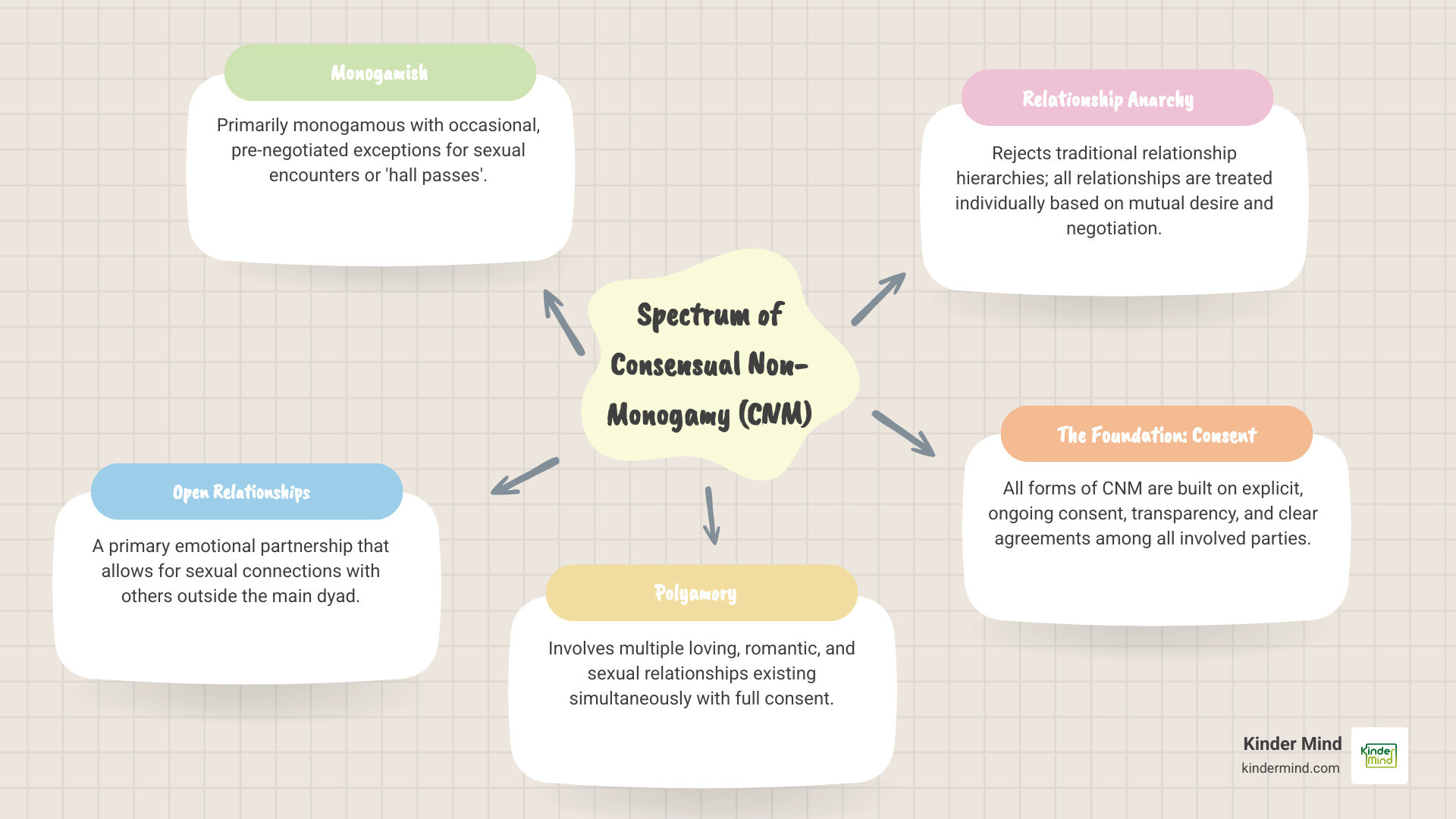
The term “open relationship” is often used broadly, but consensual non-monogamy encompasses a rich and varied spectrum of structures, each with its own unique dynamics and agreements. Understanding these differences is key to navigating them successfully, and therapists specializing in couples therapy for open relationships are well-versed in these nuances.
| Relationship Type | Definition | Key Characteristics |
|---|---|---|
| Polyamory | The practice of engaging in multiple romantic relationships with the full knowledge and consent of all partners. | Focuses on deep emotional connection and love with multiple partners; often involves long-term commitments and integration into one’s life. More on polyamory. |
| Swinging | Involves partners in a committed relationship engaging in sexual activities with other people, often as a couple and in social settings. | Primarily sexual in nature; emotional exclusivity usually maintained within the primary partnership; often group-oriented. |
| Monogamish | A primary relationship that is mostly monogamous but allows for occasional, agreed-upon sexual encounters with others under specific circumstances. | High degree of emotional and romantic exclusivity; limited, pre-defined sexual flexibility; often a compromise between monogamy and open relationships. |
| Open Relationship | A primary romantic couple agrees to allow each partner to engage in sexual relationships with other people. | Emotional exclusivity often maintained within the primary couple; external relationships are typically sexual, not romantic; rules vary widely. |
| Relationship Anarchy | Rejects traditional relationship norms and hierarchies, advocating for individual autonomy and non-prescriptive connections. | No inherent distinction between platonic, romantic, or sexual relationships; all connections are valued and defined by individuals involved; emphasizes self-determination and consent. |
Beyond these structures, you may encounter terms like “Vee” (one person with two partners who aren’t involved with each other), “Throuple” or “Triad” (a three-person relationship), “Quad” (four people), or “Polyfidelity” (a closed group). A “Polycule” is the interconnected network of people in polyamorous relationships. Each structure requires careful agreements. For more in-depth information, refer to Exploring Ethical Non-Monogamy and Polyamory.
Potential Benefits and Challenges
Exploring CNM can offer many benefits. Partners often report increased sexual satisfaction and novelty, as well as significant personal growth from confronting insecurities and articulating needs. The required explicit communication can lead to deeper, more honest conversations, strengthening the primary bond. Having multiple partners can also reduce pressure on one person to fulfill all needs, fostering freedom and authenticity. Some even report that opening their relationship saved it.
However, CNM has its challenges. Managing jealousy and insecurity is a common difficulty. Juggling the schedules of multiple partners requires careful time management and communication. Societal stigma can lead to judgment and isolation. There’s also a higher risk of STIs, requiring rigorous safe sex practices and open discussion about sexual health. Other drawbacks include emotional pain, dislike between partners, and self-esteem issues if agreements are broken.
A study on relationship functioning, published in the Journal of Sex Research, sheds light on these dynamics. It found that while consensual non-monogamous (CNM) relationships can demonstrate high levels of functioning, similar to monogamous relationships, those categorized as “partially open” or “one-sided non-monogamous” often exhibited lower functioning, lower dedication, and more psychological distress. This highlights that success in non-monogamy isn’t about the structure itself, but the underlying health of the communication, consent, and comfort within it.
The Unique Role of Couples Therapy for Open Relationships

The landscape of couples therapy for open relationships is distinct from traditional counseling for several key reasons. Therapists specializing in CNM understand the importance of creating a non-judgmental space where clients feel safe to discuss their relationship structures without fear of being pathologized or misunderstood. This is crucial because societal norms and stigma around non-monogamy can significantly impact couples seeking therapy, often leading them to anticipate judgment.
A critical aspect of a therapist’s role is addressing their own potential biases. Many clinicians lack sufficient training in non-monogamous relationships, and some may unconsciously hold heteronormative or monogamous assumptions. A competent therapist will be aware of their own reactions and biases, ensuring they provide culturally competent care that validates non-traditional relationship structures. This allows them to focus on the dynamics within the relationship rather than questioning the validity of the structure itself.
In this affirming environment, therapists help couples foster secure attachment, which is vital for any healthy relationship, regardless of its structure. Even in CNM, partners need to feel safe, seen, and connected. Therapy can help identify and heal attachment injuries, which are violations of trust that damage the belief in the security of the relationship. For more on this topic, refer to Polyamory and Attachment.
A cornerstone of successful non-monogamous relationships, and a focus in therapy, is the “Triple-C Model”: Consent, Communication, and Comfort.
- Consent: This is the absolute foundation. Therapy ensures that all agreements are genuinely consensual, enthusiastic, and regularly revisited.
- Communication: Therapists help couples develop explicit, honest, and frequent communication strategies to steer the complexities of multiple relationships.
- Comfort: This refers to the emotional security and ease each partner feels within the arrangement. Therapy helps address insecurities and build a sense of comfort with the chosen structure. When these “Three Cs” are present, non-monogamous relationships tend to thrive. When they are lacking, sexual activity with others can quickly turn into betrayal or cheating, jeopardizing the relationship.
Essential Communication Strategies in Couples Therapy for Open Relationships
Communication is often cited as the backbone of any successful relationship, but it’s especially crucial—and often more complex—in open relationships. Couples therapy for open relationships excels at helping partners develop the explicit communication skills needed to thrive.
Therapists guide couples in using ‘I-statements,’ which focus on personal feelings and needs rather than blame, fostering a more constructive dialogue. For instance, instead of saying, “You always ignore my feelings when you’re with someone else,” a partner might learn to say, “I feel anxious when I don’t hear from you for a long time while you’re on a date.” Active listening techniques are also emphasized, ensuring each partner feels heard and understood, even when discussing difficult topics.
Regular check-ins are a non-negotiable best practice in CNM. Therapy helps couples establish routines for these check-ins, creating dedicated time to discuss experiences, feelings, and any shifts in needs or boundaries. This proactive approach helps in navigating difficult conversations before they escalate into conflicts. Therapists can teach concrete strategies for conflict resolution, helping partners express their concerns and work through disagreements effectively. For deeper dives into developing these skills, explore Couples Communication Skills.
Emotionally Focused Therapy (EFT), an evidence-based approach, has also been successfully adapted for CNM couples. EFT helps partners understand their underlying emotional needs and attachment patterns, allowing them to express vulnerabilities and respond to each other with empathy. This therapeutic modality has a strong track record, with research showing 70%-75% of couples moving from distress to recovery, and 90% showing significant improvements. By understanding their emotional cycles, CNM couples can build stronger, more secure bonds within their chosen structure.
Establishing and Maintaining Boundaries
One of the most critical aspects of a successful open relationship is the establishment and continuous maintenance of clear boundaries, rules, and agreements. This is where couples therapy for open relationships shines, providing a structured environment to define these parameters.
Couples work together to define what is and isn’t acceptable within their unique arrangement. This includes differentiating between rules (non-negotiable guidelines) and boundaries (personal limits and preferences). Agreements might cover specific aspects like:
- Sexual boundaries: What types of sexual activities are permitted with other partners?
- Romantic boundaries: Is emotional connection with others allowed, or is the primary relationship exclusively romantic?
- Time commitments: How much time can be spent with other partners? Are overnights allowed?
- Information sharing: How much detail about external relationships should be shared with the primary partner? Do partners meet each other’s outside connections?
- Sexual health: Mandatory STI screenings, consistent use of barrier methods, and transparent discussions about new partners.
These agreements are not static. Therapy helps couples understand that their needs and comfort levels may change over time, necessitating regular renegotiation. It’s vital to establish time periods for review, or to identify specific events that might warrant a re-evaluation of the rules. The goal is to protect the primary partnership and ensure all individuals feel secure and respected. Formalizing these agreements, even in writing, can be incredibly beneficial, providing a clear reference point. For guidance on setting effective boundaries, see A guide to setting better boundaries. The core principle underpinning all these agreements is consent, ensuring all parties enthusiastically agree to the terms. For comprehensive insights into this, check out the <