
Beginner’s Guide to Discernment Counseling
Dr. Elizabeth Barlow, LCSW-S · 2/12/2026

Introduction: At a Crossroads in Your Relationship?
Discernment counseling is a short-term therapy (1-5 sessions) designed for couples where one partner is considering divorce while the other wants to save the relationship. Unlike traditional couples therapy, the goal isn’t to fix problems—it’s to help you gain clarity and confidence about whether your relationship issues can be solved.
Key Facts:
- Duration: Typically 1-5 sessions (initial 2-hour session, then 90-minute sessions)
- Format: Mix of individual conversations and joint time with your therapist
- Goal: Decide on one of three paths forward
- Best for: “Mixed-agenda” couples where partners have different goals
The Three Possible Outcomes:
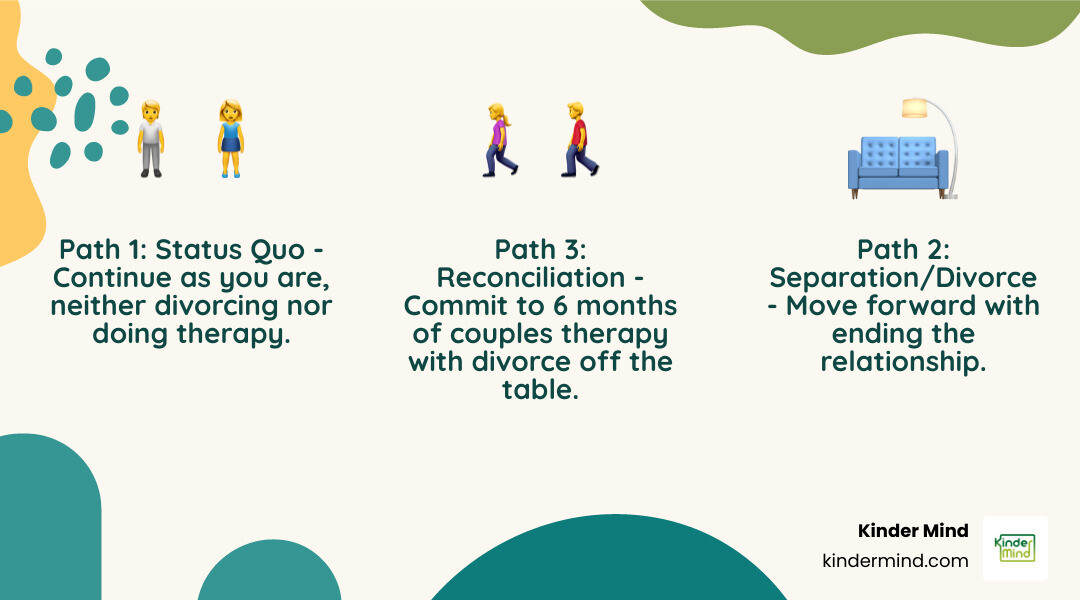
- Status Quo – Continue as you are, neither divorcing nor doing therapy
- Separation/Divorce – Move forward with ending the relationship
- Reconciliation – Commit to 6 months of couples therapy with divorce off the table
Nearly everyone enters marriage dreaming of a lifelong union. But many couples reach a crisis point where divorce feels like it’s on the table. If you’re reading this, you might be there right now.
Maybe you feel like you’re mentally packing your bags while your partner desperately wants to work things out. Or perhaps you’re the one fighting to save the relationship while your partner seems checked out.
This imbalance—where one person is “leaning in” and the other is “leaning out”—is exactly what discernment counseling addresses. It’s not about convincing anyone to stay or leave. It’s about helping both of you understand what’s happened, see your own contributions to the problems, and make a decision you can feel confident about.
Research shows that over 40% of marriages end in divorce. But many of those relationships end without couples ever gaining real clarity about whether their issues could have been resolved. Discernment counseling fills that gap—giving you a structured way to decide if your relationship problems are fixable before committing to extensive therapy or filing for divorce.
What is Discernment Counseling and Who Is It For?
At its heart, discernment counseling is a specialized approach for couples struggling with one of life’s toughest decisions: whether to stay married or move toward separation and divorce. It’s designed specifically for those moments of profound uncertainty, offering a clear alternative to either rushing into divorce or endlessly trying to “fix” a relationship when one partner isn’t fully committed to the repair process.
The primary aim of discernment counseling is to help couples achieve clarity and confidence in their decision-making about the future of their marriage. Unlike other forms of therapy that jump straight into problem-solving, this unique approach focuses on understanding the underlying dynamics of the relationship and each individual’s contributions to its current state. It’s a space for reflection, not immediate resolution.
This type of counseling is particularly well-suited for “mixed-agenda” couples—a term we’ll explore in more detail shortly—where partners find themselves on different pages regarding the relationship’s future. It acknowledges that it’s perfectly normal for one person to feel more hopeful about reconciliation while the other is seriously contemplating an exit. The therapist acts as a neutral guide, validating both perspectives without pushing for a specific outcome.

Defining the Goal: Clarity, Not a Cure
The core goal of discernment counseling is straightforward: to help couples gain a greater sense of clarity and confidence in their decision about the future of their marriage. This isn’t about solving all your relationship problems in a few sessions. Instead, it’s about exploring whether those problems can be solved and if both partners are willing to engage in the effort required.
Think of it less as a repair shop and more as a detailed diagnostic assessment. The process helps each person understand their own contributions to the marital issues and gain insight into what has happened to the relationship. This deeper understanding forms the foundation for making a well-considered decision. For many, this exploration can be immensely helpful, even if the ultimate decision is to part ways, as it provides valuable insights for future relationships. You can explore more about various Relationship Issues that might lead couples to this crossroads.
A key distinction is that the discernment counseling therapist does not advocate for either staying together or divorcing. Their role is to create a safe, compassionate, and non-judgmental space where each individual can openly explore their feelings, concerns, and options. This neutrality is crucial for both partners to feel heard and respected, regardless of their current stance.
The “Mixed-Agenda” Couple Explained
The term “mixed-agenda” couple is central to understanding who discernment counseling is for. This refers to couples where one partner is “leaning in” and wants to preserve the relationship, ideally through therapy, while the other partner is “leaning out” and seriously considering separation or divorce.
This dynamic is incredibly common and often makes traditional couples therapy challenging, if not impossible. If one person is already halfway out the door, it’s difficult for both partners to engage meaningfully in interventions designed to improve the relationship. Discernment counseling acknowledges and accepts this ambivalence rather than trying to overcome it.
For the “leaning-in” partner, the process offers a chance to explore their own contributions to the relationship’s challenges and to understand their partner’s perspective more deeply. For the “leaning-out” partner, it provides a structured way to clarify their thoughts and feelings about ending the marriage, without immediately committing to divorce. This allows them to fully explore their ambivalence, rather than feeling pressured to make a premature decision. Research on mixed-agenda couples highlights the specific challenges and needs of these relationships, which discernment counseling aims to meet.
Discernment Counseling vs. Traditional Couples Therapy
It’s crucial to understand how discernment counseling differs from traditional Couples Therapy. While both involve a therapist working with a couple, their goals, structures, and intended outcomes are distinct.
Here’s a comparison to help clarify the differences:
| Feature | Discernment Counseling | Traditional Couples Therapy |
|---|---|---|
| Primary Goal | Gain clarity and confidence about the future of the marriage (to stay, divorce, or try therapy). Not to solve problems. | Improve and repair the relationship, solve problems, strengthen connection. |
| Duration | Brief: typically 1 to 5 sessions. | Often longer-term, ongoing as needed. |
| Session Format | Significant individual time with each partner, combined with brief joint sessions for reflection and decision-making. | Primarily joint sessions, focusing on couple interaction and communication. |
| Therapist Role | Neutral guide, helping each partner explore their options and contributions without advocating for either outcome. | Facilitator, guiding both partners to work collaboratively on relationship improvement. |
| Ideal Candidates | “Mixed-agenda” couples where one partner is leaning out and the other is leaning in, or couples deeply uncertain about divorce. | Couples where both partners are committed to improving the relationship and are motivated to work together. |
| Focus | Decision-making about the relationship’s future. | Problem-solving, communication skills, emotional connection. |
The key takeaway is that traditional couples therapy assumes both partners are motivated to improve the relationship. If that shared motivation isn’t there, discernment counseling offers a valuable preliminary step to determine if such motivation can be found, or if another path is more appropriate.
The Discernment Counseling Process: A Path to Clarity
The journey through discernment counseling is intentionally structured to be brief yet impactful, guiding couples toward a confident decision about their relationship’s future. It emphasizes individual exploration within a supportive, neutral framework.

Structure and Duration: What to Expect
Discernment counseling is a short-term process, typically lasting between one and five sessions. This brevity is intentional, designed to help couples make a focused decision without prolonged engagement if it’s not the right fit.
The initial commitment is usually just the first session, allowing couples to experience the process before deciding to continue. The first session is often longer, around two hours, to allow ample time for initial discussions and individual check-ins. Subsequent sessions typically last about 90 minutes. On average, couples attend around 3.5 sessions, demonstrating its concise nature.
A unique aspect is the “one session at a time” commitment. After each session, both partners decide separately if they wish to return for another, up to the maximum of five sessions. This flexibility ensures that couples only continue as long as they find the process beneficial for their decision-making.
Inside a Session: A Blend of Individual and Joint Work
A discernment counseling session is a carefully orchestrated blend of joint and individual conversations. This format is crucial for addressing the “mixed-agenda” dynamic effectively.
Sessions typically begin with a brief joint check-in, where both partners can share their current thoughts and feelings with the therapist. Following this, the therapist will spend significant individual time with each partner, usually 30-45 minutes. This individual time is where much of the intensive work happens. It allows each person to speak freely and candidly about their experiences, concerns, and contributions to the relationship’s problems without the immediate presence or reaction of their partner.
The therapist’s role during these individual conversations is to help each person gain clarity and confidence in their own perspective. They encourage self-responsibility and understanding of individual patterns within the relationship. The therapist remains neutral throughout, avoiding taking sides or advocating for a particular outcome.
After the individual conversations, the couple reconvenes for a joint debrief. Here, the therapist shares carefully prepared summaries of what was discussed individually (without revealing confidential information, of course). The goal is to help each spouse understand shifts in the other’s perspective and to collaboratively decide if they want to attend another session. This structured approach helps improve Couples Communication Skills by fostering deeper understanding, even in a crisis.
The Three Potential Outcomes
By the end of the discernment counseling process, couples are guided toward making a decision on one of three distinct paths for their relationship’s future:
-
Path One: The Status Quo
This path means deciding to continue the marriage as it has been, neither pursuing divorce nor committing to therapy for change. It might involve postponing a decision for a period, perhaps with individual therapy for one or both partners, or simply remaining in the current situation. This choice is made with greater clarity about what it means and what has contributed to the current state. -
Path Two: Separation or Divorce
If, after careful discernment, both partners (or the leaning-out partner) decide that ending the relationship is the most appropriate path, the counseling helps them move forward with that decision confidently. This isn’t viewed as a failure of the counseling but as a successful outcome of the decision-making process. The therapist can help the couple articulate guiding principles for a more cooperative separation or Divorce Therapy process, especially if children are involved. -
Path Three: Six-Month Commitment to Couples Therapy
This path is chosen when both partners decide they want to make an all-out effort to try and save the marriage. They commit to at least six months of traditional couples therapy, with divorce “off the table” during this period. This commitment comes with a clear agenda for personal change and a deeper understanding of what each partner needs to contribute to improve the relationship. It’s a focused, intensive effort to see if the relationship can become healthy and good for both individuals.
These three paths offer concrete options, ensuring that couples leave discernment counseling with a clear direction, rather than continued uncertainty.
Benefits, Limitations, and Long-Term Impact
Engaging in discernment counseling offers unique advantages for couples at a critical juncture, providing a structured way to steer uncertainty. However, it’s also important to understand its limitations.
Key Benefits for Couples on the Brink
For couples standing on the edge of a major life decision, discernment counseling provides a crucial pause and a clear roadmap. The primary benefit is gaining profound clarity and confidence about the next steps for the relationship. This is not just about making a decision, but about making an informed decision that both partners can stand by, reducing future regret.
Here are some key benefits:
- Gaining Clarity: It helps cut through the emotional fog, enabling each partner to understand their own feelings and desires regarding the relationship’s future. This clarity helps reduce the often agonizing ambivalence that can paralyze couples.
- Reducing Ambivalence: By providing a safe space to explore doubts without pressure, it helps the “leaning-out” partner move from indecision to a confident choice, whether that’s to leave or to commit to reconciliation.
- Deeper Self-Understanding: The process encourages each individual to reflect on their own contributions to the marital problems, fostering p
