
Anxious About Therapy? Here is How Couples Can Calm the Storm
Dr. Elizabeth Barlow, LCSW-S · 3/12/2026

Why Anxiety Couples Therapy Matters for Your Relationship
Anxiety couples therapy helps partners manage worry, fear, and overthinking that strain their connection. Research shows that people with generalized anxiety disorder are twice as likely to experience relationship problems and three times more likely to avoid intimacy with their partner. The good news? Specific therapy approaches can break these patterns and rebuild trust.
Quick Answer: What Is Anxiety Couples Therapy?
- For the anxious partner: Therapy reduces excessive reassurance-seeking, overthinking, and self-silencing behaviors that create distance
- For both partners: Learn communication tools, emotional regulation skills, and how to respond to anxiety without enabling it
- Effective approaches: Emotion-Focused Therapy (EFT), the Gottman Method, and Cognitive Behavioral Therapy (CBT) all show promise
- When to seek help: Persistent worry, intimacy avoidance, regular arguments, or feeling stuck despite wanting the relationship to work
If you’ve ever laid awake worrying whether your partner truly loves you—despite them telling you so repeatedly—you’re not alone. Or maybe you’re the partner who feels exhausted from providing constant reassurance, watching your loved one struggle with doubts you can’t seem to ease.
Relationship anxiety is not a sign your relationship is doomed. It’s also not proof you’re “too broken” for love. It’s a pattern rooted in attachment history, past experiences, and brain chemistry—and patterns can change.
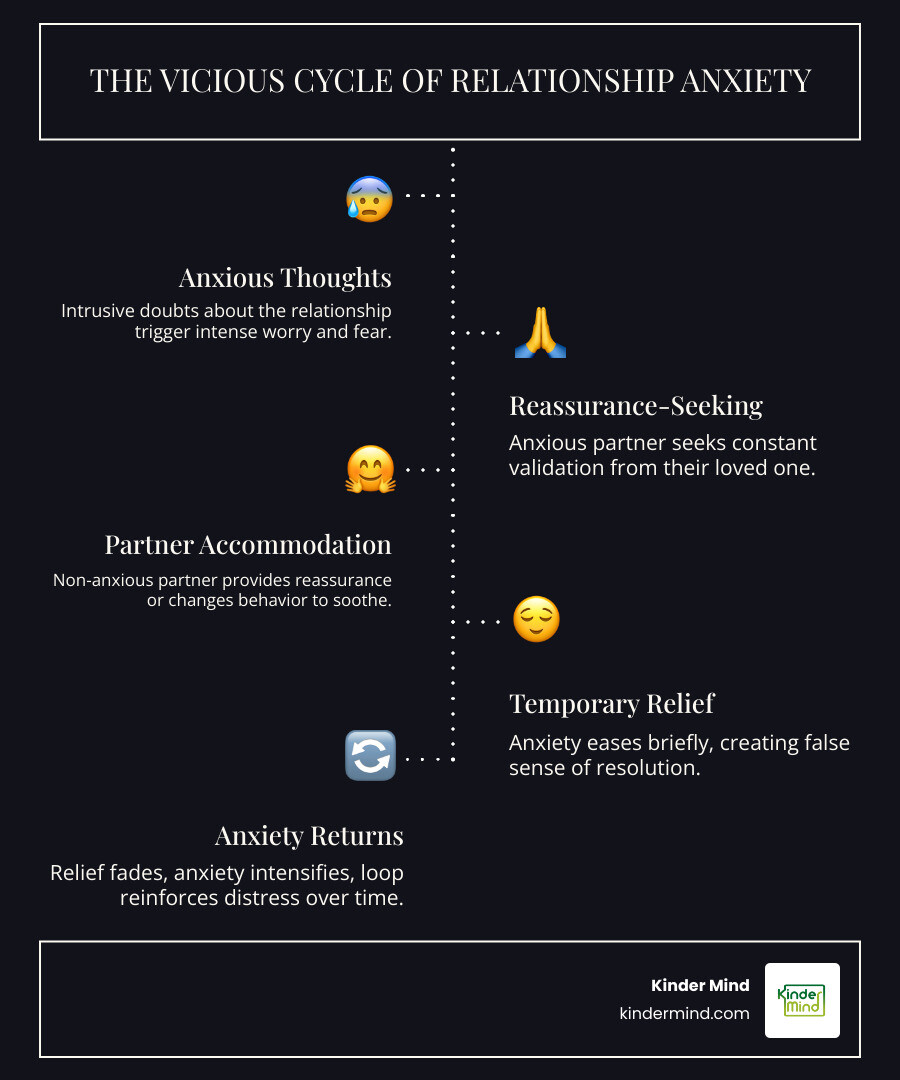
The cycle often looks like this: anxiety triggers doubt, doubt leads to reassurance-seeking, temporary relief fades quickly, and the cycle repeats. Meanwhile, the non-anxious partner may adapt their behavior to avoid triggering anxiety, which researchers call “partner accommodation.” This actually makes anxiety worse over time.
Anxiety couples therapy interrupts this cycle. It creates a safe space where both partners can understand what’s happening, learn new responses, and build emotional security together. Whether anxiety stems from childhood attachment patterns, past relationship trauma, or a diagnosable anxiety disorder, targeted therapy helps couples move from surviving to thriving.
Common anxiety couples therapy vocab:
Understanding Relationship Anxiety and Its Manifestations
Relationship anxiety is a persistent feeling of unease, worry, or fear regarding one’s romantic partnership. It isn’t just a “bad day” or a temporary tiff; it is a chronic state of scanning the relationship for threats. For many, this manifests as an internal voice asking, “Are they going to leave?” or “Is this actually going to work?” even when things are going well.
Psychologists have identified several key behaviors that define this state. One of the most common is excessive reassurance-seeking. This involves repeatedly asking a partner for proof of their love or commitment. While a little reassurance is normal, the anxious version feels like a bottomless pit—no matter how much the partner says “I love you,” the relief only lasts for a few minutes before the doubt returns.
Another significant manifestation is self-silencing. This is a coping mechanism where an individual limits their self-expression to avoid conflict or rejection. They might hide their true feelings or needs because they fear that being “difficult” will cause their partner to leave. Ironically, this behavior often causes the very distance they fear, leading to resentment and poor mental health outcomes.
The physical toll is also real. Anxiety isn’t just in the head; it’s in the body. People experiencing intense relationship worry often report:
- Rapid breathing and increased heart rate
- Trembling or feeling weak
- Difficulty concentrating on anything other than the relationship
- Sleep disruption and chronic fatigue
According to Scientific research on relationship-based anxiety, these behaviors often stem from underlying issues like an anxious attachment style. When these patterns take over, the “emotional interdependence” of the couple—the healthy way partners rely on each other—becomes skewed. Instead of a supportive net, it feels like a tightrope. You can find more info about relationship issues and how they intersect with anxiety on our specialty pages.
Root Causes: From Attachment Styles to Past Trauma
Why does one person feel secure while another feels like they are standing on shaky ground? The answer usually lies in the past.
Anxious Attachment Style Developed in childhood, this attachment style often results from caregivers who were inconsistent. Sometimes they were there, and sometimes they weren’t. As adults, people with this style are highly sensitive to small changes in their partner’s behavior. If a partner takes ten minutes longer than usual to text back, the anxious brain interprets this as a sign of impending abandonment.
Low Self-Esteem If someone doesn’t believe they are worthy of love, they will constantly look for evidence that their partner agrees. They might assume their partner is “settling” or will eventually find someone better. This internal narrative fuels a constant state of high alert.
Past Trauma and Infidelity Traumatic experiences, such as being cheated on in a previous relationship or witnessing a high-conflict divorce between parents, create a “blueprint” for disaster. The brain tries to protect the person by expecting the worst. They are essentially waiting for “the other shoe to drop.”
Differentiating Normal Worries from ROCD
It is important to distinguish between general relationship anxiety and Relationship Obsessive-Compulsive Disorder (ROCD). While they share some symptoms, ROCD is a specific subtype of OCD characterized by intrusive, unwanted thoughts about the relationship.
In ROCD, the doubts are often “ego-dystonic,” meaning they go against what the person actually wants to feel. A person might be deeply in love but plagued by thoughts like, “Is this the right person?” or “Are they attractive enough?”
Key differences include:
- Intrusive Thoughts: In ROCD, thoughts are repetitive, distressing, and feel impossible to stop.
- Compulsive Checking: This might involve spending hours comparing the partner to others or constantly checking one’s own internal “feelings” to see if they still feel “in love.”
- Heightened Expectations: Those with ROCD often have an idealized view of what a relationship should look like and struggle with the reality that every partnership has flaws.

If the worry feels like a loop you cannot exit, it may be more than standard anxiety. Professional assessment is key to getting the right type of help.
How Anxiety Couples Therapy Transforms Relationships
The goal of anxiety couples therapy is not to eliminate every worry—that’s impossible. Instead, it aims to transform how the couple interacts with that anxiety. When anxiety enters the room, therapy helps the couple turn toward each other rather than away.
Therapy focuses on shifting communication patterns. Instead of the anxious partner “testing” the other through sabotage or the non-anxious partner withdrawing to protect themselves, both learn to speak from a place of vulnerability. This creates a deeper emotional connection where anxiety becomes a shared challenge to solve, rather than a wall between them.
For a quick look at how different methods handle these issues, see the table below:
| Therapy Method | Core Focus | Key Technique |
|---|---|---|
| Gottman Method | Building the “Sound Relationship House” | Managing “bids for connection” and reducing criticism |
| Emotion-Focused (EFT) | Attachment and emotional bonds | Identifying the “negative cycle” and fostering security |
| CBT for Couples | Thoughts and behaviors | Reframing negative beliefs and behavioral experiments |
To learn more about how Kinder Mind practitioners apply these methods, visit our couples therapy page.
The Gottman Method and EFT for Secure Bonds
Two of the most effective frameworks for managing anxiety are the Gottman Method and Emotion-Focused Therapy (EFT).
The Gottman Method Developed by Drs. John and Julie Gottman, this approach emphasizes “bids for connection.” A bid is any attempt from one partner to get attention, affirmation, or affection. In anxious relationships, these bids are often missed or misinterpreted. The Gottman Method teaches couples how to “turn toward” these bids, building a “bank account” of trust that makes anxiety feel less threatening.
Emotion-Focused Therapy (EFT) EFT is rooted in attachment theory. It views the anxious partner’s behavior (like reassurance-seeking) as a desperate cry for safety. According to Scientific research on couple-based interventions, EFT helps couples de-escalate their “negative cycle.” For example, if one partner pursues and the other withdraws, EFT helps them see the cycle as the “enemy,” not each other. This fosters a secure attachment where both feel validated.
Cognitive Behavioral Therapy (CBT) in Anxiety Couples Therapy
CBT is a powerhouse for treating anxiety because it targets the thoughts that fuel the fire. In a couples context, CBT helps partners identify maladaptive patterns and “thought traps.”
Common CBT techniques in anxiety couples therapy include:
- Thought Reframing: Challenging the assumption that a partner’s silence means they are angry. Instead of thinking, “They are ignoring me because they’re bored of me,” the person learns to think, “They had a long day at work and need ten minutes of quiet.”
- Behavioral Experiments: An anxious partner might agree to not send a “check-in” text for three hours to see if the relationship survives. When it does, the brain learns that the compulsive behavior wasn’t actually necessary for safety.
- Identifying Triggers: Couples work together to list what sparks anxiety (e.g., social events, talking about the future) and create a plan to handle those moments as a team.
You can explore more info about therapy for anxiety and how these individual tools integrate into a shared relationship plan.
The Role of the Non-Anxious Partner and Individual Coping
If you are the partner of someone with anxiety, your role is vital—but it’s also challenging. It is common for the non-anxious partner to fall into partner accommodation. This happens when you change your life to keep the other person’s anxiety at bay. You might stop seeing friends, check in every 20 minutes, or avoid certain topics entirely.
While this comes from a place of love, research shows that accommodation actually maintains the anxiety. It prevents the anxious partner from learning that they can handle uncertainty.
The Balance of Support:
- Set Boundaries: It is okay to say, “I love you, but I cannot answer twenty texts while I’m at work.”
- Encourage Independence: Support your partner in their own hobbies and interests.
- Self-Care: You cannot pour from an empty cup. To avoid burnout, you must maintain your own support system.
Many couples find that virtual therapy is an excellent way to fit these vital sessions into a busy schedule, ensuring both partners get the support they need without added logistical stress.
Practical Strategies for Managing Anxiety Couples Therapy Sessions
Entering therapy can itself be anxiety-inducing! To make sessions more productive, some therapists use the Relational Life Therapy (RLT) framework of the “Wise Adult” versus the “Adaptive Child.”
- The Adaptive Child: This is the part of us that learned to survive childhood. It is reactive, defensive, and often drives our anxiety.
- The Wise Adult: This is the mature, centered part of us that can listen, take responsibility, and stay present.
In therapy, couples learn to recognize when their “Adaptive Child” has taken the steering wheel and how to hand it back to the “Wise Adult.”
Preparation Tips for Your First Session:
- Ask Questions: Reach out to your therapist beforehand to ask about the structure. Reducing uncertainty is a great first step.
- Bring Comfort Items: A favorite sweater, a notebook, or even a specific piece of jewelry can act as a “grounding object” during tough conversations.
- Create a Signal: Agree on a small gesture, like a hand touch, that means
