
Beyond “How Was Your Day?”: Deepening Communication in Open Relationships
Dr. Elizabeth Barlow, LCSW-S · 2/17/2026

Why Open Relationship Communication Matters More Than You Think
Open relationship communication is the foundation that determines whether your consensual non-monogamous arrangement will thrive or struggle. Here’s what you need to know:
The Essential Elements of Strong Open Relationship Communication:
- Trust and transparency – All partners know about and consent to outside connections
- Clear boundaries – Explicit agreements about what is and isn’t allowed
- Regular check-ins – Scheduled conversations to discuss feelings, concerns, and experiences
- Honest disclosure – Sharing information about other partners according to agreed-upon guidelines
- Active listening – Understanding your partner’s needs without judgment
- Conflict resolution skills – Addressing jealousy, insecurity, and disagreements constructively
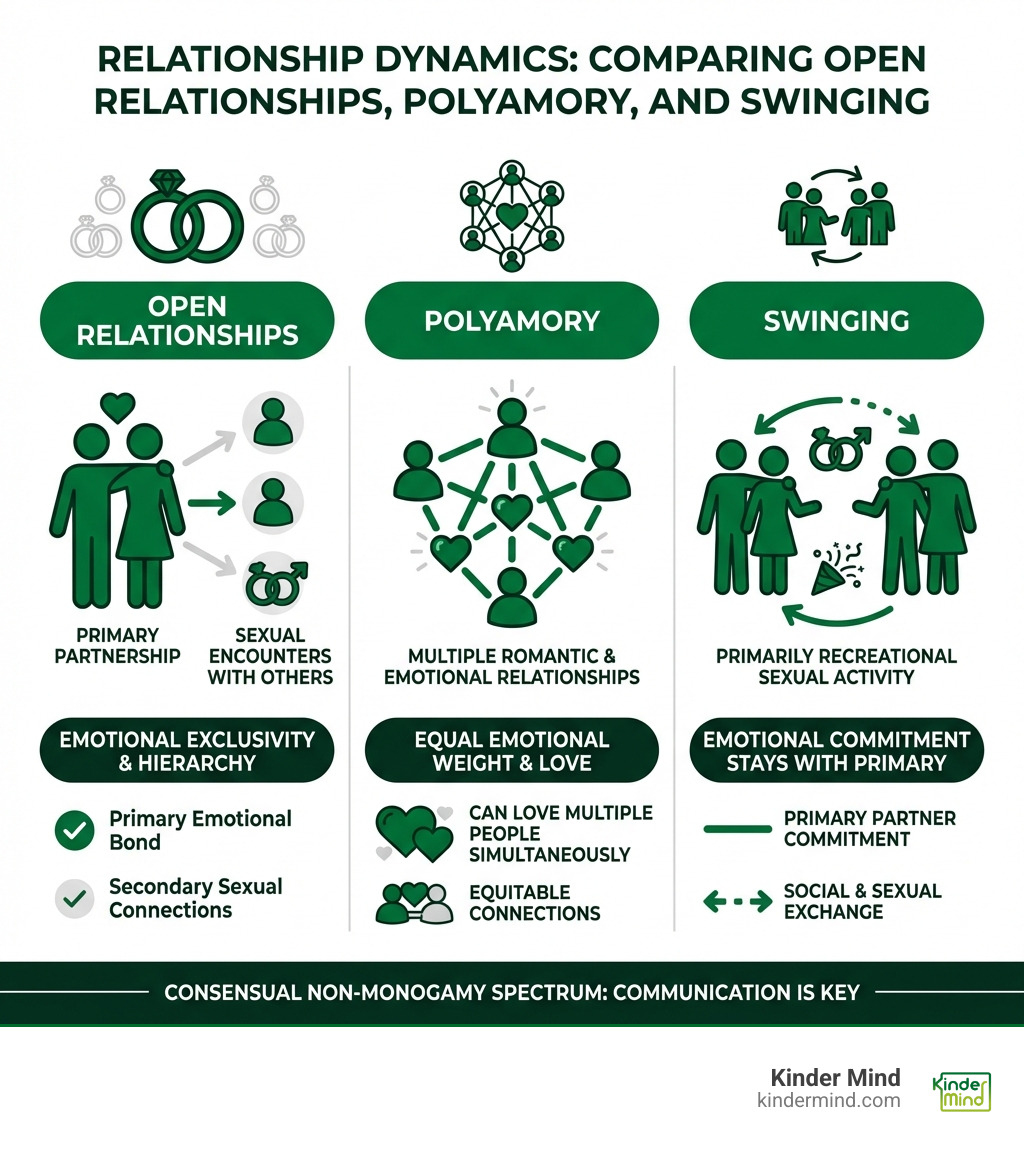
An open relationship is a form of consensual non-monogamy (CNM) or ethical non-monogamy (ENM) where all partners agree that one or more people may pursue romantic or sexual relationships outside their primary partnership. The key difference from cheating? Everyone knows, everyone consents, and everyone feels respected.
Here’s the reality: 34% of Americans now prefer relationship styles other than complete monogamy, according to a 2023 poll. Yet most of us never learned how to communicate in these relationships.
Without clear communication, any relationship is doomed. Couples in successful open relationships spend considerable time discussing boundaries, exploring fears, and examining motives. They continue to discuss and evaluate their experience throughout the journey.
The stakes are higher in open relationships because there are no default cultural scripts to follow. Every expectation must be articulated. Every boundary must be discussed. As one therapist notes, partners who have the most success are those who have learned to communicate, even about hard or unpleasant topics.
This guide will show you how to build that communication foundation.
The Pre-Flight Check: Laying the Groundwork for Openness
Opening up a relationship is a significant decision that requires careful consideration, honest self-reflection, and extensive dialogue. It’s not a step to be taken lightly or as a quick fix for existing problems. In fact, experts strongly advise addressing any underlying issues in your primary relationship before considering non-monogamy. The journey into an open relationship can be a profound path for personal growth, deepening self-understanding, and enhancing emotional resilience, but only if approached from a place of strength and genuine desire.
Couples often choose to explore open relationships for various reasons. Some seek to explore their complex sexuality, enrich their existing relationship with new individual experiences, or simply experience the diversity of human connection. Differing libidos, where one partner desires more sexual activity than the other, is another common motivation that can lead couples to consider opening their partnership. This can alleviate pressure on the primary relationship to fulfill all needs and desires.
Before starting on this journey, individuals must engage in intentional self-reflection. Ask yourself: What are my personal desires? What are my boundaries? What do I truly need from a relationship? This deep self-awareness is crucial for navigating the complexities of non-monogamy.
Therapists often recommend engaging in “5 Conversations” before opening a relationship:
- Your goals for opening the relationship: What do you hope to gain? Is it to grow closer, improve communication, explore connections, or address differing libidos?
- Your expectations and boundaries: What is and isn’t on the table? Are you seeking sexual connections, romantic connections, or both? What are the specific “rules” you’ll need?
- How you plan to deal with conflict and difficult emotions: Jealousy and insecurity are common. How will you manage them constructively?
- The logistics of non-monogamy: How will time, holidays, household labor, and childcare be divided? What happens if a new partner wants to move in?
- What steps you want to take to begin: Will you use dating apps, seek introductions, or look for partners together?
If, after this thorough self-reflection, the desire to explore non-monogamy persists, it may move from a mere “want” to a deeply felt “need” for personal fulfillment.
Is an Open Relationship Right for You?
Understanding yourself is the first, most critical step. This involves a deep dive into your self-awareness, identifying your personal boundaries, and acknowledging your wants and needs without judgment. Being “brutally honest with yourself about your comfort levels” is paramount. Agreeing to an open relationship out of fear of losing a partner, rather than genuine enthusiasm, can lead to an unhealthy and heartbreaking dynamic.
Your attachment style can also play a role in how you steer open relationships. While there’s a misconception that open relationships are linked to insecure attachment, research suggests they are often associated with secure attachment. However, for individuals with insecure attachment styles, navigating an open relationship can be an opportunity for growth, pushing them to confront fears and develop stronger communication skills. Understanding your own attachment style can provide valuable insights into your emotional responses and needs within any relationship structure.
It’s also vital to ensure your primary relationship is on solid ground. Opening a relationship won’t magically fix existing problems; it will likely amplify them. Therefore, address current issues and strengthen your primary bond before introducing additional partners. All partners must be genuinely excited and enthusiastic about the arrangement, not just reluctantly agreeing to it.
If you find yourselves feeling stuck or unsure at this stage, working with a therapist who understands consensual non-monogamy can give you a neutral space to explore these questions together.
The Initial Conversation: How to Talk About Opening Up
Initiating the conversation about opening your relationship can feel daunting, fraught with fears that your partner might interpret it as dissatisfaction. However, avoiding the discussion can lead to relationship dissatisfaction or even infidelity down the line.
When you decide to talk, choose a dedicated, calm time, free from distractions and stress. Express your feelings and desires using “I-statements” to avoid placing blame. For example, instead of saying, “You never want to try new things,” try, “I’ve been feeling a desire to explore different connections, and I wanted to talk about it with you.” Reinforce that your desire isn’t about dissatisfaction with your current relationship or sex life, but rather a personal exploration or a way to enrich your shared experience.
Be prepared for pushback or resistance from your partner. This is a big topic, and their initial reaction might be fear, confusion, or even anger. Validate their feelings and listen actively. If resistance occurs, lead with curiosity. Ask them about their fears, their needs, and their point of view. Exploring fears and motives together can help both of you understand the underlying concerns and work towards shared solutions.
If the conversation becomes too charged or you find yourselves looping through the same arguments, a couples therapist can help you slow things down and communicate more effectively so both of you feel heard and respected.
The Core of Open Relationship Communication: Building Your Toolkit

At the heart of any successful open relationship lies an extraordinary commitment to open relationship communication. It’s the toolkit that allows partners to steer complex emotions, manage logistics, and maintain strong, healthy bonds. The main pillars of a healthy open relationship are communication, consent, and comfort. These elements are so critical that some researchers refer to them as the “Triple-C Model” for assessing relationship success in non-monogamous arrangements.
Fostering Trust and Unbreakable Transparency
Trust is the bedrock upon which all strong relationships are built, and in open relationships, it’s even more pronounced. Transparency acts as the safety net, making the arrangement safe for both partners. The key distinction from infidelity is that everyone knows, everyone consents, and ideally, everyone feels respected. This means ongoing dialogue and continuous evaluation of the experience.
Secrecy, on the other hand, is toxic. When sexual activity with someone else occurs without mutual consent, comfort, or communication, it is considered a form of betrayal or cheating. This can seriously undermine or jeopardize the relationship, leading to negative emotions like neglect, insecurity, and jealousy. Honesty, therefore, is not just a virtue but a crucial safeguard against conflicts and misunderstandings.
Building emotional security in an open relationship comes from clear agreements, established boundaries, and consistent honesty. It means openly discussing feelings, desires, and experiences without fear of judgment. While relationship satisfaction in consensually non-monogamous relationships has been found to be similar to monogamous relationships, this parity is largely attributed to robust communication practices.
Essential Skills for Effective Open Relationship Communication
Mastering open relationship communication requires specific skills and consistent practice. Here’s how to build your toolkit:
- Active Listening: Listen with the intent to understand, not just to respond. Give your partner your full attention, validate their feelings, and ask clarifying questions.
- “I-Statements”: Express your feelings and needs using “I-statements” (e.g., “I feel [emotion] when [situation] because [need]”) to articulate your experience without placing blame.
- Regular Check-ins: Schedule dedicated “relationship check-ins” to discuss feelings, boundaries, and expectations. These aren’t optional; they’re essential for monitoring what’s working and what isn’t. Some couples even use shared calendars to manage time with multiple partners – there’s a joke in the non-monogamy community that having multiple partners means getting really good at using Google Calendar!
- Expressing Needs Clearly: Articulate your expectations, desires, and concerns explicitly. No one is a mind-reader, especially when navigating non-traditional dynamics.
- Giving and Receiving Feedback Constructively: Provide feedback that is honest, empathetic, and constructive. Reflection on how your words and actions impact your partners is crucial for personal growth and relationship strengthening.
- Cultivating Empathy: Empathy in open relationships involves a deep recognition of each other’s complex needs and desires. It acts as a vital conduit for emotional connection, fostering a more profound and genuine bond.
- Maintaining the Primary Connection: While exploring outside connections, dedicate time and energy to nurturing your primary relationship. This includes quality time, affection, reaffirming your commitment, and creating rituals that strengthen your bond, such as regular date nights.
Navigating Turbulence: Managing Challenges and Difficult Emotions

Even with the best communication tools, open relationships can present unique challenges and trigger difficult emotions. Jealousy, insecurity, and the complexities of time and emotional management are common problems. However, these aren’t necessarily signs of failure; they can be opportunities for profound personal and relational growth.
From Jealousy to Growth: A New Perspective
Jealousy is a natural human emotion that can arise in any relationship, and open relationships are no exception. It often stems from feelings of inadequacy, insecurity, or fear of loss. Instead of viewing jealousy as a relationship killer, consider it a tool to explore unmet needs or insecurities within yourself or your primary relationship.
When jealousy strikes, acknowledge and communicate your feelings openly with your partner. Discuss what triggers these emotions and work together to address their root causes. Self-soothing techniques, such as journaling, can be incredibly helpful for sorting through your thoughts and processing difficult emotions. Journaling has been associated with improved mental health and can provide clarity during challenging times.
A powerful shift in perspective is to cultivate “compersion,” which is the feeling of joy for a partner’s happiness even when it doesn’t directly involve you. While jealousy is about insecurity and envy, compersion is about celebrating your partner’s positive experiences with others. It’s a challenging but rewarding emotional muscle to develop.
Conflict Resolution for Multiple Relationships
Conflict is an inevitable part of any relationship, and in open relationships, the dynamics can be even more intricate. Having a plan for conflict resolution before disagreements arise is crucial.
Approach conflicts with empathy, focusing on mutual understanding rather than winning an argument. Use active listening to ensure both parties feel heard and understood. Avoid passive-aggressive tactics, which can erode trust and transparency. Instead, address issues directly and respectfully.
It’s also important to know when to take a break from a discussion if emotions become too overwhelming. Stepping away to cool down and returning to the conversation with a calmer mindset can prevent escalation. When handling unequal experiences or power dynamics, such as one partner having more success finding new connections, have honest conversations to ensure both partners feel respected and neither feels neglected. Equality doesn’t always mean identical experiences, but it does require mutual respect and fairness.
Building a Sustainable Structure: Boundaries, Safety, and Long-Term Health
A sustainable open relationship is built upon a clearly defined framework, often referred to as an “Open Relationship Contract.” This isn’t a legal document, but rather a set of mutual agreements and expectations that guide the relationship. Given that societal structures and systems aren’t designed for open relationships, consciously negotiating and communicating these parameters is even more critical.